The first government reorganization plan under the Lee Jaemyung administration, which includes the abolition of the Prosecutors’ Office and the restructuring of the Ministry of Economy and Finance and the Ministry of Environment, has passed the Legislation and Judiciary Committee of the National Assembly, led by the ruling party.
On the afternoon of the 24th, the Legislation and Judiciary Committee held a plenary meeting and passed the amendment to the Government Organization Act, led by the Democratic Party. The People Power Party criticized the prosecution reform bill as the so-called “Prosecutors’ Office Dismantlement Act” and opposed the amendment, but it was approved with the support of the Democratic Party and the Rebuilding Korea Party, which together have a majority of seats.
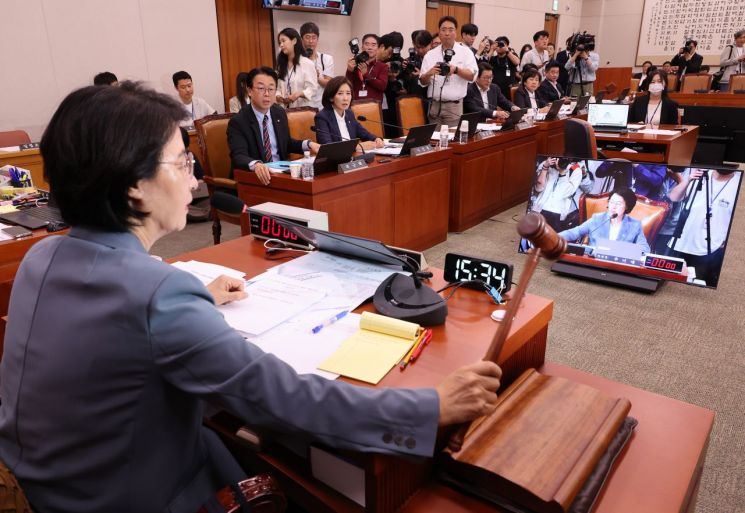 On the 24th, at the plenary meeting of the Legislation and Judiciary Committee held at the National Assembly in Yeouido, Seoul, Chu Mi-ae, a member of the Democratic Party, declared a recess. Photo by Yonhap News Agency
The amendment calls for the abolition of the Prosecutors’ Office and the establishment of the Serious Crimes Investigation Agency and the Public Prosecution Agency, thereby separating the investigation and prosecution functions of the prosecution. The Serious Crimes Investigation Agency will be under the Ministry of the Interior and Safety, and the Public Prosecution Agency will be under the Ministry of Justice.
The Ministry of Economy and Finance will be divided into the Planning and Budget Office and the Ministry of Finance and Economy. The budget function of the Ministry of Economy and Finance will be transferred to the Planning and Budget Office under the Prime Minister’s Office. The Planning and Budget Office will be responsible for establishing mid- to long-term national development strategies and fiscal policies, formulating, executing, and managing the performance of budgets and funds, managing private investment, and overseeing national debt. The Financial Services Commission will transfer domestic financial policy functions, including the Financial Intelligence Unit, to the Ministry of Finance and Economy, and will be reorganized into the Financial Supervisory Commission to focus on financial supervision.
The energy sector within the Ministry of Trade, Industry and Energy will be transferred to the Ministry of Environment, which will be reorganized as the Ministry of Climate, Energy and Environment. The newly established Ministry of Climate, Energy and Environment will be responsible for environmental and climate change response as well as the energy sector. The ministry's name will be changed to the Ministry of Trade and Industry.
The Korea Communications Commission will be abolished, and a new Broadcasting, Media and Communications Commission will be established. In addition, the Ministry of Gender Equality and Family will be reorganized as the Ministry of Gender Equality and Family Affairs to comprehensively promote gender equality policies.
Furthermore, in order to efficiently oversee and coordinate economic and science and technology policies, two Deputy Prime Ministers will be appointed. The Minister of Finance and Economy and the Minister of Science and ICT will each serve concurrently as Deputy Prime Minister.
A Director General in charge of industrial safety and health affairs will be appointed within the Ministry of Employment and Labor, and the Statistics Korea will be reorganized as the National Data Agency under the Prime Minister’s Office. The Korean Intellectual Property Office will be reorganized as the Intellectual Property Agency under the Prime Minister’s Office.
The amendment is expected to be submitted to the plenary session on the 25th after a review of its structure and wording by the Legislation and Judiciary Committee.
© The Asia Business Daily(www.asiae.co.kr). All rights reserved.

















