The theme of the fourth session at the 2025 Sejong International Conference, hosted by the Supreme Court at the Shilla Hotel in Jung-gu, Seoul, on September 23, was "The Protection of Innovative Technologies and the Role of the Judiciary."
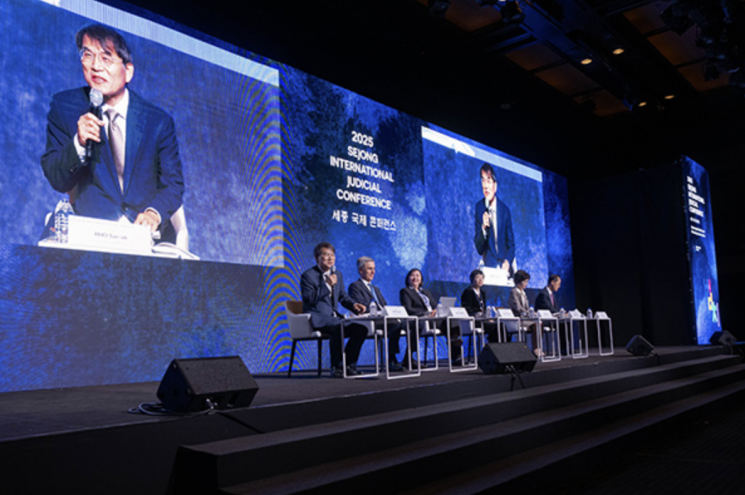
In the third session, the prevailing opinion was that AI serves as an auxiliary tool and that the essence of the judiciary lies with humans. The subsequent fourth session focused on discussions regarding the digital transformation in specific areas such as patents, copyrights, and civil procedures, as well as the limitations and principles facing the judiciary in the age of AI.
Supreme Court Justice Noh Taeak (Judicial Research and Training Institute, Class 16), who chaired the session, stated, "This session will be a meaningful opportunity to reflect on the future direction of the judiciary and the Intellectual Property Court, as well as the competencies required of judges." He emphasized, "It is important to examine the role of judges and the judiciary in codifying and effectively protecting innovative technologies in line with technological advancements."
Gravinski, President of the Unified Patent Court of Europe: "Ensuring Fairness through Expedited Procedures and Specialized Panels"
Klaus Gravinski, President of the Court of Appeal of the Unified Patent Court of Europe, introduced the core principles of the European Patent (EP) infringement litigation process, emphasizing, "As a rule, oral arguments are concluded within a single day for the sake of efficiency and focus." He explained that lawsuits proceed in three stages: written procedure, intermediate procedure, and oral procedure. He reiterated the importance of speed and procedural focus, stating, "All facts and evidence must be submitted in advance, and during oral arguments, the court and parties can directly question witnesses and experts." He also noted, "To be appointed as a Technically Qualified Judge (TQJ), one must possess a university degree in a relevant field and technical expertise, as well as sufficient knowledge of civil and procedural law applicable to patent litigation." He emphasized that "with a panel of judges possessing such broad backgrounds and expertise, technical issues in patent disputes can be addressed more fairly and professionally."
Nguyen, Judge of the U.S. Court of Appeals for the Ninth Circuit: "Duplicative Litigation Undermines Efficiency... International Cooperation Needed"
Jacqueline Nguyen, Judge of the U.S. Court of Appeals for the Ninth Circuit, highlighted the need for international coordination and cooperation, stating, "The globalization of intellectual property disputes often leads to duplicative litigation of the same issues in multiple jurisdictions, which severely undermines efficiency." She also raised new legal issues related to AI, such as whether AI can be considered an author or inventor, whether training on copyrighted materials constitutes infringement, and whether lawyers can draft legal documents using AI.
Song Eosu, Vice President of the Beijing Intellectual Property Court: "Enhancing Reliability of Judgments through Advanced TIO System"
Song Eosu, Vice President of the Beijing Intellectual Property Court, emphasized, "A common challenge faced by courts worldwide is to fairly and efficiently ascertain the technical facts of cases, thereby enhancing the reliability and authority of judicial decisions." He identified the development of the Technical Investigator Officer (TIO) system as a key task. He stated, "The court will refine rules based on practical experience, resolve bottlenecks, broaden recruitment channels, and accelerate TIO training in emerging fields such as AI and quantum information." He also emphasized, "While TIOs play a supporting role in identifying the technical facts of a case, the final judgment and responsibility rest with the judge." He added, "We will expand exchanges with courts in other countries with an open and inclusive attitude and deepen mutual learning regarding mechanisms for ascertaining technical facts." He concluded, "Through these efforts, we aim to create an innovation-friendly legal environment and develop the Beijing Intellectual Property Court into a preferred international venue for dispute resolution."
Takabe Makiko, Former Chief Judge of Japan: "Enhancing Public Convenience through Digital Litigation Systems"
Takabe Makiko, former Chief Judge of the Intellectual Property High Court of Japan, explained that, following amendments to Japan's Civil Procedure Act, the full-scale digitization of civil litigation will be implemented by May 2026. She noted that the introduction of online litigation systems, such as electronic litigation, electronic case management, and electronic trials, will greatly improve litigation efficiency and public convenience.
Han Kyuhyun, Chief Judge of the Patent Court: "The Judiciary’s Ongoing Efforts to Keep Pace with Technological Advancement"
Han Kyuhyun (Judicial Research and Training Institute, Class 20), Chief Judge of the Patent Court, stated, "The spirit of King Sejong, who created the world's first rain gauge, continues today in our IP protection system," and emphasized, "The Korean judiciary operates specialized courts and dedicated panels capable of efficiently handling patent disputes." He also introduced the implementation of the senior judge system in 2016, the establishment of international panels at the Seoul Central District Court and the Patent Court in 2018, and the expansion of video trials in 2021. He explained, "We are continuously striving to overcome various challenges in the rapidly changing technological environment and to achieve world-class IP trials." He particularly noted, "Judges collaborate with internal technical experts, such as technical advisors and technical investigators, to understand technology," and added, "We aim to ensure predictable, prompt, and fair trials in complex patent disputes."
Efforts to Harmonize Judiciary and Technology Highlighted in Discussions
During the discussion, participants addressed whether the judicial systems of each country are sufficiently reflecting current advances in innovative technologies and whether new legislative measures or judicial plans are being considered. Han Kyuhyun, Chief Judge of the Patent Court, further introduced legislative discussions regarding the IP trial system. He explained that bills are currently being proposed and discussed in the National Assembly concerning the simplification of witness examination procedures in court, the system for expert fact-finding, the system for preservation orders of evidence, and the concentration of jurisdiction.
Song Juhee, reporter for Legal News
※This article is based on content supplied by Law Times.
© The Asia Business Daily(www.asiae.co.kr). All rights reserved.

![Clutching a Stolen Dior Bag, Saying "I Hate Being Poor but Real"... The Grotesque Con of a "Human Knockoff" [Slate]](https://cwcontent.asiae.co.kr/asiaresize/183/2026021902243444107_1771435474.jpg)















