75th Anniversary Roundtable of Boeing's Presence in Korea
Boeing Korea announced its intention to leverage Korea's advanced innovative technologies, such as artificial intelligence (AI) and smart factories, in its core businesses, creating opportunities for mutual growth.
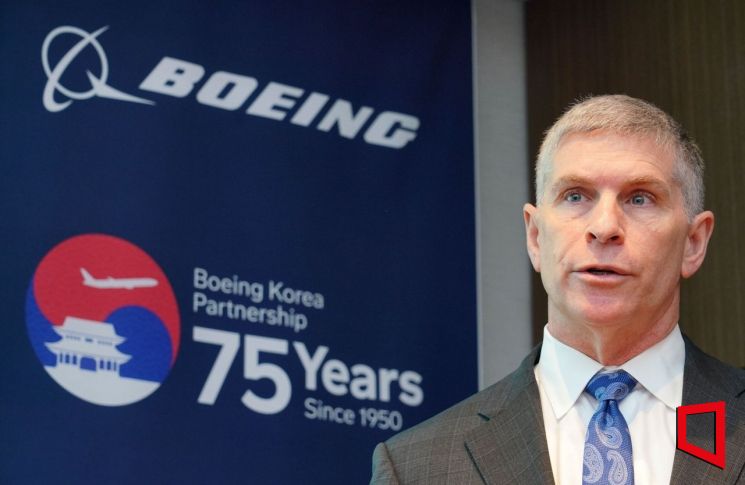 Will Saefer, President of Boeing Korea, is giving a presentation at the '75th Anniversary of Partnership' meeting held at Lotte Hotel Seoul on the 24th. Boeing Korea
Will Saefer, President of Boeing Korea, stated at the '75th Anniversary of Partnership' meeting held at Lotte Hotel Seoul on the 24th, "We are focusing on core research areas such as software engineering and AI, avionics and electronics, data solutions, and model-based engineering, and are preparing for next-generation businesses." He added, "We plan to increase our research and development (R&D) workforce by 20% by next year."
Saefer emphasized, "Korea is a key partner for Boeing's future, and it is extremely important for us to fully utilize Korea's innovation and innovative capabilities." He continued, "Our goal is to learn world-class manufacturing technologies and capabilities, adopt production automation using AI, and apply these to next-generation manufacturing."
Boeing Korea established the Boeing Korea Engineering & Technology Center in 2019 and has since been conducting research and development in various fields, including software. He explained, "Of the 300 employees working in Korea, about 100 are researchers at the center," adding, "These researchers are involved in Boeing's product development, with a representative example being the development of 'Boeing Linux,' which will be applied to next-generation aircraft."
He continued, "We regularly send research personnel to the U.S. headquarters to study whether AI can be applied to production systems," and added, "We plan to expand the role of Korean personnel in the engineering field going forward."
Boeing Korea supplies commercial aircraft to Korean Air, Asiana Airlines, Jeju Air, T'way Air, and others, accounting for 60% of the domestic commercial aircraft market. In particular, in August, Korean Air and Boeing signed a contract to supply 20 777-9 aircraft, 25 787-10 aircraft, 50 737-10 aircraft, and 777-8F freighters by 2030, totaling $36.2 billion (50 trillion won).
Saefer stated, "As of 2024, we have invested $325 million (approximately 453.4 billion won) in Korea, with a significant portion used for procuring parts from partner companies." He added, "Given the scheduled aircraft deliveries, this amount is expected to increase by more than 50% in the future."
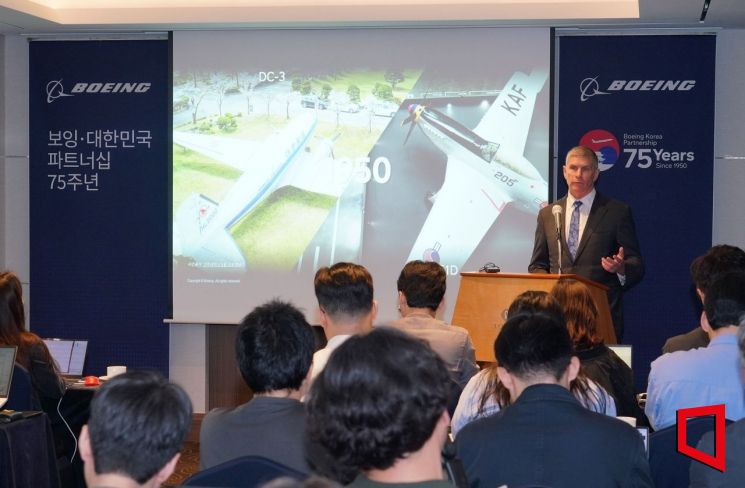 Will Saefer, President of Boeing Korea, is giving a presentation at the '75th Anniversary Partnership' meeting held at Lotte Hotel Seoul on the 24th. Boeing Korea
He also announced plans to strengthen cooperation with domestic companies in the defense sector. Saefer explained, "For the F-15K, we jointly developed avionics and flight control system components with companies such as Korea Aerospace Industries (KAI), Hanwha, and LIG Nex1, while KAI manufactures the fuselage for the Apache helicopter." He continued, "We are also working on a project with LIG Nex1 and LG to apply OLED technology to aircraft."
Saefer stated, "The Korean government is strategically promoting defense exports with the goal of becoming one of the top four defense exporters by 2027." He added, "Through close collaboration with the Korean government, we will support these national goals and further grow Boeing Korea's business in Korea."
Meanwhile, Boeing entered the Korean market in 1950 by delivering a 'DC-3' aircraft to Korean National Airlines (now Korean Air). In the same year, Boeing supplied 'F-51D Mustang' fighter jets to the Republic of Korea Air Force, marking the starting point of military cooperation between Korea and the United States.
© The Asia Business Daily(www.asiae.co.kr). All rights reserved.


















