Industry: "Korea Faces a Crisis Where Complacency Is Not an Option"
China Monopolizes LCDs, Poised to Overtake OLED by 2028
Calls for Extension of Tax Credit Carry-Forward and Increased Facility Investment
The Korean display industry is facing the risk of losing its competitiveness amid fierce pursuit from China. Lawmakers, industry leaders, and academics emphasized that relying solely on technological superiority has its limits, and called for comprehensive government support, including expanded tax credits, research and development (R&D), workforce, and infrastructure.
The "National Assembly Forum for Strengthening the Competitiveness of the Display Industry," jointly organized by the National Assembly's Trade, Industry, Energy, SMEs and Startups Committee and the Korea Display Industry Association, was held on the 23rd at the National Assembly Members' Office Building. The forum was attended by officials from the Ministry of Trade, Industry and Energy, Park Junyoung, Vice President of Samsung Display, Lee Hangu, Executive Director of LG Display, Kim Byungwook, CEO of Dongjin Semichem, and other stakeholders from related industries.
Industry representatives unanimously agreed on the sense of crisis that Korea’s display sector could lose its competitive edge due to China’s rapid advances. Assemblyman Lee Jaegwan of the Democratic Party of Korea stated, "While Korea has been complacent, there are already industrial sectors where China has overtaken us, and the government’s role, as well as the way it connects and collaborates with companies, is being criticized. Although we say Korea is leading in displays, given the current trend, we are entering a crisis phase where we cannot afford to be complacent."
Lee Seungwoo, Executive Vice Chairman of the Korea Display Industry Association, also expressed concern, saying, "Our display industry’s stronghold is being threatened by relentless Chinese competition. Even industry giants like Samsung and LG are reducing investments, making it difficult for materials, parts, and equipment companies to weather these challenging times."
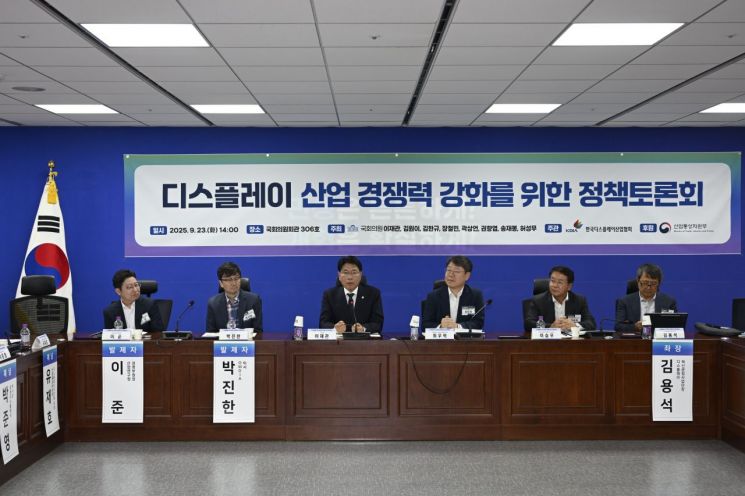 The "National Assembly Forum for Strengthening the Competitiveness of the Display Industry," hosted by Lee Jaegwan, a member of the Democratic Party of Korea, and organized by the Korea Display Industry Association, was held on the 23rd at the National Assembly Members' Office Building. Korea Display Industry Association.
Park Jinhan, Director at Omdia, a market research firm, who gave a keynote presentation, diagnosed that the LCD (liquid crystal display) sector is already monopolized by China. Park analyzed, "In the past, Korean, Chinese, and Taiwanese TV panel manufacturers competed to supply better products at better prices, but now, with Chinese companies dominating the market, most of Samsung and LG’s TV panel purchases have shifted to Chinese products."
He further predicted a natural shift from the traditional LCD market to an OLED (organic light-emitting diode) market focus. "Korean companies currently hold 70% of global OLED market demand," he said. "Nevertheless, by 2028 to 2030, there is a high possibility that China will overtake Korea’s market share." Although Korea currently holds a technological edge in OLED, if the current growth rates continue, Chinese companies will rapidly accelerate mass production and catch up technologically. He also urged that Korea must quickly establish R&D and mass production systems for the microLED market, which is expected to emerge after 2030.
Lee Joon, Deputy President of the Korea Institute for Industrial Economics and Trade, stated, "China is implementing a fundamentally different industrial policy. When China significantly increases its industrial production capacity, it creates a temporary oversupply, forcing most competing countries and companies to surrender." He added, "There is a strong possibility that the Korean display industry could become a prime victim of China’s advanced manufacturing. The sense of crisis we feel now is the fundamental growth momentum that can unite us as one team."
Industry participants at the forum presented their views on necessary policy improvements to the government and National Assembly. Park Junyoung, Vice President of Samsung Display, said, "To ensure continuous investment, the carry-forward period for tax credits should be extended from the current 10 years to more than 20 years. Over the past five years, there have been 21 cases of display technology leakage, with the scale of damage also increasing. Therefore, it is urgent to strengthen effective penalties and protective measures against the leakage of national core technologies."
Lee Hangu, Group Leader at LG Display, pointed out, "The current tax credit system is insufficient for advanced industries that require massive initial investments. Like the U.S. Inflation Reduction Act, a direct refund system and a cash-out system through third-party transfers should be introduced so that companies can secure investment funds and continue R&D facility investments regardless of profitability."
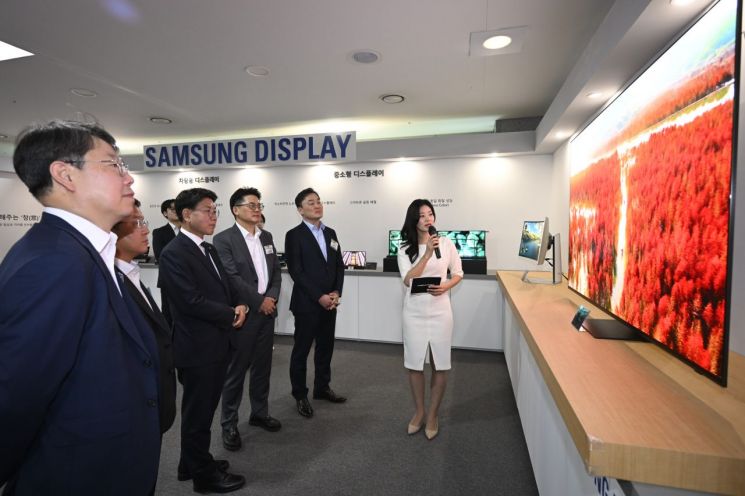 Attendees of the "National Assembly Forum for Strengthening Competitiveness in the Display Industry," hosted by Lee Jaegwan, a member of the Democratic Party of Korea, and organized by the Korea Display Industry Association, are touring the display exhibition hall set up at the National Assembly Members' Office Building on the 23rd. Korea Display Industry Association.
Materials, parts, and equipment companies also stressed the urgent need for government support. Kim Byungwook, CEO of Dongjin Semichem, proposed that, to stabilize supply chains and build a cooperative ecosystem, a tax credit incentive system should be introduced for companies that use a certain proportion of domestically produced materials and parts, as a way to foster the display materials and components sector, which is at a price disadvantage.
Moon Sungjun, CEO of HB Technology, emphasized, "Because the display industry is characterized by rapid technological change and large-scale investments, it is essential to secure flexibility in the preliminary feasibility study system, strengthen future-oriented R&D, and design projects centered on companies in order to regain global competitiveness."
The panelists unanimously agreed on the need for comprehensive support, including talent development, R&D support, and infrastructure. Kwon Janghyuk, President of the Korean Information Display Society, said, "With the emergence of next-generation display technologies, the demand for skilled professionals is continuously increasing, and securing talent has become a key factor in competitiveness. Therefore, it is urgent to establish a workforce training system specialized for the display industry."
Lee Sangjin, Executive Director of the Korea Display Industry Association, stated, "A special law for the display industry that covers R&D, taxation, workforce, and infrastructure support should be enacted so that companies can invest with confidence. If decisive action is not taken now, Korea could lose its leadership in future markets. Therefore, the National Assembly and the government must provide institutional support for the industry’s long-term vision."
© The Asia Business Daily(www.asiae.co.kr). All rights reserved.


















