Promoting 'Greenlight Gwangmyeong'... Establishing Public-Private Cooperative Governance
Expanding Resident Participation and Capacity Building for Local Asset Development
Gwangmyeong City in Gyeonggi Province is promoting a carbon-neutral urban regeneration project by expanding resident participation.
On September 23, Gwangmyeong City held a policy briefing in the city hall's medium conference room and unveiled its urban regeneration policy brand, 'Greenlight Gwangmyeong (Greenlight 光明),' which embodies this vision.
'Greenlight Gwangmyeong' is a concept that expands the positive meaning of the green light in traffic signals. It incorporates the ideas of 'City of Light, Gwangmyeong,' 'Green, the symbolic color of carbon neutrality,' and 'empathy and approval from citizens.' The brand reflects the city's commitment to building a sustainable city that responds to the climate crisis, based on a public-private cooperative urban management system.
Sangwoo Lee, Director of the New Town Development Bureau of Gwangmyeong City, stated, "The Gwangmyeong-type urban regeneration goes beyond improving the physical urban environment. It is meaningful in that it simultaneously revitalizes the community and addresses the climate crisis based on citizen participation. We will continue to develop a sustainable Gwangmyeong-style urban regeneration model by strengthening the governance of public-private cooperation, the foundation of citizen participation, and residents' capacity for carbon neutrality."
Establishing Cooperative Governance for Urban Regeneration through Citizen Participation
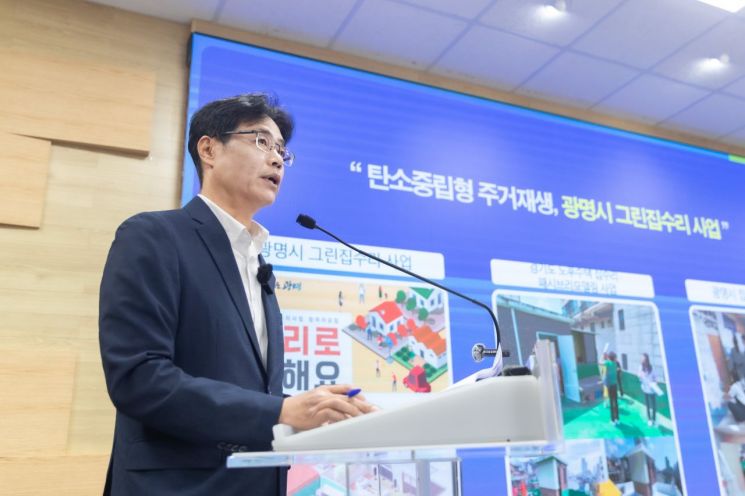 Sangwoo Lee, Director of the New Town Development Bureau of Gwangmyeong City, is explaining the Gwangmyeong-type urban regeneration brand 'Greenlight Gwangmyeong' at a briefing held on the 23rd in the city hall's medium conference room. Provided by Gwangmyeong City
The core of Gwangmyeong-style urban regeneration being promoted by the city is 'citizen participation' and 'public-private cooperation.' To this end, the city has established a cooperative governance structure centered on the Urban Regeneration General Planning Group, the Urban Regeneration Residents' Council, and the Urban Regeneration Promotion Group.
The 'Urban Regeneration General Planning Group,' led by Mayor Seungwon Park, includes private experts, relevant departments, and a citizen participation group, thereby enhancing the professionalism and execution of policies.
In each neighborhood, an 'Urban Regeneration Residents' Council' has been formed, allowing citizens to discuss key issues and explore solutions on their own. The Residents' Council deals with issues closely related to daily life, such as project proposals and planning village festivals, and plays a role in strengthening residents' capabilities.
The 'Urban Regeneration Promotion Group' is an organization in which relevant departments cooperate to provide administrative support for urban regeneration projects.
The city is also strengthening resident participation and cooperation by holding customized education, meetings, and festivals at local Urban Regeneration Field Support Centers, and is building a model to turn these activities into local assets.
A representative example is the 'Gwangmyeong 3-dong Rainbow Village Management Social Cooperative.' By participating in the Gwangmyeong 3-dong urban regeneration project, the cooperative has led community revitalization through resident cultural education programs and operating local festivals. In October last year, it was officially approved by the Ministry of Land, Infrastructure and Transport.
Combining Urban Regeneration and Carbon Neutrality... Aiming for a Sustainable City
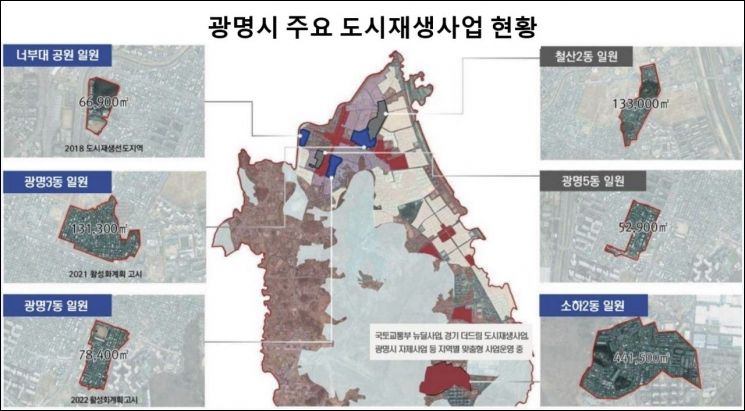
Based on this cooperative capacity, the city is especially working to incorporate carbon neutrality throughout its urban regeneration projects to create a sustainable city.
In the case of the Soha 2-dong urban regeneration project, it was selected for Gyeonggi Province's 'The Dream Urban Regeneration Project' and has been promoting various carbon-neutral initiatives since last year under the theme 'A Carbon Opportunity! Small Happiness Where the Village and the Earth Revive.'
In the Soha 2-dong area, various carbon-neutral urban regeneration projects are being carried out, including operating climate response activity groups for youth and seniors, providing gardening education, producing eco-friendly goods, and improving the energy efficiency of aging homes through repairs.
Here, the 'Youth Climate Hwarangdan' consisting of 206 young people, and the 'Carbon Neutrality Action Group' made up of 20 seniors, directly plan and implement local climate response activities, promoting resident-led carbon neutrality practices.
In the children's park, self-powered exercise equipment and smart recycling bins have been installed and are being used as spaces for climate change education. Projects to create green spaces such as alley forests, village forests, and community gardens are also being carried out in parallel, expanding green areas within living zones.
Thanks to these achievements, the city recently received the grand prize in the urban environment and landscape category at the '2025 Korea Urban and Regional Innovation Awards' hosted by the Ministry of Land, Infrastructure and Transport.
The city plans to implement the Gwangmyeong-style urban regeneration model, 'Greenlight Gwangmyeong,' in the 135,000-square-meter area of Gwangmyeong 3-dong.
To this end, from next year until 2028, the city will promote the 'Green Alley Project' to create carbon-neutral alleys, the 'Rainbow Care Project' to support the activities and capacity building of the Village Management Cooperative, and the 'Carbon Opportunity Popup Project' to establish a resident participation platform in cooperation with social economy enterprises.
© The Asia Business Daily(www.asiae.co.kr). All rights reserved.


















