Attending the 2025 SME Leaders Forum
Lecture on "Smart Manufacturing Innovation 3.0 Opened by AI"
Minister Han Sung-sook of the Ministry of SMEs and Startups has set a goal to enact the Smart Manufacturing Innovation Industry Act within this year to achieve "Smart Manufacturing Innovation 3.0."
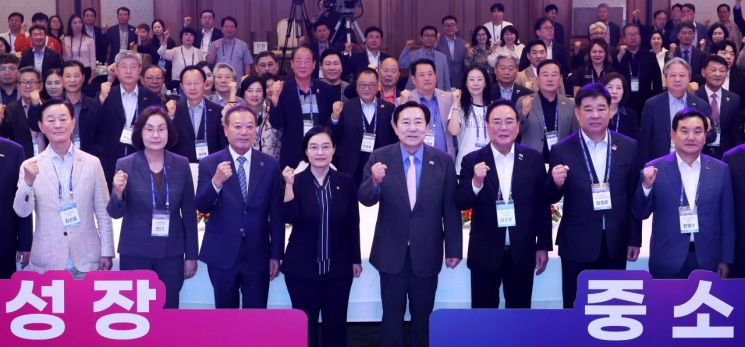 Minister Han Sung-sook of the Ministry of SMEs and Startups and Kim Ki-moon, Chairman of the Korea Federation of SMEs, are taking a commemorative photo at the "2025 SME Leaders Forum" held on the 23rd at Lotte Hotel Jeju in Seogwipo City, Jeju Province. Korea Federation of SMEs
On the 23rd, serving as a keynote policy speaker at the "2025 SME Leaders Forum" held at Lotte Hotel Jeju in Seogwipo City, Minister Han stated, "Starting with the 'Smart Manufacturing Innovation 1.0' model, which achieved informatization by integrating information and communication technology (ICT) into manufacturing sites, it is now time to move toward the 'Smart Manufacturing Innovation 3.0' model, which achieves autonomy." Smart Manufacturing Innovation 3.0 refers to a model that achieves autonomy by introducing AI based on digital transformation (DX).
Minister Han explained, "When I recently visited a factory that successfully implemented DX, I saw that there were hardly any employees in front of the machines, with only a few checking for defective products, and that the factory had transformed into a dynamic site where young employees gathered to design the facility. Even companies that have not yet adopted AI can experience significant changes simply by implementing DX."
She also emphasized the need for change by presenting productivity improvement cases from companies that have introduced manufacturing AI. Minister Han said, "According to a survey, companies that adopted manufacturing AI saw a 73.8% improvement in quality and a 72.2% increase in on-time delivery rates. Nevertheless, many domestic SMEs are struggling to keep up with manufacturing trends due to several reasons, including insufficient investment, lack of application services, data limitations, and inadequate IT infrastructure." The labor productivity index (KPC, million KRW) for SMEs stands at 142.7, which is significantly lower than that of large corporations (492.7). Minister Han stressed, "The productivity gap between large corporations and SMEs continues to widen due to differences in conditions for adopting AI, among other factors. For SMEs, which need to respond more quickly, transitioning to AI is an unavoidable task."
She also announced plans to establish a "manufacturing AI ecosystem" where manufacturing and technology companies interact organically, and to implement a "phased approach" to AI adoption tailored to each company's situation. The manufacturing AI ecosystem refers to an environment where technology companies develop and deploy AI using manufacturing data from manufacturing companies.
Minister Han stated, "It is important to go beyond simple technology companies and ultimately foster specialized smart manufacturing technology enterprises. Within this year, we will enact the Smart Manufacturing Industry Promotion Act to provide the legal and institutional foundation for nurturing such specialized smart manufacturing technology companies." She added, "We will support the growth of small and medium-sized manufacturers into truly strong and innovative enterprises through the use of AI."
The SME Leaders Forum is the largest economic forum for SMEs, presenting new future visions and policy issues for SME CEOs since 2007. Marking its 18th year, the event will be held for four days and three nights until the 26th, with around 400 SME representatives from various industries and regions across the country gathering under the theme "Challenge and Innovation, Toward the Future and the World!" to share solutions for overcoming crises. On this day, Minister Han Sung-sook delivered a policy lecture titled "Smart Manufacturing Innovation 3.0 Opened by AI."
© The Asia Business Daily(www.asiae.co.kr). All rights reserved.

















