Housing Prices Stir Again, Most Concerned About Household Loan Expansion
"If I Had to Decide Rates Now, Would Prioritize Financial Stability" Hints at Holding Steady
Chuseok Holiday a Key Juncture, Economic Assessment Should Focus on Housing Prices
"If I had to decide on the interest rate right now, I would personally want to focus more on financial stability. I believe I should express an opinion in favor of an additional rate cut once more this year, and I am considering whether to do so in October or November."
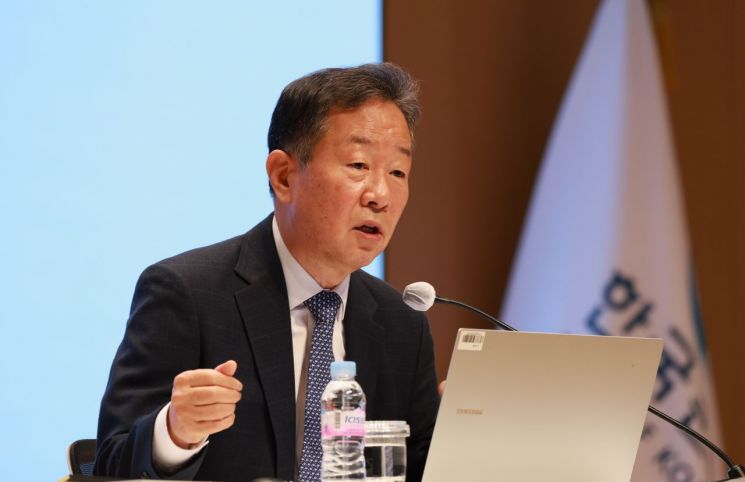 Hwang Geonil, a member of the Monetary Policy Committee of the Bank of Korea, is speaking at a press conference held at the Bank of Korea in Jung-gu, Seoul, on the morning of the 23rd. Bank of Korea
Hwang Geonil, a member of the Monetary Policy Committee of the Bank of Korea, emphasized this point at a press conference held on September 23 under the theme "The Role of the Bank of Korea and Responses to Changes in the Policy Environment." If concerns about financial imbalances due to rising household debt persist, this would support maintaining the current interest rate. Hwang stated, "What I am most concerned about is the recent uptick in housing prices, particularly in some areas of Seoul, which could spread and lead to an increase in household debt," adding, "The situation before and after the Chuseok holiday will be important."
He projected that there will likely be only one additional rate cut this year. However, he explained that he is still considering whether to make this decision at the remaining monetary policy meetings in October or November. He said, "The Bank of Korea's recent Monetary Credit Policy Report also showed that interest rate cuts have a significant impact on housing prices and household debt," stressing, "Going forward, we will closely monitor household debt, especially its overall trend."
From an economic perspective, he said he would focus on developments in the construction sector. He noted, "In previous decisions, exports and consumption performed better than expected, but the construction sector overwhelmingly outweighed these positive factors," adding, "We will assess how things have changed recently due to factors such as halted construction projects and climate conditions."
Hwang emphasized, "When making policy decisions, we must always keep in mind the saying, 'Anything that is unsustainable will eventually stop,'" and added, "In Korea, we must especially be mindful of this in relation to real estate issues linked to household debt, so that we can detect in advance what kind of shock could occur if a problem arises."
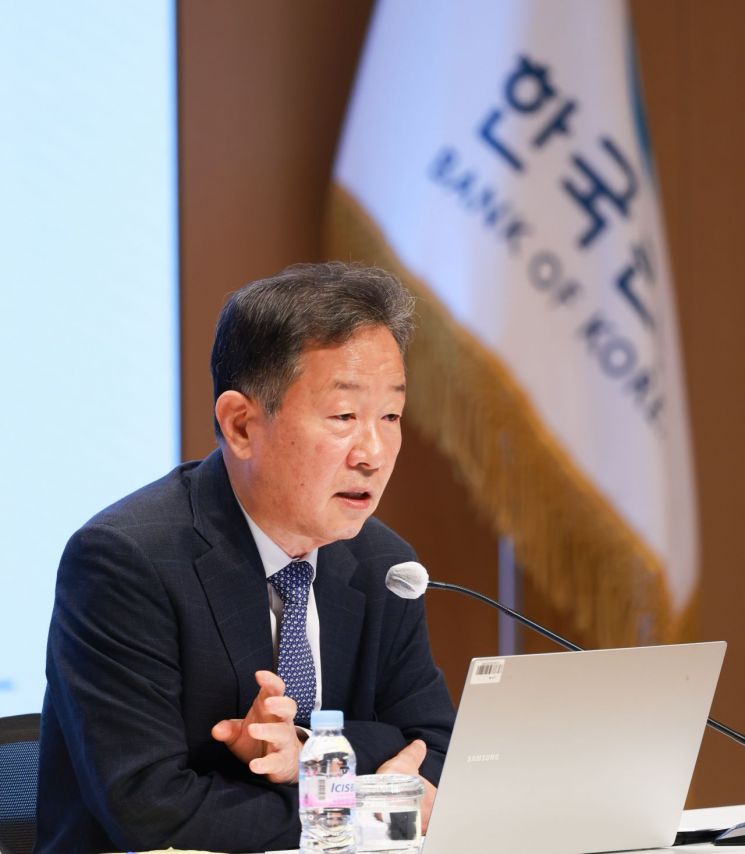 Hwang Gunil, a member of the Monetary Policy Committee of the Bank of Korea, is speaking at a press briefing held at the Bank of Korea in Jung-gu, Seoul on the 23rd. Bank of Korea
Sensitive to Korea-US Interest Rate Gap, Needs to Be Narrowed Gradually... Currency Swap Is a 'Highly Political Area'
He stressed that the interest rate gap between Korea and the United States should be gradually reduced. This month, after the United States cut its policy rate by 0.25 percentage points, the Korea-US interest rate gap (upper bound) narrowed to 1.75 percentage points, but it remains significant. Hwang said, "Compared to other members of the Monetary Policy Committee, I am particularly sensitive to the domestic-foreign interest rate gap," and added, "I expect the pace and scale of US rate cuts to be in line with market expectations. I hope the interest rate gap will be narrowed gradually."
Regarding the Korea-US currency swap, which has drawn attention recently alongside increased investment in the US, he described it as a "highly political area." A currency swap is an agreement that allows each country to deposit its own currency with the other and exchange it for the other country's currency at a predetermined exchange rate. Recently, President Lee Jaemyung expressed concern that if Korea were to withdraw and invest $350 billion entirely in cash, as required by the United States and without a currency swap, the country could face a crisis similar to the 1997 financial crisis.
Hwang stated, "Currency swaps serve as a safety net in foreign exchange transactions, so the more diverse they are, the better. In the past, the Korea-US currency swap had a clear effect on the foreign exchange market," but he also pointed out, "Entering into a currency swap is a type of negotiation, and in important negotiations with foreign countries, it is difficult because you cannot reveal your strategy to the other side."
As of the end of last year, Korea's foreign exchange reserves stood at $415.6 billion, slightly above $400 billion. Regarding this, Hwang said, "The more, the better, but the issue is that to increase reserves, you have to buy dollars in the market or issue foreign exchange stabilization bonds, which can have ripple effects such as impacting the foreign exchange market rate, so various factors must be considered."
Regarding the current won-dollar exchange rate, which is approaching 1,400 won, he said, "I do think it is excessive, but I am more concerned about the actual volatility than the level itself." He added, "Even though the Dollar Index (DXY), which reflects the value of the dollar against the six major currencies, has stabilized around 97, the won-dollar rate is still near 1,400 won. Some members of the Monetary Policy Committee are concerned about this, and I am as well. I believe the foreign exchange authorities are monitoring various factors to address this." However, he noted that volatility has decreased compared to the sharp fluctuations seen in April and May.
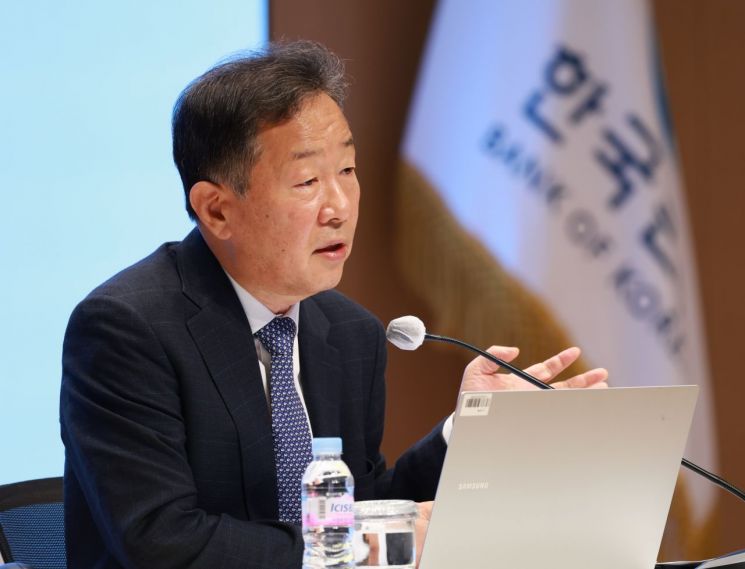 Hwang Geonil, a member of the Monetary Policy Committee of the Bank of Korea, is speaking at a press conference held at the Bank of Korea in Jung-gu, Seoul, on the 23rd. Bank of Korea
Stablecoins: Unprecedented Private Currency Creation Function... Difficult to Ease Foreign Exchange Regulations All at Once
Regarding the introduction of a won-based stablecoin, he emphasized, "This is a sensitive area because it includes an unprecedented private currency creation function," and added, "We need to take a cautious approach." Hwang explained, "Among the concerns related to stablecoins are capital outflows and third-party remittances. In fact, Korea is virtually the only country with such regulations; other countries are much more liberalized. Since Korea has historically suffered from a shortage of dollars, foreign exchange management has been strict, and even as the Foreign Exchange Control Act is gradually relaxed, there has been sensitivity regarding capital outflows. Easing regulations all at once is still difficult given Korea's situation."
He said, "I always keep in mind the saying, 'Countries without internationalized currencies are born with the original sin of being vulnerable to foreign exchange crises.' This is why the Bank of Korea is advocating for a gradual, bank-centered approach with appropriate regulations."
Regarding the government's ongoing financial supervisory reform, he said, "I hope the discussion will focus more on the demand side than the supply side," and added, "I would like the perspective to be that of financial institutions and ordinary consumers, who are the subjects of supervision." He believes that, in this process, the Bank of Korea should independently and responsibly assert its views, especially on macroprudential policies, in areas where the government may find it difficult to speak out.
© The Asia Business Daily(www.asiae.co.kr). All rights reserved.



















