Over 600 Domestic Drone Manufacturers,
But Market Size Remains Modest at 1 Trillion Won
Hanwha Aerospace Collaborates with U.S. on Short Take-Off and Landing UAV
KAI Develops System to Control 16 Drones with KF-21 Fighter
Poongsan Unveils Small Bomb-Dropping Drone Assembled in 15 Minutes
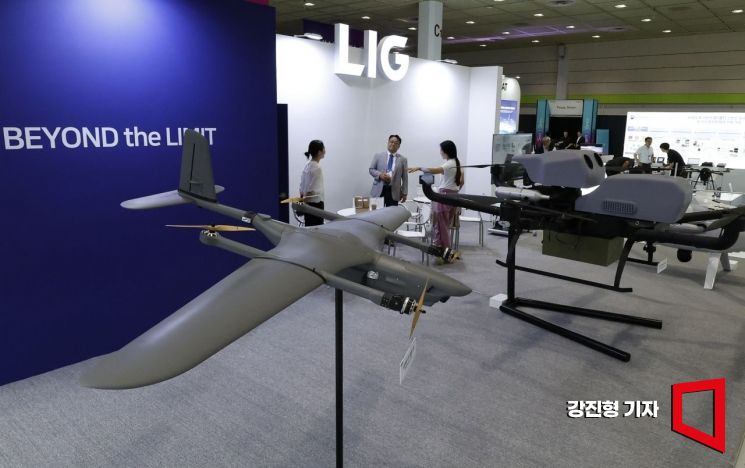 On the 9th, LIG's small reconnaissance and strike hybrid drone was exhibited at the 2025 Unmanned Mobility Industry Expo, which opened at COEX in Seoul. Photo by Kang Jinhyung
The effectiveness of military drones has been proven in the Russia-Ukraine war. In particular, Ukraine’s so-called “Spider Web Operation,” in which drones were sent deep into Russian territory to destroy fighter jets, is a representative example demonstrating the low-cost, high-efficiency strike capabilities of drone swarms. Drones are becoming more capable of carrying out missions as they become smaller and incorporate artificial intelligence (AI). The United States, China, and Europe are also investing heavily in the development of aerial vehicles and anti-drone systems in preparation for drone warfare.
South Korea is also working to strengthen its manned-unmanned combined forces by advancing a “dronebot” (drone + robot) combat system. In 2018, the Army officially launched the Dronebot Combat Unit, which operates reconnaissance and strike drones. In 2023, the Drone Operations Command, a joint combat unit consisting of the Army, Navy, Air Force, and Marine Corps, was established to prepare for missions such as responding to enemy unmanned aerial vehicles and conducting various military operations using drones. As the military drone market expands, which domestic companies are active in this field? On the 23rd, Daishin Securities introduced companies developing military drones and anti-drone systems in Korea through its report, “Drone War: Spear vs. Shield.”
The Domestic Drone Industry Remains Modest
In Korea, there are a total of 6,835 drone-related companies: 608 manufacturers and 6,227 user companies. Among manufacturers, 173 companies (28.5%) focus on hardware, while 435 companies (71.5%) specialize in software. As of 2023, the total revenue of businesses in the drone industry was 1.0993 trillion won. When limited to military drone applications, revenue was 195.4 billion won.
Large defense companies are leading the development of large-scale and advanced unmanned systems based on their accumulated defense technology and capital. Mid-sized, small, venture, and startup companies are differentiating themselves by targeting niche markets with specific technologies such as small UAVs, drone swarms, and sensors. The government is encouraging the participation of small and medium-sized companies in the defense industry by supporting their involvement in defense innovation clusters and rapid demonstration projects. Lee Taehwan, an analyst at Daishin Securities, stated, “In the future, collaboration between large corporations and startups is expected to accelerate across various fields.”
Who Are Korea’s Leading Drone Companies?
Hanwha Aerospace has shown interest in building facilities for unmanned aerial system and engine development, and has allocated 300 billion won from a recent rights offering for related projects. Hanwha Aerospace is collaborating with the U.S.-based General Atomics Aeronautical Systems (GA-ASI) to jointly develop the “Gray Eagle-STOL,” a short take-off and landing (STOL) unmanned aerial vehicle. There are predictions that this UAV will eventually be miniaturized enough to take off and land on the Dokdo-class amphibious assault ship.
Hanwha Systems is responsible for developing an integrated control network capable of operating multiple unmanned aerial vehicles, as well as anti-drone projects. The company is planning a multi-layered anti-drone defense system that integrates electronic warfare equipment and laser interception weapons. The system is designed to jam drones at a distance of 3 kilometers, capture them with a “net-type” killer drone at 2-3 kilometers, and neutralize them with a high-powered laser within 1 kilometer. The system is being developed as a mobile platform mounted on vehicles to ensure mobility.
LIG Nex1 is developing a small reconnaissance and strike hybrid drone (MPD) UAV. This drone operates as a small reconnaissance drone during peacetime and can strike targets when necessary. Since 2022, LIG Nex1 has also been developing a low-altitude small unmanned aerial vehicle response system (Block-1). This anti-drone equipment detects small UAVs, receives tracking information, and emits jamming signals to induce the UAV to deviate from its course or crash-a “soft kill” method.
Korea Aerospace Industries (KAI) is reportedly envisioning a two-tiered manned-unmanned teaming (MUM-T) system that connects manned fighter jets, UCAVs (Unmanned Combat Aerial Vehicles), and AAPs (Advanced Armed Platforms). Initially, the plan is to link about four UCAVs to manned fighters such as the KF-21 and FA-50. The small multi-purpose UAV AAP, scheduled for test flights this month, is a 3-meter-class small drone that can be mounted on the outside of a fighter jet and deployed in midair, functioning as an air-launched effect (ALE) UAV. Each UCAV is linked with four AAPs, meaning a single manned aircraft could indirectly control up to 16 AAPs.
Poongsan, an ammunition manufacturer, has identified small military combat drones as a next-generation growth engine. The Multi-purpose Combat Drone (MCD) series developed by Poongsan-MCD-2 and MCD-7-features a cylindrical design with coaxial counter-rotating rotors. The focus is on making these drones even smaller than the commonly used fixed-wing or multicopter types, and they are designed to be assembled and deployed within 15 minutes.
Mid- and Small-Sized Drone Companies Preparing for IPO
No startups specializing exclusively in military drones have gone public in Korea yet. However, there are active efforts to apply AI and sensor technologies developed for civilian use to weapon systems. Among the companies with export or military supply and demonstration records that are preparing for an IPO are Nearthlab, Soombi, and Pablo Air.
Nearthlab is a company specializing in autonomous drone flight software, recognized for its drone technology in inspecting industrial facilities such as wind turbines and bridges. To expand into the defense sector, Nearthlab has developed the multi-purpose small autonomous drone AiDEN and the direct-impact high-speed kamikaze drone KAiDEN. The company reportedly achieved export sales of over 2 million dollars for safety inspection and military purposes as of last year.
Soombi specializes in military drones and AI-based integrated control systems. The company has supplied drones to the Korean Army, Navy, Air Force, and the Korea National Park Service. In collaboration with Hanwha Aerospace, Soombi is participating in a project to develop small reconnaissance drones for chemical, biological, radiological, and nuclear reconnaissance vehicles, and is responsible for developing the technology to integrate drone flight devices and detection equipment.
Pablo Air possesses autonomous swarm flight technology for unmanned vehicles and an integrated drone control system. Its dedicated defense brand, “Pablo M,” includes the small swarm kamikaze drone S10s and the surveillance reconnaissance drone R10s. The company’s technology has been demonstrated and evaluated at domestic and international events.
© The Asia Business Daily(www.asiae.co.kr). All rights reserved.