Selective Fat Loss Reproduced in Obese Primate Study Administering HM17321
Hanmi Pharmaceutical announced on September 23 that it has scientifically elucidated the mechanism of action for a "novel obesity drug" that enables muscle growth for the first time in the world.
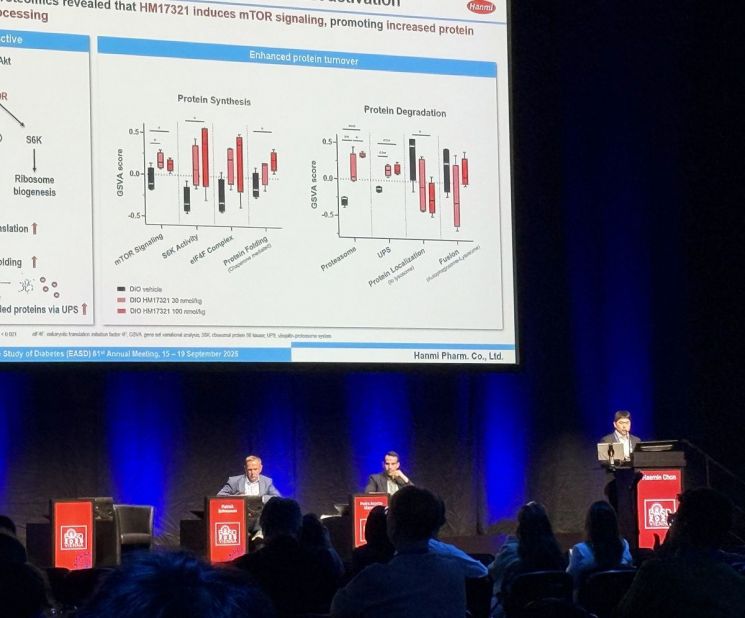 Paek Jongmin, Head of Clinical Implementation Team at Hanmi Pharmaceutical R&D Center, delivered an oral presentation on September 19 at the European Association for the Study of Diabetes (EASD 2025) held in Vienna, Austria. He presented the world's first molecular biological elucidation of the muscle growth mechanism of the obesity drug HM17321 through mouse muscle proteome research. Hanmi Pharmaceutical
Hanmi Pharmaceutical presented the results of six preclinical studies on three next-generation obesity drugs-triple-acting anti-obesity agent (LA-GLP/GIP/GCG, HM15275), novel obesity treatment (LA-UCN2, HM17321), and oral obesity treatment (HM101460)-at the 61st European Association for the Study of Diabetes (EASD 2025) held in Vienna, Austria, from September 15 to 19.
The main presentations included: ▲ Skeletal muscle proteome analysis supporting the muscle growth and metabolic improvement effects of HM17321 ▲ Weight loss efficacy of HM17321 in obese primate models and incretin combination efficacy in rodent models ▲ Demonstration of HM17321’s effects on body composition improvement, energy expenditure, and metabolic health enhancement ▲ Potential beneficial effects of HM17321 on muscle and skeletal health based on blood proteome analysis ▲ Mechanistic insights into the potent anti-obesity effects of HM15275 ▲ Demonstration of the oral GLP-1 agonist potential of HM101460.
At this conference, Chon Haemin, Head of the Clinical Implementation Team at Hanmi Pharmaceutical R&D Center, delivered an oral presentation on the molecular biological elucidation of the muscle growth mechanism of HM17321 through muscle proteome research in animal models administered with the drug, and presented results demonstrating its blood glucose control effects via metabolic adaptation.
HM17321 is being developed as the world’s first innovative obesity drug (First-in-Class) that not only compensates for muscle loss but also simultaneously achieves "muscle mass increase" and "selective fat reduction," which were previously considered unattainable.
This new drug is a UCN2 analog that selectively targets the CRF2 receptor, rather than incretin receptors such as GLP-1, and was designed using advanced artificial intelligence and structural modeling technologies developed in-house at the Hanmi Pharmaceutical R&D Center.
The oral presentation revealed research data showing that HM17321 induces muscle growth by activating the mTOR pathway and promoting glycolysis-dependent metabolic adaptation. The Hanmi research team confirmed that HM17321 stimulates the division and differentiation of satellite cells-the origin of muscle cells-by activating regulatory T cells within the muscle.
These research findings suggest that HM17321 induces muscle growth by leveraging the physiological muscle hypertrophy mechanism seen in weight training, and indicate that it offers low potential toxicity while providing both quantitative and functional improvements in muscle. A Hanmi Pharmaceutical representative stated, "Through this mechanistic research, we have overcome the challenge of animal-to-human translatability, a major hurdle for first-in-class drugs, thereby significantly increasing the likelihood of clinical success."
In another study, long-term administration of HM17321 in an "obese primate model" confirmed its clinical applicability, as selective fat loss and preservation of lean body mass were both reproduced. Additionally, in the Glucose Tolerance Test (GTT), improvements in blood glucose control, reductions in blood triglyceride levels (triglycerides) indicating metabolic benefits, and blood pressure-lowering effects indicating cardiovascular benefits were also observed.
A Hanmi Pharmaceutical representative commented, "The EASD research presentations are significant achievements that scientifically demonstrate the pharmacological efficacy of HM17321, which is about to enter Phase 1 clinical trials, may also be reproduced in humans." The representative added, "HM17321, which aims to deliver high-quality weight loss efficacy by simultaneously achieving fat reduction, muscle gain, and improvements in exercise and metabolic function, is expected to become a first-in-class drug in the field of metabolic diseases associated with obesity and muscle loss."
Hanmi Pharmaceutical also presented new research results on its next-generation obesity drug, HM15275. The precisely designed triple-acting agent HM15275, developed based on Hanmi’s expertise in incretin research, aims to achieve weight loss effects comparable to or exceeding those of bariatric surgery, with up to 25% reduction. Furthermore, by minimizing muscle loss through metabolic optimization, it is expected to improve the quality of weight loss. This demonstrates its potential to be developed as the best-in-class drug in the field of obesity treatment, with commercialization targeted for 2030.
Choi Inyoung, Head of the R&D Center, stated, "Hanmi’s obesity drug H.O.P. project is built on a pipeline spanning six areas, providing a comprehensive solution that directly addresses the limitations of currently marketed drugs and introduces a new therapeutic paradigm." He added, "Armed with a differentiated and comprehensive innovation pipeline, we will establish a new milestone in obesity treatment in the global healthcare market."
© The Asia Business Daily(www.asiae.co.kr). All rights reserved.
![Clutching a Stolen Dior Bag, Saying "I Hate Being Poor but Real"... The Grotesque Con of a "Human Knockoff" [Slate]](https://cwcontent.asiae.co.kr/asiaresize/183/2026021902243444107_1771435474.jpg)
















