Core Strategic Regulatory Reform Meeting Focuses on Forest Tourism Revitalization in Jeongseon
Addressing Population Decline and Polarization
Boosting Regional Economic Vitality by Leveraging Forests as Tourism Resources
Gangwon Special Self-Governing Province (Governor Kim Jin-tae) has joined forces to identify and resolve various regulations that need to be lifted in order to boost tourism by utilizing the province’s forest resources.
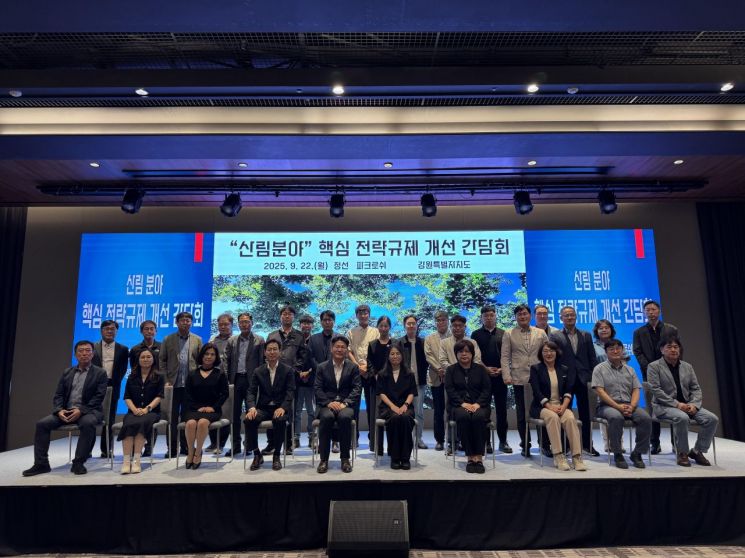 Gangwon Special Self-Governing Province held a meeting on regulatory improvements in the forestry sector to promote tourism at Park Roche in Jeongseon at 1:30 PM on the 22nd, followed by a commemorative photo session. Provided by Gangwon Special Self-Governing Province
On September 22 at 1:30 PM, the province held a meeting at Park Roche in Jeongseon to discuss regulatory improvements in the forestry sector for tourism revitalization, bringing together business leaders, officials from related organizations, experts, and public officials from both the provincial and municipal governments to discuss institutional reform measures.
The meeting was held with the aim of actively utilizing forests, which make up more than 80% of the province’s total area, as resources for tourism, recreation, and healing, in response to population decline and regional economic stagnation.
To this end, the province conducted a preliminary survey of relevant departments, tourism associations, and businesses at both the provincial and municipal levels, identifying seven key issues that need to be addressed to sustainably conserve and rationally utilize forest resources and integrate them with tourism.
First, Samcheok City pointed out the issue of area restrictions under the Mountainous Districts Management Act, which make it difficult to develop rural tourism and recreation complexes in areas experiencing population decline.
The current system only allows for developments under 3 hectares, making systematic complex development virtually impossible. The city proposed easing or removing these area restrictions specifically for regions facing population decline.
Jeongseon County presented innovative administrative measures to increase the utilization of national forests.
The county highlighted problems such as lengthy approval processes for the use of national forests (taking two to four months) and the requirement for duplicate documentation. As alternatives, it suggested introducing an online application system, streamlining paperwork, and using drones for on-site inspections. The county expressed its intention to actively utilize national forests as resources for ecotourism through these measures.
Other topics discussed included establishing a new system to allow for temporary accommodation facilities in forested areas to encourage urban-to-rural migration and increase regional consumption.
Additionally, before the discussion, Dr. Jung Yunhee from the Gangwon Research Institute proposed directions for the province’s forest policy and introduced international cases related to the creation of "therapeutic forests," which go beyond the concept of healing forests.
The province is currently operating quarterly on-site meetings as a way to identify regional characteristics and group together areas with common regulatory issues for a joint response.
In April, the province began with border areas, addressing issues such as improving living conditions caused by overlapping regulations like military facility protection zones. In June, discussions focused on support systems and regulatory solutions to address the uncertainties of the climate tech industry.
The issues identified are being addressed through various solutions, including submitting recommendations to relevant ministries and considering the inclusion of special provisions in the Gangwon Special Act, based on alternatives derived from collective discussions.
Meanwhile, the province is categorizing long-standing, deeply entrenched, and unreasonable regulations as core strategic regulations* and is pursuing innovation to foster future industries and improve residents’ quality of life by eliminating these regulations in line with the province’s policy direction.
To resolve these regulations, it is essential to gain understanding and consensus from central government ministries, where regulatory authority is concentrated, as well as to cooperate with the National Assembly. Recently, cooperation between the province and the National Assembly on the "regulation on the use of river water"-for which amendments to the "River Act" and "Framework Act on Fire Services" have been proposed-has been cited as a model case for resolving regulatory issues.
The "River Act" requires prior notification to the Minister of Environment to use river water for purposes such as firefighting, which has been criticized as impractical in emergency fire or disaster situations. In addition, while the "Framework Act on Fire Services" allows the use of water from dams and reservoirs for firefighting, it does not specifically mention river water.
In response, Assemblyman Lee Cheolkyu has proposed an amendment to allow the use of river water for firefighting without prior notification and to explicitly include river water among the resources that can be used in firefighting measures. The province’s persistent efforts to directly persuade both the National Assembly and government ministries, ultimately securing the support and cooperation of local political circles, proved to be effective.
Gwak Ilgyu, Director-General of Special Self-Governing Affairs, who presided over the meeting, stated, “Regulatory innovation begins with detailed requests from the field,” as he listened attentively to the spontaneous suggestions made by business leaders and engaged in open communication.
Director Gwak added, “We will work to solve these issues by persuading relevant agencies to relax regulations in line with current realities, so that we can enhance the value of spaces within the scope of harmony between environmental conservation and utilization.”
© The Asia Business Daily(www.asiae.co.kr). All rights reserved.

















