Korea Economic Association and World Bank Announce Entrepreneurship Index
Ranks 5th Among 21 Countries in Global Entrepreneurship
"Regulatory Innovation and Labor Market Flexibility Needed"
South Korea ranked 5th out of 21 countries worldwide in an index measuring the level of entrepreneurship. Although its ranking has improved over the past five years, analysts say that excessive regulations and a rigid labor market have prevented resource inputs from translating into sufficient outcomes, highlighting the need for improvements to secure global innovation capabilities.
The Korea Economic Association held a seminar titled "Entrepreneurship as a Sustainable Engine for Future Growth" at the FKI Tower in Yeouido, Seoul, on the 22nd, in cooperation with the World Bank. Utilizing entrepreneurship-related databases from the World Bank and other sources from 2019 to 2023, the association developed the Global Entrepreneurship Index (GEI) and announced its first results on this day.
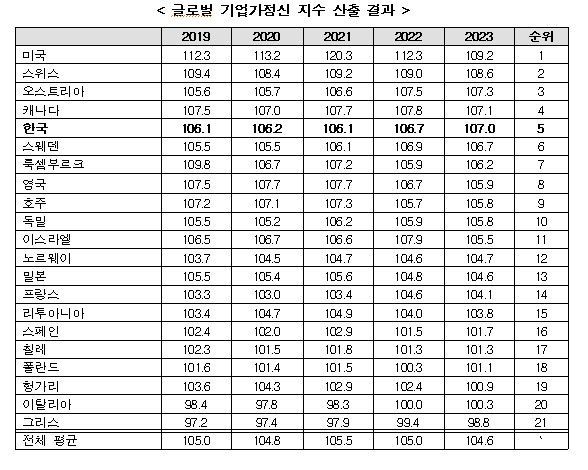
The index was calculated using the latest comparable data on entrepreneurship-related statistics, such as regulations, investment, and technology, from 21 countries among OECD members. The countries compared included the United States, Japan, Germany, and France.
South Korea's GEI for 2023 was 107.0, placing it 5th. The United States ranked first with 109.2, followed by Switzerland (108.6). Austria (107.3) and Canada (107.1) were slightly ahead of Korea. Korea's ranking has improved from 8th in 2020 to 10th in 2021 and 7th in 2022, but analysts point out that the environment for spreading entrepreneurship has not been sufficiently supportive, resulting in outcomes that fall short of the efforts made. In the 2023 index, Korea ranked among the top globally in input factors such as government policy (3rd) and technology (2nd), but its outcome index was 99.5, ranking 10th, indicating shortcomings in entrepreneurship, growth, and globalization.
Lee Kyuseok, Senior Research Fellow at the Korea Economic Research Institute, stated, "In Korea, regulations (13th), human resources (20th), and investment (9th) act as bottlenecks, preventing the excellence of inputs from leading to results," and added, "To secure global innovation capabilities, Korea needs regulatory innovation, a more flexible labor market, and revitalization of private investment."
Frederic Munier, Senior Economist at the World Bank, also suggested, "Although the number of startups in Korea nearly doubled in 2023 compared to 2006, it is still lower than in advanced economies such as Australia and New Zealand, so a more dynamic environment is needed."
Erkko Autio, a renowned expert in corporate innovation and professor at Imperial College London, emphasized, "Korea cannot simply apply its past formula for success to future growth engines," and added, "Future prosperity will be created through 'symbiotic entrepreneurship,' where large corporations, small and medium-sized enterprises, and startups are interconnected in a complementary way."
The Korea Economic Association explained that the newly developed GEI will allow for a more systematic diagnosis of entrepreneurship than the Global Entrepreneurship Monitor (GEM) index previously published by the Global Entrepreneurship Research Association (GERA), and will produce indicators that better reflect reality. The index comprehensively reflects actual business activities by quantifying the entire process, including startup, growth, and globalization. The association plans to strengthen cooperation with the World Bank to further develop this as a global standard indicator.
Kim Changbeom, Executive Vice Chairman of the Korea Economic Association, said, "Entrepreneurship is the ability to discover new markets, manage risk, and turn innovation into action," and added, "For startups, it becomes a springboard for survival and growth, while for existing companies, it creates a 'Second Wave' of innovation." Jason Alford, Head of the World Bank Korea Office, commented, "We value the development of the GEI and the co-hosting of the international conference with the Korea Economic Association, and will further strengthen cooperation between the World Bank and the association."
In the "Challenges Faced by Entrepreneurs and Strategies for Overcoming Them" session at the seminar, Kim Dongchan, CEO of Samyang Foods, who sparked a K-Food boom with Buldak Bokkeum Myeon, and Ismael Belkayat, founder and CEO of the Moroccan fintech company Chari, gave presentations. CEO Kim said, "If Samyang Foods had given up on developing Buldak Bokkeum Myeon because it was 'too spicy,' we would not have achieved our current success," and added, "It is the entrepreneurial spirit of boldly choosing the future without fear of uncertainty that opens new markets and transforms industries."
© The Asia Business Daily(www.asiae.co.kr). All rights reserved.


















