From January to August, Number of Non-Residents Surges by 52%
Island Tourism Revenue Jumps by 5.6 Billion Won Year-on-Year
Incheon City's passenger ferry fare reduction policy, the 'i Sea Pass,' has been found to significantly contribute not only to transportation welfare but also to the revitalization of tourism and the local economy.
This year, the city launched the Sea Pass program, which allows Incheon residents to use coastal passenger ferries for 1,500 won, the same as the standard public transportation fare. For residents of other regions, the fare subsidy was expanded from 50% last year to 70% this year, so they now only pay 30% of the regular fare to use Incheon's coastal passenger ferries.
The Sea Pass was introduced to reduce the burden of relatively high maritime transportation fares compared to land-based public transit, promote the use of ferries as public transportation, and stimulate the economies of island regions. Since its implementation, both the number of users and tourism revenue from the islands have increased significantly.
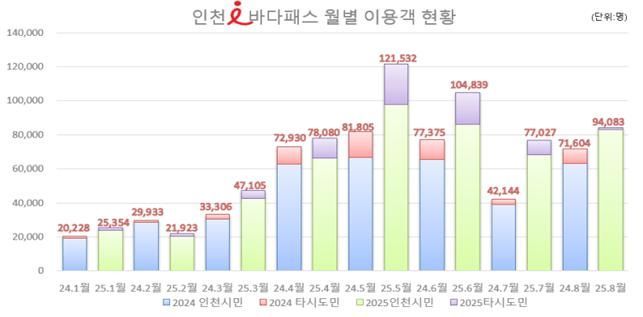
From January to August of this year, the total number of coastal passenger ferry users reached 569,943, a 32.7% increase compared to 429,325 during the same period last year. Notably, the growth rate in July alone was 83%, the highest since the introduction of the Sea Pass.
Among ferry users, the number of Incheon residents increased by 29.9% year-on-year to 488,474, while the number of residents from other regions rose by 52.2% to 81,469. The city explained that the increase in non-Incheon residents goes beyond simple transportation cost savings, as it has broadened the base for tourism to Incheon’s islands and created new demand.
The increase in ferry passengers has directly translated into economic impact. The city estimates that tourism revenue in island areas rose from 15.7 billion won last year to 21.3 billion won following the introduction of the Sea Pass. This calculation is based on the 2024 Ministry of Culture, Sports and Tourism’s National Travel Survey, which found that the average expenditure per trip to Incheon is 63,000 won for a day trip and 145,000 won for an overnight stay.
The city further analyzed that the reduction in ferry fares has led to lower transportation costs, encouraging tourists to spend more on accommodations, food, and experiences. This has resulted in a virtuous cycle of longer stays and increased local spending, boosting the regional economy.
An Incheon City official stated, "The Sea Pass is more than just a transportation discount; it is a new bridge connecting the islands and the city, and a growth engine driving Incheon’s islands to become a leading tourist destination in Korea."
Meanwhile, the 'i Sea Pass' ranked first in this year's Incheon City Top 10 Policy Citizen Satisfaction Survey and has been selected as a candidate (public nomination) for the '2025 Korea Tourism Star' award in the Innovative Tourism Policy category, organized by the Korea Tourism Organization. The final results will be announced in November.
© The Asia Business Daily(www.asiae.co.kr). All rights reserved.

















