Village Bus Association: "Will Withdraw in January if Demands Are Rejected"
"Transfer System Creates a Structure That Causes Losses"
Support Has Its Limits... Transportation Costs Must Reflect Reality
Without Village Buses, Passengers Must Pay 1,200 Won Separately
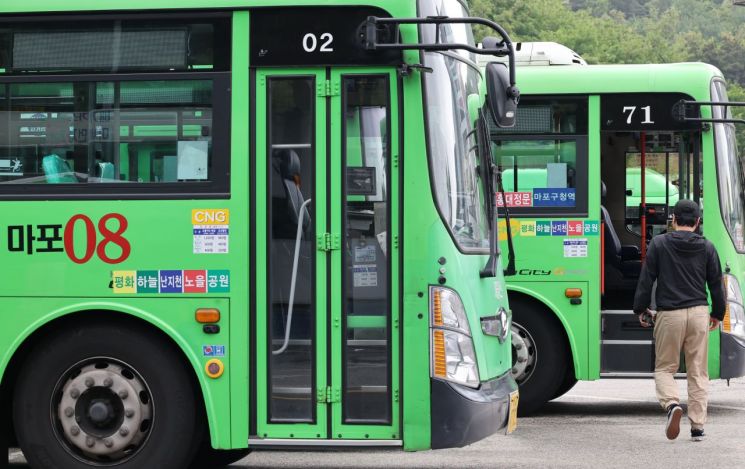
Seoul village bus operators have warned that they will withdraw from the city’s public transportation transfer system if Seoul does not expand its financial support. If village buses are excluded from the transfer system, citizens will have to pay 1,200 won for each ride without any transfer benefits.
The Seoul Village Bus Transport Business Association announced at a press conference held at its meeting room in Yeongdeungpo-gu on the morning of the 22nd that it would send an official notice to Seoul City regarding the termination of the "Integrated Public Transportation Transfer Agreement."
At the briefing, Chairman Kim Yongseung stated, "Until July 1, 2004, when Seoul implemented the public transportation transfer policy, 140 village bus companies operated normally and well without any financial support from the city, relying solely on passenger fares." He continued, "However, with the introduction of the transfer system, a structure was created in which village bus companies could no longer retain the full fare paid by passengers, resulting in losses."
Currently, privately operated village bus companies claim that the transfer system has led to accumulating deficits. When a passenger transfers from a village bus to another form of public transportation, only 676 won is settled to the village bus operator, resulting in a loss of 524 won per passenger compared to the base fare of 1,200 won. While the city of Seoul covers part of these deficits, the association argues that this support is limited. Chairman Kim said, "Over the past 20 years, the average annual transfer loss has been 100 billion won, and the total amount not compensated by Seoul exceeds 1 trillion won." He added, "Despite this, the city is demanding more frequent operations than before, pushing the village bus industry into a crisis."
Additionally, the association points out that while Seoul fully compensates city buses for their discounted fare losses, it only partially supports village buses for their deficits without covering the full amount. Previously, the association requested an increase in the financial support standard per bus from the current 486,098 won to 509,720 won to stabilize finances.
The calculation standard for labor costs is also a point of contention. The association claims that 2.5 drivers are needed to operate a village bus all day, but Seoul only reflects 2.2 drivers in its cost calculations. This is lower than the 2.89 drivers used for city buses, leading to criticism that labor costs are underestimated.
According to the association, the public transportation transfer agreement signed on July 1, 2004, by Seoul City, the Seoul Bus Transport Business Association, and the Seoul Village Bus Transport Business Association, was valid until December 31 of that year and would be automatically extended by one year unless any party expressed otherwise. Since the agreement was signed, it has been automatically extended until the end of this year, but this time, the village bus association intends to withdraw. The association has requested that Seoul City: ▲ amend the fare settlement regulations in the public transportation transfer agreement and conduct a new settlement, ▲ establish new regulations for compensation and methods regarding transfer losses, and ▲ adjust transportation costs to reflect price and wage increases.
If village buses withdraw from the transfer system, passengers will no longer receive transfer discounts when switching to subways or city buses. Instead, they will have to pay village bus fares separately using dedicated card readers, not the integrated transfer terminals.
Seoul City has a different stance. The city says that, having spent hundreds of billions of won each year to cover deficits, it is difficult to fully accommodate all demands. Seoul allocated 49.5 billion won in 2022, 45.5 billion won in 2023, and 36.1 billion won in 2024 to support village bus deficits, and has set aside 41.5 billion won for this year.
In particular, the city believes that since some operators comply with operation rates and intervals while others do not, support should not be based solely on deficits but should be established on a performance-based system. The city has stated that if the association actively participates in and agrees to improve village bus services, it may consider raising the financial support standard.
The city also stated that these issues are directly harming citizens’ transportation convenience and that special measures are needed. Previously, the city proposed: ▲ adjusting the number of operations and intervals by route to match actual demand, ▲ calculating subsidies based on the actual number of vehicles in operation and introducing incentives linked to operation rates, and ▲ designating accounting firms for each operator and conducting regular inspections. The aim is to resolve bus shortages during rush hours and prevent budget waste.
In line with these measures, the city has also launched a research project to recalculate village bus transportation costs. Although this is a regular survey conducted every two years, the association’s warnings about possible service suspension and withdrawal from the transfer system mean that the results could affect next year’s financial support structure. The study will calculate transportation costs for village buses based on data from 2016 to 2024, analyze the validity of the current financial support method, and review the future direction of the system. The comparison will include all 25 districts of Seoul, 16 metropolitan local governments nationwide, and some overseas cities.
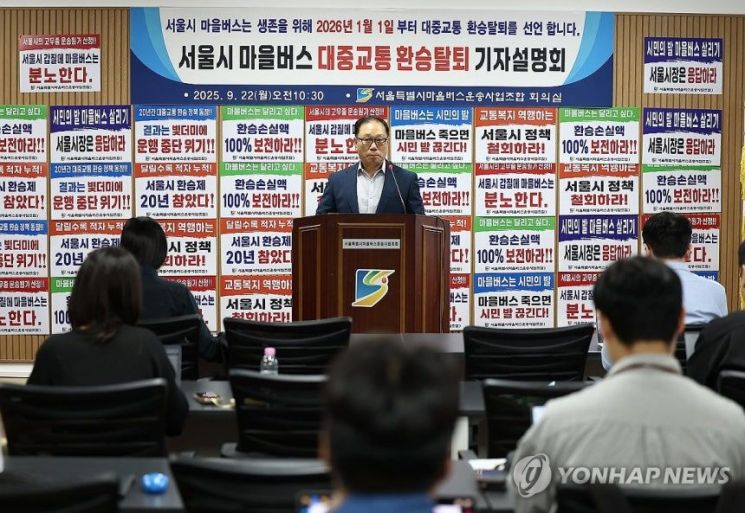 Kim Yongseung, chairman of the Seoul Village Bus Transportation Business Association (hereinafter referred to as the Seoul Village Bus Association), is speaking at a press briefing on "Seoul Village Bus Public Transportation Transfer Withdrawal" held on the 22nd at the Seoul Village Bus Association conference room in Yeongdeungpo-gu, Seoul. Photo by Yonhap News
© The Asia Business Daily(www.asiae.co.kr). All rights reserved.


















