Professor Kyungjun Park's DGIST Team
Achieves 18% Productivity Increase in Logistics Centers and Smart Factories
A new "Physical AI" technology has been developed for Autonomous Mobile Robots (AMR), enabling them to naturally forget unnecessary information and share only essential data for efficient cooperative driving.
On September 22, the Daegu Gyeongbuk Institute of Science and Technology (DGIST) announced that the research team led by Professor Kyungjun Park from the Department of Electrical Engineering and Computer Science (Physical AI Center) had developed an innovative Physical AI technology. This technology models the spread and forgetting of social issues to enhance the autonomous driving efficiency of multiple robots.
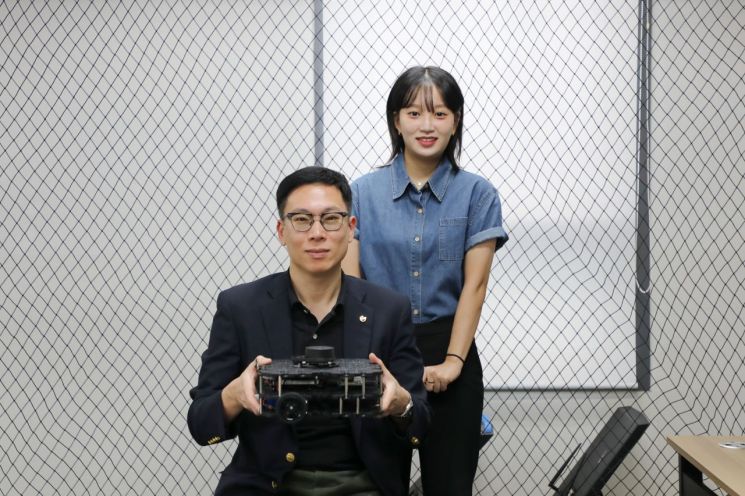 Professor Kyungjun Park of the Department of Electrical Engineering and Computer Science at DGIST (left), Ji Young Chae, integrated master's and doctoral student. Provided by DGIST
When AMRs operate in logistics and manufacturing sites, unexpected obstacles such as forklifts, work lifts, or suddenly stacked cargo can hinder smooth movement. In these situations, robots typically react only to immediate circumstances, frequently altering their routes, which leads to unnecessary detours and delays, ultimately reducing productivity.
The research team mathematically modeled the unique human social phenomenon in which certain events or issues spread rapidly and are gradually forgotten over time. They applied this model to the collective intelligence algorithm of robots, enabling them to naturally forget unnecessary information while acquiring and sharing only important data, thus allowing for efficient cooperative driving.
In driving tests using the "Gazebo simulator," which replicates an actual logistics center environment, the robots demonstrated up to an 18.0% increase in task throughput and up to a 30.1% reduction in average travel time compared to the existing "ROS 2 Navigation" autonomous robot control algorithm. This demonstrates that robots are evolving from simple obstacle-avoiding machines into Physical AI systems that learn social principles and make autonomous decisions.
Another advantage of this technology is its ease of field application. It can be implemented using only 2D LiDAR without additional sensors and is provided as a plugin compatible with the ROS 2 Navigation stack. This allows for immediate integration into existing autonomous driving systems without complex equipment, enabling rapid adoption in industrial fields such as drone swarms, autonomous vehicles, and logistics robots. In particular, it is expected to be highly beneficial for implementing cooperative autonomous driving systems in smart city traffic management or large-scale exploration and rescue operations.
Professor Kyungjun Park stated, "This research is significant in that it demonstrates how Physical AI is becoming more human-like," adding, "This achievement will become a core technology for enhancing the productivity of autonomous robots in logistics centers, large warehouses, and smart factories."
This research was led by Ji Young Chae and Sang Hoon Lee, integrated master's and doctoral students at DGIST, as first authors, with Professor Park as the corresponding author. The results were published online on September 10 in the Journal of Industrial Information Integration, which ranks in the top 2% of international journals in the field of industrial engineering according to the JCR index.
© The Asia Business Daily(www.asiae.co.kr). All rights reserved.

















