Tariff Growth Rate Highest Since Trump Administration
Effective Tariff Rate Ranks Third After China and Japan
In the second quarter of this year, tariffs imposed on South Korean exports to the United States amounted to 3.3 billion dollars. This is the sixth largest amount in the world. This figure is 47 times higher than before the launch of the Trump administration, marking the highest rate of increase globally.
The Korea Chamber of Commerce and Industry announced on the 21st, based on an analysis of U.S. International Trade Commission (ITC) tariff statistics for the top 10 countries exporting to the United States, that South Korea’s export tariffs to the U.S. totaled 3.3 billion dollars in the second quarter of this year. This ranked sixth after China (25.93 billion dollars), Mexico (5.52 billion dollars), Japan (4.78 billion dollars), Germany (3.57 billion dollars), and Vietnam (3.34 billion dollars). Compared to the fourth quarter of last year, before the start of Trump’s second term, Korea’s tariff increase amounted to 3.23 billion dollars, the fourth highest after China (14.18 billion dollars), Mexico (5.21 billion dollars), and Japan (4.2 billion dollars).
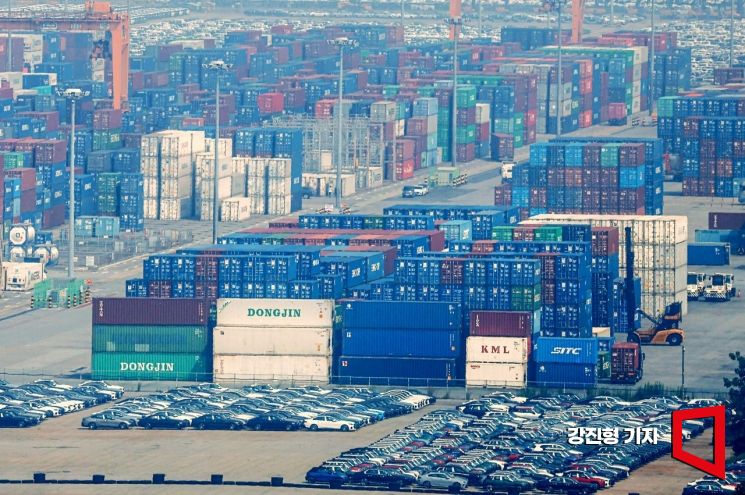 Cars awaiting shipment for export are lined up at the export yard of Pyeongtaek Port in Gyeonggi. Photo by Kang Jinhyung
In terms of tariff growth rate, South Korea recorded the highest among the 10 countries at 4,614% (a 47.1-fold increase). This was followed by Canada at 1,850% (19.5-fold), Mexico at 1,681% (17.8-fold), Japan at 724% (8.2-fold), Germany at 526% (6.3-fold), and Taiwan at 377% (4.8-fold).
Until the first quarter, South Korea had incurred almost no tariffs due to the Korea-U.S. Free Trade Agreement (FTA). However, in the second quarter, the application of a 10% general tariff, as well as tariffs on items such as automobiles and parts, and steel and aluminum, led to a sharp increase. In China’s case, although the increase in tariffs was the largest in absolute terms, the growth rate was the lowest among the countries, as high tariffs on electric vehicles, batteries, semiconductors, and solar cells had already been in place during the Biden administration.
By product category, tariffs on South Korean exports to the U.S. in the second quarter were led by automobiles and parts, which accounted for 1.9 billion dollars, or 57.5% of the total. This was largely due to the imposition of a 25% item-specific tariff on finished vehicles in April and on auto parts in May.
The effective tariff rate, calculated by dividing Korea’s tariff payments by its export value, stood at 10% in the second quarter, ranking third among the top 10 exporting countries to the U.S., after China (39.5%) and Japan (12.5%). The Korea Chamber of Commerce and Industry interpreted this to mean that, considering Korea ranked eighth globally in export volume to the U.S. in the second quarter, the tariff burden is relatively high compared to the scale of exports.
The Korea Chamber of Commerce and Industry emphasized the urgent need for policy and legislative support to ease the burden on exporting companies. It called for the swift implementation of the previously concluded Korea-U.S. tariff agreement to lower tariffs on automobiles and parts to 15%, and for diplomatic efforts to secure favorable conditions for item-specific tariffs on products such as semiconductors and pharmaceuticals.
Kang Seokgu, head of the Research Division at the Korea Chamber of Commerce and Industry, pointed out, "Assuming exporters bear a quarter of the 15% reciprocal tariff, this means that 3.75% of U.S.-bound exports would be paid in tariffs. Given that the operating margin of Korean manufacturing companies was 5.6% last year, it is undeniable that the burden has increased significantly."
Kang further emphasized, "As this is a challenging period for our companies to adapt to the new trade environment, we must work together to find ways to ease the burden and ensure they do not fall behind in global competition."
© The Asia Business Daily(www.asiae.co.kr). All rights reserved.
![User Who Sold Erroneously Deposited Bitcoins to Repay Debt and Fund Entertainment... What Did the Supreme Court Decide in 2021? [Legal Issue Check]](https://cwcontent.asiae.co.kr/asiaresize/183/2026020910431234020_1770601391.png)