Three Key Solutions Proposed at National Assembly Policy Forum:
Governance Building, Legal Foundation, and Financial Support
The introduction of a "climate insurance" system to protect vulnerable groups from the climate crisis has begun to be actively discussed at the National Assembly level.
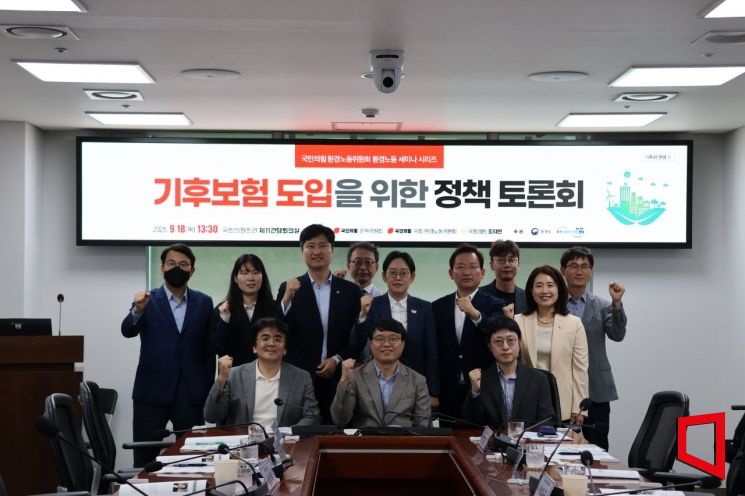
On September 18, Assemblywoman Cho Jiyeon of the People Power Party (Gyeongsan City, North Gyeongsang Province) held a "Policy Forum on the Introduction of Climate Insurance" in the 11th meeting room of the National Assembly Members' Office Building, stating, "The National Assembly will take the lead in discussions on climate insurance, which can no longer be delayed."
This forum was jointly hosted by members of the People Power Party Policy Committee and the Environment and Labor Committee, with participation from academia, government, local governments, and the insurance industry to explore concrete institutionalization measures for responding to the climate crisis.
Kim Kyungseon, Research Fellow at the Korea Insurance Research Institute, emphasized the need for integrated, cross-ministerial governance to address climate and health risks, highlighting the use of index-based insurance.
Nam Sangwook, Professor at Seowon University, suggested, "It is realistic to prioritize climate-vulnerable groups and gradually expand coverage, and public-private cooperation is the optimal approach."
The discussion, moderated by Choi Yangho, Professor at Hanyang University, focused on the urgent need for legal grounds and administrative support, with representatives from the Ministry of Environment, Gyeonggi Province, the National Center for Climate Crisis Adaptation, and the General Insurance Association of Korea in attendance.
Park Jeongcheol, Director at the Ministry of Environment, stated, "If climate insurance is introduced, it will enable the stabilization of livelihoods for vulnerable groups and allow for proactive fiscal management."
Park Daekeun, Director at Gyeonggi Province, noted, "Gyeonggi Province is taking the lead in operating climate insurance through the enactment of ordinances," and stressed the importance of a legal foundation for nationwide expansion.
Jung Huicheol, Director of the Center, said, "A survey on the actual conditions of vulnerable groups must precede the design of effective target groups," while Eom Junsik, Team Leader, argued, "It is necessary to establish an immediate support system by sharing health information on heat- and cold-related illnesses."
Assemblywoman Cho emphasized, "The damage from climate change poses the greatest threat to vulnerable groups," adding, "The National Assembly will take responsibility for establishing climate insurance governance, providing legal grounds, and supporting finances through a climate response fund."
The climate crisis is no longer an abstract risk but a real issue directly linked to the survival of society's most vulnerable. Attention is focused on whether the National Assembly can create an institutional framework to help close the 'climate gap.'
© The Asia Business Daily(www.asiae.co.kr). All rights reserved.

















