Exhibition of Works from France's Mus?e de l'Orangerie and Mus?e d'Orsay
First-Ever Orangerie Museum Exhibition in Korea
120 Works on Display, Including 51 Oil Paintings by Renoir and C?zanne
On View Until January 25, 2026
To commemorate the 140th anniversary of diplomatic relations between Korea and France, the special exhibition "C?zanne, Renoir," featuring works from France's renowned national museums, the Mus?e d'Orsay and the Mus?e de l'Orangerie, is being held at the Hangaram Design Museum of the Seoul Arts Center. More than 120 works (including 51 oil paintings and approximately 70 videos and photographs) from these two museums-both among the four major art museums in France-are on display for Korean audiences. This marks the first Orangerie Museum exhibition in Korea, with 40 pieces, and the first Mus?e d'Orsay exhibition in nearly a decade since 2016.
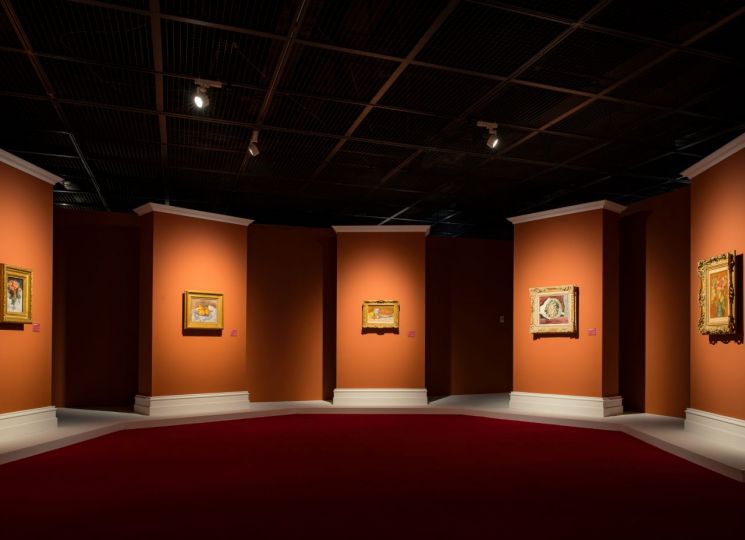 Interior view of the "Orangerie-Orsay Museum Special Exhibition: C?zanne, Renoir" held at the Hangaram Design Museum of the Seoul Arts Center. Courtesy of Seoul Arts Center
This exhibition presents works by two iconic 19th-century artists: Paul C?zanne (1839-1906) and Pierre-Auguste Renoir (1841-1919). The two first met in Paris in the 1860s, developing mutual respect. While both began with Impressionism, their artistic journeys diverged. Renoir’s works are known for their delicate and harmonious expression, while C?zanne’s are distinguished by their strict and geometric depiction. However, the two also share notable similarities, having served as each other's spiritual anchors and pioneers of experimental art. Discovering these hidden similarities amidst their differences is one of the exhibition’s highlights.
The term "Orangerie" originally referred to a greenhouse for cultivating oranges in the French royal court. Later, Napoleon III transformed the greenhouse into an art museum, which now houses 127 pieces in its collection. Of these, 39 oil paintings have traveled to Korea for this exhibition. From the Mus?e d'Orsay, an additional 12 works have been included, bringing the total to over 120 pieces, including 51 oil paintings, all transported to Korea aboard four airplanes.
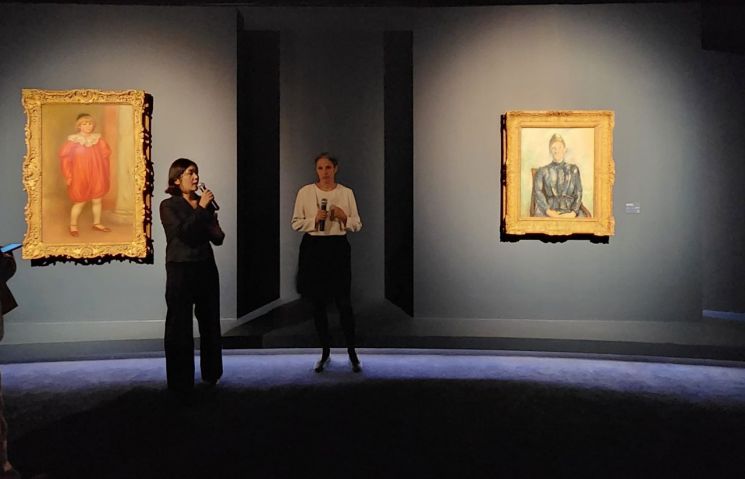 On the morning of the 19th, a curator is explaining at the 'Orangerie - Mus?e d'Orsay Special Exhibition: C?zanne, Renoir' preview held at the Hangaram Design Museum in the Seoul Arts Center. The artwork in the background is a portrait C?zanne painted of his son (left) and wife. Photo by Seo Mideum
At the entrance to the exhibition, visitors are greeted by a portrait of C?zanne’s wife and son, painted by the artist himself, who is often considered the "father of modern art." C?zanne frequently painted family portraits, with his wife as a regular model. Her portrait reveals a delicate style, capturing even the fine wrinkles beneath her eyes. The bright blush on her cheeks and the blue hues in her clothing stand out vividly. It is said that C?zanne often painted his wife because her expressionless face, which did not reveal emotion, fascinated him.
Next to this, the portrait of their youngest son is unusual in that he is posed, unlike the more natural depictions found in other portraits. The boy’s shining hair, bright eyes, and the delicate texture of his clothing all reflect C?zanne’s affection for his son.
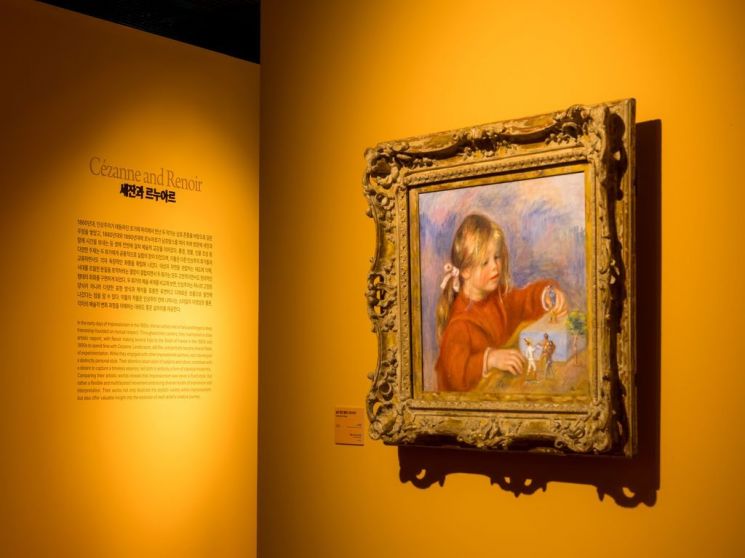 Interior view of the exhibition hall. The artwork at the center is "Claude Renoir Playing," painted by Pierre-Auguste Renoir around 1905, depicting his youngest son. Courtesy of Seoul Arts Center.
Renoir also frequently painted portraits of his family, especially his third (youngest) son. He strove to capture a natural image through multiple studies and sketches, and his soft depiction of skin and facial features reveals his deep affection.
The two artists also display artistic differences in their nude paintings. Renoir emphasized colors that harmonized with nature and rendered details like hair realistically, blending the figure seamlessly into the background.
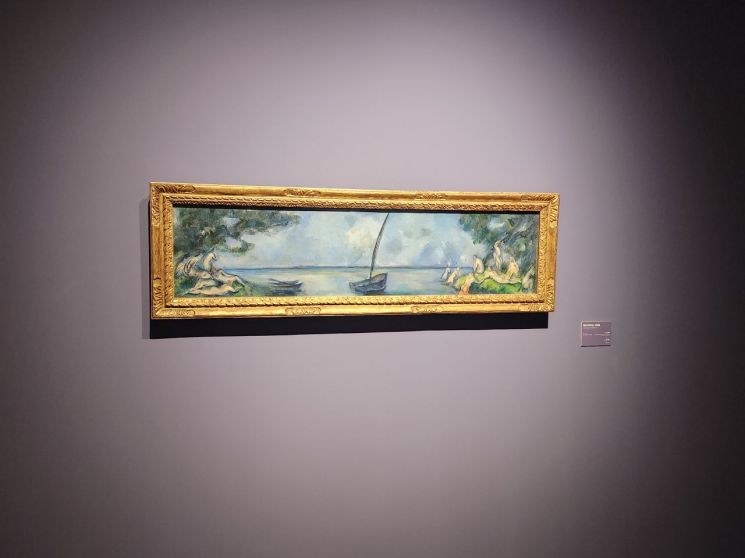
In contrast, C?zanne outlined his figures with black lines, clearly distinguishing people from nature. "The Bathers with Pears" (circa 1890), which is about one meter wide, was commissioned to decorate the home of his friend and collector Victor Chocquet. Although the work was once split into three parts, the museum reunited them in 1980, restoring the original form. Upon close inspection, traces of the previous separation can still be seen.
The exhibition also features works by Pablo Picasso (1881-1973), who was influenced by Renoir. Picasso’s "Nude Draped with Cloth" (1923) is said to have been inspired by Renoir’s nudes, with similarities in the voluptuous, rounded body and warm color palette.
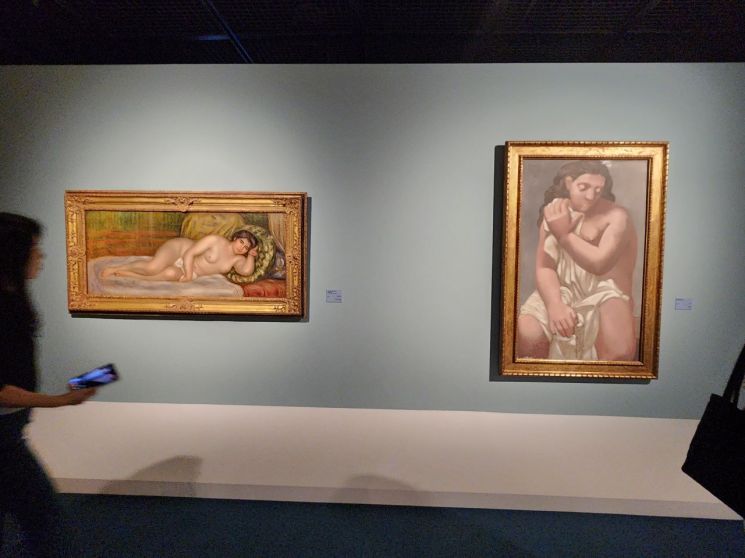 The artwork on the left is Pierre-Auguste Renoir's "Reclining Nude Woman" (1906?1907), and the artwork on the right is Pablo Picasso's "Nude Draped with Cloth" (1923). Photo by Seomideum.
Nathalie Bager Verdier, Deputy Director of the Mus?e de l'Orangerie, said, "We are delighted to introduce the Orangerie’s collection to Korea for the first time. The exhibition offers a broad overview of works from the 1870s to the artists’ final years in the 1910s. In celebration of the 140th anniversary of Korea-France diplomatic relations, we hope this will be a special occasion for our Korean visitors, who are among the most frequent from Asia to our museum."
As part of the educational program, guided exhibition tours are held twice daily on weekdays (at 11 a.m. and 1 p.m.), and there are also children’s programs, including the Seoul Arts Center Children’s Academy, Museum Stories, and the Thinking Museum. The exhibition runs until January 25 next year.
© The Asia Business Daily(www.asiae.co.kr). All rights reserved.



















