Seoul National University Nuclear Policy Center Releases Study Results
Wages for Nuclear Workers in Major Countries Are Over 25% Higher Than Other Industries
In Korea, the Gap Is Less Than 5%... Continued Outflow of Key Personnel
"Appropria
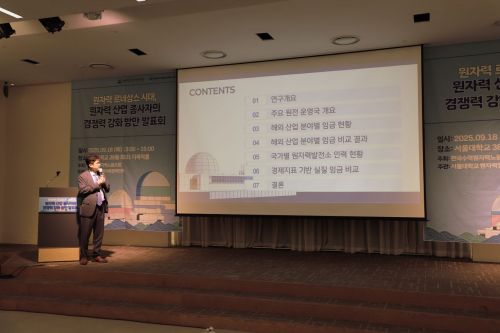 At the 'Nuclear Renaissance Era, Measures to Strengthen the Competitiveness of Nuclear Industry Workers' event held on the 18th at Multipurpose Hall 38, Seoul National University, the research team from the Seoul National University Nuclear Policy Center presented the research results on the 'Global Nuclear Power Plant Workers' Wage Status Analysis.' Korea Hydro & Nuclear Power Labor Union
The wage levels of workers at domestic nuclear power plants have been found to be significantly lower than those in major competing countries. There are concerns that the weakening wage competitiveness in Korea is leading to a continued outflow of key personnel.
According to the results of the 'Global Nuclear Power Plant Workers' Wage Status Analysis' presented by the Seoul National University Nuclear Policy Center at the 'Nuclear Renaissance Era, Measures to Strengthen the Competitiveness of Nuclear Industry Workers' event, hosted by the Korea Hydro & Nuclear Power Labor Union at Seoul National University on the 18th, major nuclear power operating countries such as the United States, France, Canada, and Japan pay their nuclear industry workers wages that are at least 25% higher than the average in other industries.
In contrast, the gap between the nuclear industry and other industries in Korea was less than 5%. This indicates that the treatment of Korea's nuclear workforce is significantly different from international standards.
Specifically, the average wage for workers in Korea's nuclear industry was 85.47 million won, which was not significantly different from construction (78.79 million won), telecommunications (84.9 million won), and environment/energy (84.3 million won). Compared to the average wage in other industries (82.66 million won), it was only 1.03 times higher.
In contrast, the average wage for nuclear industry workers in the United States was 186.68 million won, which was 1.25 times higher than the average wage in other industries (149.45 million won). In Canada, the figure was 147.34 million won, 1.30 times higher than the average in other industries (113.45 million won), while in France, it was 168.69 million won, 2.34 times higher than the average in other industries (72 million won), the highest among the countries surveyed.
In neighboring Japan, the average wage for nuclear industry workers was 168.99 million won, 1.42 times higher than the average in other industries (119.27 million won).
According to the research, major countries overseas pay wages that are on average more than 27% higher than those in Korea. The number of personnel assigned to power plants of the same output standard was also found to be about twice as high as in Korea. The research team pointed out that these wage and workforce disparities are directly linked to the safety and competitiveness of the nuclear industry.
The study particularly highlighted the case of France, where a special allowance of 25% is paid to nuclear workers to account for radiation exposure risks, emphasizing the need for institutional compensation that reflects the unique characteristics of the nuclear industry. In contrast, it was pointed out that in Korea, the control of labor costs at public institutions prevents adequate reflection of the industry's unique demands.
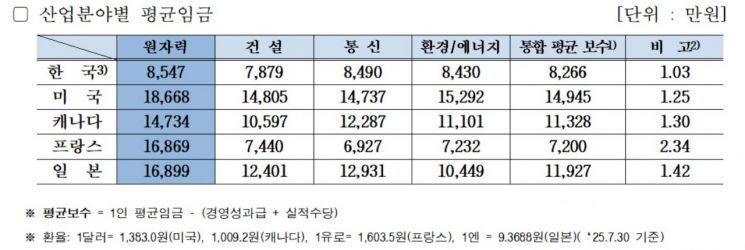 Current Wage Status of Nuclear Power Plant Workers in Major Nuclear Power Operating Countries (Source: Seoul National University Nuclear Policy Center and ALIO)
The research team stated, "As the outflow of highly skilled personnel overseas accelerates and it becomes increasingly difficult to attract new talent, if wage levels and working conditions are not improved to meet international standards, the sustainable development of the nuclear industry could be at risk," adding, "Appropriate wage compensation and institutional support are urgently needed to ensure the stable operation of nuclear power plants and maintain global competitiveness."
The Korea Hydro & Nuclear Power Labor Union said, "Based on the issues raised today, we will visit the relevant National Assembly standing committees and government ministries to ensure that improvements in the treatment and fair compensation of nuclear industry workers are institutionally implemented."
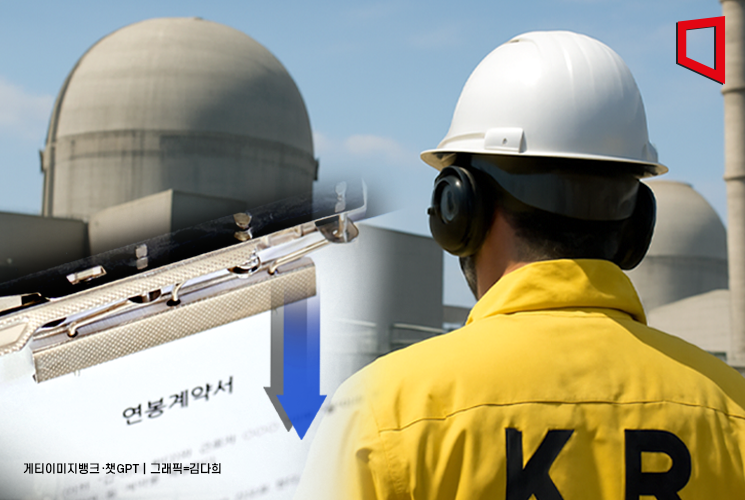
Attendees at the event included Assemblywoman Hwang Jungah of the National Assembly's Science, ICT, Broadcasting, and Communications Committee (Democratic Party of Korea), Assemblyman Kim Wisang of the Environment and Labor Committee (People Power Party), research staff from the Seoul National University Nuclear Policy Center, and central committee members of the Korea Hydro & Nuclear Power Labor Union.
Nah Yongsoo, Professor and Head of the Department of Energy Systems Engineering at Seoul National University, stated, "The role of nuclear power is once again being highlighted as a means to strengthen energy security," and emphasized, "It is urgent to improve treatment and provide institutional support in line with international standards."
Oh Youngsoo, Director of Planning at the Korea Hydro & Nuclear Power Labor Union, explained, "As the outflow of talented personnel overseas accelerates and it becomes increasingly difficult to attract new talent, we commissioned this study to analyze wage levels by country and objectively identify the wage gaps."
© The Asia Business Daily(www.asiae.co.kr). All rights reserved.



















