Super-Aging Korea Faces Risk of Hitting the Effective Lower Bound (ELB)
Non-Key Currency QE Carries Significant Side Effects When Structural Vulnerabilities Are the Cause
Lending Support Schemes as an Alternative: "Targeted BILS Support During Martial Law as an Example"
Quasi-Fiscal Policy Tools Worth Considering for the Integrated Policy Framework
Serious Issue: Growing Share of Non-Bank Financial Institutions
Financial Stability Considered in Setting Korea's Neutral Rate
"When South Korea's interest rate reaches the effective lower bound (ELB) amid structural vulnerabilities such as population aging, the alternative is the Funding for Lending (FFL) scheme."
On the 18th (local time) at the International Monetary Fund (IMF) headquarters in Washington, D.C., Lee Changyong, Governor of the Bank of Korea, took the stage at the "Michelle Candace Central Bank Lecture." He recalled the situation at the end of last year, when, after the declaration of martial law, the Bank of Korea decided to freeze the base rate at the first Monetary Policy Board meeting on monetary policy direction, and introduced the Bank Intermediated Lending Support Facility (BILS). He emphasized that when the interest rate hits a point where it cannot be lowered further, lending support schemes such as BILS can serve as supplementary tools for monetary policy. Governor Lee pointed out that when structural vulnerabilities are the cause of reaching the effective lower bound, unconventional monetary policy responses such as quantitative easing (QE) can have significant side effects. He therefore suggested quasi-fiscal policy tools like lending support schemes as alternatives.
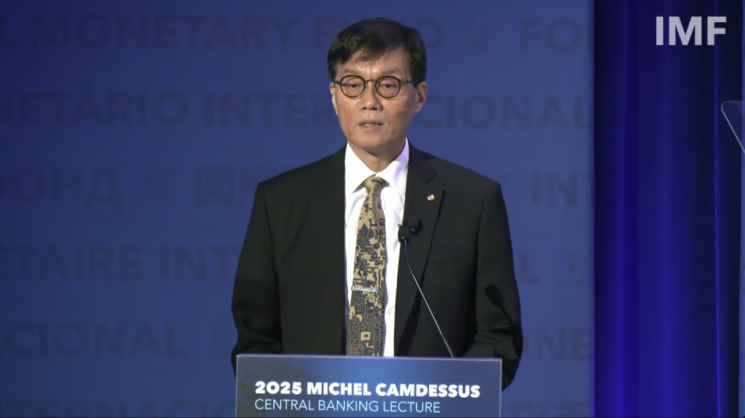 Lee Changyong, Governor of the Bank of Korea, is explaining South Korea's monetary policy at the "Michelle Candice Central Bank Lecture" held at the International Monetary Fund (IMF) headquarters in Washington DC, USA, on the 18th (local time). Screenshot from IMF YouTube live broadcast
The BILS Card Used Amid Martial Law and a Frozen Rate... FFL as an Alternative in the ELB Era
Governor Lee said, "In December last year, the unexpected declaration of martial law dampened consumer sentiment and caused a sharp decline in domestic demand, especially in self-employed business sales. While a rate cut would have been appropriate from an economic perspective, the value of the won fell to its lowest level since the global financial crisis, so the Bank of Korea decided to freeze the rate at the Monetary Policy Board meeting in January this year." He recalled that, instead of cutting rates until political uncertainty subsided, the Bank of Korea selectively provided funding to the self-employed and small businesses through the BILS. Governor Lee emphasized, "This demonstrates how targeted policy tools can supplement the limitations of interest rate policy, which is a 'large but blunt instrument.'"
The lending support scheme is a policy tool in which the central bank supplies low-interest funds to private financial institutions, which then provide targeted support to specific sectors through credit channels. This tool is widely used by central banks around the world. Governor Lee explained, "Of course, to utilize lending support schemes, meticulous institutional design is essential, including reasonable limits and usage restrictions and pre-set exit strategies, to minimize risks of fiscal dominance or undermining independence. I hope the IMF will consider whether this approach is worth adding to the policy toolkit."
Governor Lee also identified "conditional forward guidance," which presents an endogenous rate path based on economic forecasts, as another tool for the ELB scenario. He said, "Currently, the Bank of Korea is conducting a K-dot plot simulation, where the six Monetary Policy Board members (excluding the governor) indicate their views on the base rate path for the next year as dots, and this dot plot is released on a three-month horizon. If this system becomes established and the publication horizon is extended, it will enable more active communication of monetary policy direction with the market in various environments, including the ELB situation."
Risks of FX Intervention and Quantitative Easing When Structural Vulnerabilities Like Super-Aging Are the Cause
On this day, Governor Lee delivered the Candace Lecture on the theme "Korea's Integrated Policy Framework (IPF) Journey: Challenges and Responses in the ELB Era." The Integrated Policy Framework refers to a policy mix system that seeks internal and external stability by integrating not only traditional monetary policy aimed at price stability, but also foreign exchange intervention (FXI), capital flow management measures (CFM), macroprudential policy, and fiscal policy. Since the 2008 global financial crisis highlighted the limitations of relying solely on traditional monetary policy, the IMF proposed this concept in 2020.
Governor Lee remarked, "If the range of IPF policy tools is further expanded in the future, there is considerable interest in whether unconventional monetary policies (such as quantitative easing) could be used in South Korea." He noted that while such tools might be used in times of global crisis, they could have significant side effects in ELB situations caused by structural, long-term stagnation or domestic issues. He explained that, since inflation expectations are well anchored in South Korea, the country can refer to advanced small open economies like Switzerland and Sweden. However, the large-scale FX interventions, negative interest rates, and quantitative easing used by these countries are not suitable for Korea. Governor Lee pointed out, "Unlike those countries, the won is not a key currency, so unintended risks could arise. If global investors expect continued depreciation, there could be a rapid capital outflow, and despite being a net external creditor, Korea could face a 'surplus bankruptcy' due to a foreign currency liquidity crunch." He also noted that large-scale FX intervention could be interpreted as a policy to boost export competitiveness, potentially triggering trade disputes.
He further warned that quantitative easing could absorb high-liquidity assets from the market, causing collateral shortages. Governor Lee stated, "Non-bank financial institutions that do not have accounts at the central bank could face real liquidity constraints. Large-scale quantitative easing is more likely to fuel real estate price increases than to support the real economy, which could further exacerbate the already serious low birthrate problem."
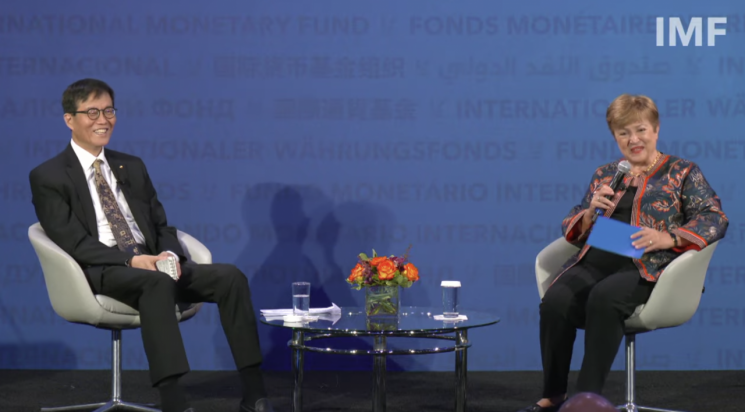 Lee Changyong, Governor of the Bank of Korea, and Kristalina Georgieva, Managing Director of the International Monetary Fund (IMF), are having a discussion on the 18th (local time) in Washington DC, USA, after the IMF Michelle Candace Central Bank Lecture. Screenshot from IMF YouTube live broadcast
"The Growing Share of Non-Bank Financial Institutions Is a Serious Issue... Korea's Neutral Rate Takes Financial Stability Into Account"
In a subsequent discussion with Kristalina Georgieva, Managing Director of the IMF, Governor Lee addressed the issue of relatively lightly regulated non-bank financial institutions, calling it "serious." He explained that Korea considers financial stability when setting the neutral interest rate, thus preferring to maintain a slightly higher rate than other countries. The neutral rate is the theoretical optimal rate that neither overheats nor depresses the economy and serves as a reference for central banks when determining policy rates.
He pointed out, "Non-bank financial institutions have grown rapidly and now account for more than 50% of Korea's financial market, but regulation remains relatively lax. There are many deposits outside the coverage of guarantees, and if a bank run occurs, it could spread much faster." Governor Lee emphasized, "Unlike large countries with resilient financial sectors, for countries like Korea, financial stability is a critical issue. When considering the neutral rate, we include the goal of financial stability, so we want to maintain a slightly higher rate than other countries over the medium to long term."
He also reaffirmed his position on stablecoins in response to related questions. He said, "I do not agree with the argument that Korea must issue a won-denominated stablecoin to counter dollar-denominated stablecoins, or else the Korean economy could become dependent on the dollar, but there is currently considerable discussion on the topic. I am concerned that stablecoins could undermine trust in the currency." Governor Lee pointed out, "If won-denominated stablecoins are permitted, it would allow people overseas to hold won deposits, which would effectively mean capital liberalization-a policy not currently allowed in Korea."
This lecture is the IMF's highest-level annual event, named after its longest-serving Managing Director, Michel Camdessus (January 1987-February 2000). By taking the stage at the Candace Lecture, Governor Lee joined the ranks of central bank governors who have participated in all three of the world's major central bank events: the Federal Reserve's Jackson Hole meeting, the European Central Bank's Sintra Forum, and the IMF Candace Lecture. Only four central bank governors in history, including former ECB President Mario Draghi and former Bank of England Governor and Canadian Prime Minister Mark Carney, have appeared at all three events before.
© The Asia Business Daily(www.asiae.co.kr). All rights reserved.
![User Who Sold Erroneously Deposited Bitcoins to Repay Debt and Fund Entertainment... What Did the Supreme Court Decide in 2021? [Legal Issue Check]](https://cwcontent.asiae.co.kr/asiaresize/183/2026020910431234020_1770601391.png)
















