Small Payment Fraud Victims Rise to 362, Damages Reach 240 Million Won... Full Compensation Provided
20,000 Customers Who Received Illegal Base Station Signals to Receive Free USIM Replacement and Insurance
"Evidence of IMSI, IMEI, and Phone Number Leaks... Authentication Key Remains Secure, Cloned Phones Impossible"
"Immediate Blocking and Retrieval of 43,000 Unused Devices Among 189,000 Femtocells"
"Security Investment Plan of 1 Trillion Won Over 5 Years to Be Reprioritized... Focus on Device and Mobile Service Security"
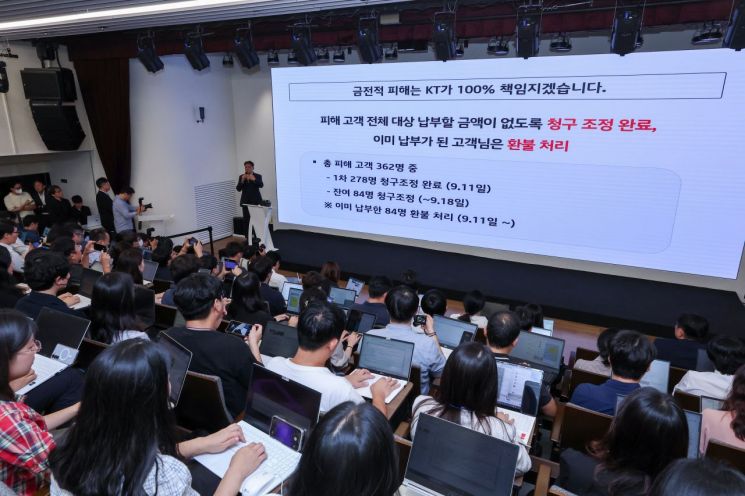
On September 18, KT addressed the recent incidents involving small payment fraud and personal data leaks caused by the misuse of illegal micro base stations (femtocells), stating, "There is absolutely no possibility of illegal cloned phones being created, as the USIM authentication key has not been leaked." The company announced large-scale customer protection measures, including free USIM replacement for all approximately 20,000 customers who received illegal base station signals, as well as providing insurance that guarantees protection against financial fraud for three years.
During a briefing held on the same day, KT reported that the number of customers affected by small payment fraud had increased from the initially reported 278 to 362, and the total amount of damages had risen from 170 million won to 240 million won. While the company emphasized that no additional damage had occurred since abnormal payment patterns were blocked on September 5, the scale of the damage expanded as the scope of the investigation widened.
The number of illegal base station IDs also increased from two to four. It was found that a total of 20,030 customers had received these signals. In addition to the previously identified international mobile subscriber identity (IMSI), further evidence of leaks involving the international mobile equipment identity (IMEI) and phone numbers was also confirmed. However, the company drew a clear line regarding concerns about cloned phones raised by some, explaining that the USIM authentication key is stored in an encrypted state both inside the USIM and on KT's servers, and has not been leaked. Therefore, the possibility of producing cloned phones has been effectively blocked. Son Jungyeop, Head of Device Business Division, emphasized, "Creating an illegal cloned phone requires all three values: IMSI, IMEI, and the authentication key. The authentication key exists only inside the USIM and on the server, and it is not transmitted during communication. It is impossible to create a cloned phone with only the IMEI and IMSI."
KT will fully compensate affected customers for all fraudulent small payment charges, support free USIM replacement, and help them enroll in USIM protection services. In particular, the company will provide all 20,000 customers who received illegal base station signals with three years of free coverage under the "KT Safe Assurance Insurance" (tentative name), which guarantees compensation for financial fraud. KT is working in partnership with Hyundai Marine & Fire Insurance and DB Insurance to develop this product, and is designing the coverage to focus on financial fraud committed through mobile phones.
More than 2,000 KT stores nationwide will be converted into "Safe Assurance Specialty Stores." Customers who visit these stores will receive tailored security checks, including malicious app detection, voice phishing response guidance, and small payment blocking. Each store will designate a dedicated security staff member to provide consultation and support.
KT currently operates about 189,000 femtocells, of which 43,000 units with no connection history in the past three months have already been blocked. KT stated, "Within two weeks, we will conduct a full inspection, retrieve long-term unused equipment, and permanently block lost devices." The company also emphasized, "We have now upgraded our management system so that illegal base stations can no longer connect to the network."
Regarding the possibility of insider involvement, KT stated, "We will monitor the police investigation and the joint public-private investigation team's analysis and prepare additional measures as needed." Some suspects have already been apprehended, and the specific causes and methods are expected to be revealed as the police investigation progresses.
KT recently announced a security investment plan of 1 trillion won over the next five years, and in light of this incident, the company stated that it would reprioritize its initiatives. Hwang Taeseon, Head of Information Security, said, "It is necessary to improve not only our aging infrastructure but also our processes. We will focus our investments on device security and mobile service security, and strengthen our security governance."
Kim Younggeon, Head of Service Product Division, reiterated, "We will fully compensate affected customers for their financial losses and alleviate their concerns through USIM replacement and insurance support. Even if additional cases emerge, we will take responsibility and provide compensation."
© The Asia Business Daily(www.asiae.co.kr). All rights reserved.

















