Tariffs on Semiconductors and Pharmaceuticals:
Closely Monitoring the US Supreme Court Ruling on Reciprocal Tariffs
Guidance on Support Measures for Companies Affected by Tariffs from Export Support Agencies
On September 18, the Korea International Trade Association held the "Support Briefing for Export Companies Responding to US Tariffs" at the Trade Tower in Samseong-dong, Gangnam-gu, Seoul, in collaboration with the Ministry of Trade, Industry and Energy, the Korea Trade-Investment Promotion Agency (KOTRA), and the Korea Trade Insurance Corporation.
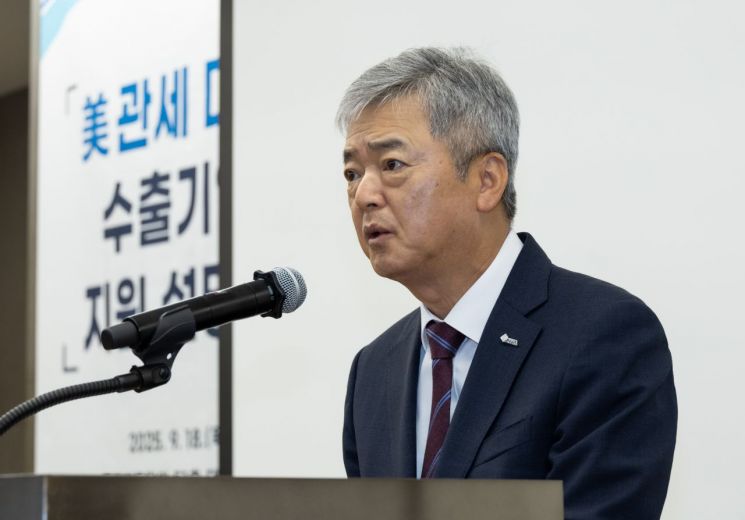 Lee Inho, Vice Chairman of the Korea International Trade Association, is delivering the opening remarks at the "US Tariff Response Export Company Support Briefing," jointly hosted by the Ministry of Trade, Industry and Energy, KOTRA, and the Korea Trade Insurance Corporation at Trade Tower in Samseong-dong, Gangnam-gu, Seoul, on the 18th. Provided by the Korea International Trade Association
This briefing was organized to strengthen the response capabilities of Korean exporters to the United States who are facing challenges due to reciprocal tariffs imposed under the US International Emergency Economic Powers Act (IEEPA) and item-specific tariffs based on Section 232 of the Trade Expansion Act. Approximately 200 representatives from exporting companies attended the event.
The briefing focused on key issues that Korean companies exporting to the United States must be aware of, including practical considerations regarding tariffs based on the main points of the Korea-US trade agreement reached at the end of July, as well as legal and contractual risk management.
Cho Seongdae, Head of the Trade Research Division at the Korea International Trade Association, who delivered the first presentation, emphasized the need to closely monitor whether the United States will impose tariffs on semiconductors and pharmaceuticals as previously announced, the possibility of expanding tariffs to steel and auto parts, and the upcoming ruling by the US Supreme Court on the legality of reciprocal tariffs expected by the end of the year.
Shim Jongseon, Partner at Deloitte Anjin LLC, stressed that in the current confusing situation where even US Customs cannot provide clear guidelines on item-specific tariffs, Korean companies must thoroughly prepare documentation to prove the rationality of their calculation methods for determining the value of steel and aluminum content.
Kim Sungjoong, attorney at Kim & Chang, advised companies to be cautious to avoid suspicion of indirect exports via low-tariff countries when exporting to the United States, and to use Incoterms such as CIF and FOB to clearly define tariff liability in contracts. He also added that companies should specify in detail how to share any future changes in tariff rates.
After the expert presentations, the export support agencies introduced support programs for companies affected by US tariffs, including trade finance, consulting, and alternative market development. In addition, more than 60 companies that applied in advance received one-on-one consultations with professional customs agents. Participating companies raised a variety of questions, including methods for calculating the content of steel and aluminum derivative products, US import clearance and origin verification procedures, taxation on commercial samples, ways to reduce tariff burdens depending on contract terms, and case studies on determining origin by type when exporting processed foreign parts and materials.
Lee Inho, Vice Chairman of the Korea International Trade Association, stated, "I hope this briefing will help minimize industry damage from US tariffs and enhance companies' ability to respond," adding, "We will continue to closely monitor the impact of US tariffs so that export support agencies can provide customized support that meets the needs of the industry."
© The Asia Business Daily(www.asiae.co.kr). All rights reserved.
![Clutching a Stolen Dior Bag, Saying "I Hate Being Poor but Real"... The Grotesque Con of a "Human Knockoff" [Slate]](https://cwcontent.asiae.co.kr/asiaresize/183/2026021902243444107_1771435474.jpg)
















