408 Billion Won Prepaid for Brand and Technology Royalties, 25.7 Billion Won Written Off as Losses
Failed Attempt to Penetrate Korea's Coffee Mix Market, Final Dividend of 10.4 Billion Won Paid to Shareholders
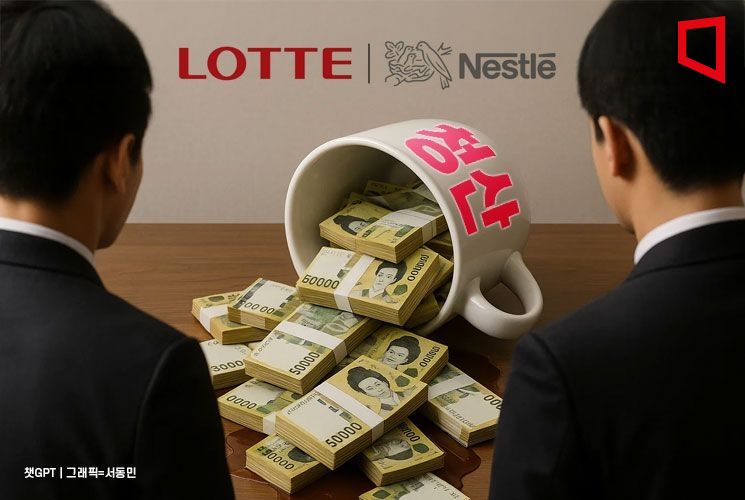
Lotte and Nestle, who joined forces to launch the joint venture Lotte Nestle Korea, have entered the liquidation process. When it was established in 2014, the partnership between a 'global food giant' and a 'domestic distribution powerhouse' drew significant market attention. However, after failing to overcome the formidable barriers of the Korean instant coffee market, the company is now closing its doors with losses after 11 years.
Out of the total paid-in capital and capital surplus of 153 billion won contributed by shareholders, as much as 135.3 billion won has been depleted. The amount remaining on the books is 17.5 billion won. Of this, the company returned 10.4 billion won to shareholders under the name of a 'final dividend.' Lotte Wellfood and Nestle each hold a 50% stake in the company.
According to the Financial Supervisory Service's electronic disclosure on September 22, Lotte Nestle Korea carried out a capital reduction without consideration in May. The company explained, "A capital reduction without consideration does not provide monetary compensation to shareholders. It is a measure to resolve capital impairment and enable shareholder dividends." The scale of the capital reduction was unprecedented. The number of issued common shares plummeted from 5,268,312 to just 10,000, and capital shrank from 52.8 billion won to 100 million won. The reduction ratio reached 99.81%. Although the number of shares held by shareholders was effectively reduced to one-hundredth, their ownership percentages remained unchanged.
This procedure was necessary because, under the Commercial Act, dividends cannot be paid if there are accumulated deficits. In the case of Lotte Nestle Korea, an existing deficit of 72.3 billion won combined with a net loss of 63 billion won in the first half of this year, resulting in a total accumulated loss of 135.3 billion won.
The net loss of 63 billion won in the first half is different from a simple operating loss. Since the company prepared its accounts on the premise of liquidation, it reflected retirement benefits, liquidation costs, and asset impairment losses all at once. After offsetting these against the paid-in capital of 153 billion won, the remaining amount was 17.5 billion won. By reducing capital and capital surplus through the capital reduction, and clearing the losses, the accumulated deficit on the books was brought down to zero.
The remaining 17.5 billion won was recorded as retained earnings, of which 10.4 billion won was immediately confirmed as a dividend. This dividend did not come from profits generated through business activities. It is analyzed that this is closer to shareholders reducing their previously contributed capital and receiving back a portion of what remained in the process. An accounting industry source explained, "Shareholders covered the company's losses with their own money and split the remaining funds among themselves. After cleaning up the financial statements, a portion was converted to cash in the form of a dividend."
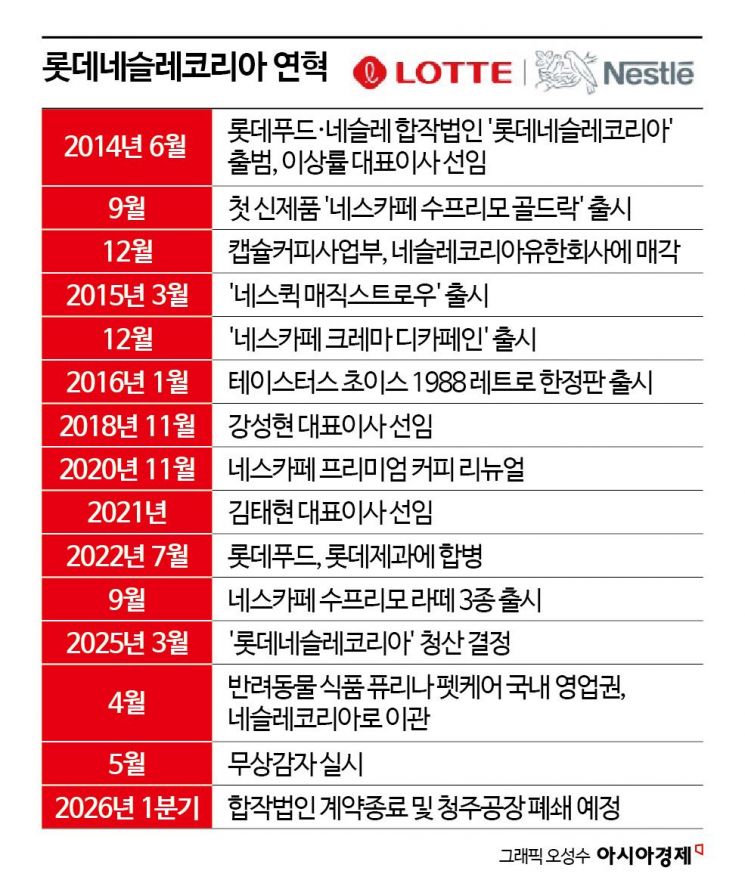
The roots of Lotte Nestle Korea lie in Nestle's Korean subsidiary. Nestle initially operated as a standalone entity, but in 2014, when Lotte Food (now Lotte Wellfood) participated in a paid-in capital increase, it was converted into a joint venture. At that time, Lotte injected 51.3 billion won in new capital, and Nestle contributed its existing capital, resulting in a 50-50 ownership structure.
At the time of launch, the book value of the investment stake exceeded 60 billion won, but as losses continued, it had dropped to 16.8 billion won as of the first half of this year. Due to the deteriorating financial structure, it is widely believed that the chances of recovering the investment are virtually nonexistent.
At its inception, Lotte Nestle Korea entered into a technology introduction agreement with its Swiss headquarters and prepaid 40.8 billion won, equivalent to half of the royalties to be paid over 30 years, as compensation for brand and technology use. However, during the liquidation process, 25.7 billion won of this amount could not be recovered and was treated as a liquidation loss. In the end, the funds that flowed out to headquarters never returned.
Lotte Nestle Korea attempted aggressive expansion with a variety of products, including Nescafe instant coffee, coffee mix, chocolate and fruit-flavored powdered beverages, and pet food. Nestle aimed to leverage Lotte's distribution network to increase market share, while Lotte sought to strengthen its competitiveness in the coffee sector by utilizing Nestle's product capabilities.
However, the market was unforgiving. The Korean instant coffee market remained an 'impregnable fortress' dominated by Dong Suh Foods. According to market research firm Nielsen, as of the end of last year, Dong Suh Foods held an overwhelming 90.8% share in the coffee mix market, followed by Namyang Dairy Products at 5.6%, while Lotte Nestle Korea remained at 1.5%. In the instant coffee market, Dong Suh Foods had 75%, Nestle 19.1%, and Namyang Dairy Products 0.1%.
Performance also stagnated. Sales fell from 284.4 billion won in 2014 to 256.9 billion won last year. After five consecutive years of losses following the joint venture, the company finally turned a profit of 3.4 billion won in 2019, but by then, accumulated deficits had already exceeded 70 billion won. Last year, operating profit increased to 11 billion won, but it was not enough to dispel the 'shadow of losses.'
A food industry official commented, "The Korean instant coffee market is characterized by strong brand loyalty and entrenched consumption habits, making it difficult for latecomers to break through," adding, "The liquidation of Lotte Nestle Korea is a case that illustrates the realities of the market."
© The Asia Business Daily(www.asiae.co.kr). All rights reserved.
![Clutching a Stolen Dior Bag, Saying "I Hate Being Poor but Real"... The Grotesque Con of a "Human Knockoff" [Slate]](https://cwcontent.asiae.co.kr/asiaresize/183/2026021902243444107_1771435474.jpg)


















