Chun Hyunhee, Chair of the Special Committee for the Three Major Special Prosecutions
"We Have Eliminated Any Possibility of Unconstitutionality"
The Democratic Party's Special Committee for Comprehensive Response to the Three Major Special Prosecutions (hereafter referred to as the Special Committee) has emphasized distrust in the judiciary and proposed a bill to establish a dedicated court division for insurrection and state corruption cases.
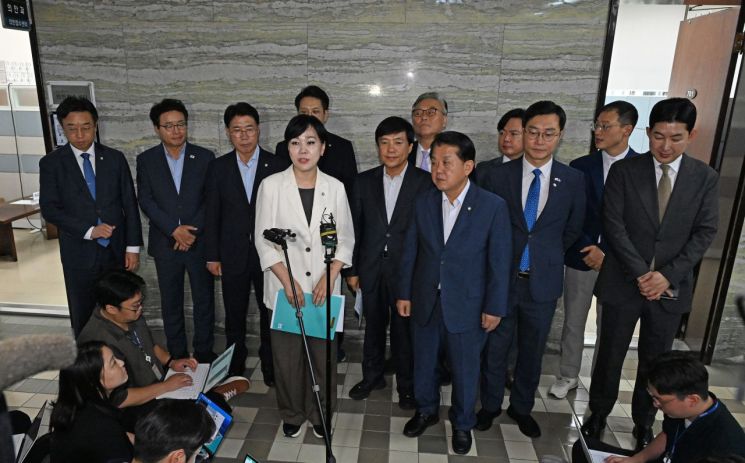
On September 18, in front of the Bill Division of the National Assembly main building in Yeouido, Special Committee Chairperson Chun Hyunhee, who is also a Supreme Council member, stated, "The Special Committee has introduced and submitted a bill to establish a dedicated court division for insurrection and state corruption cases." The bill was sponsored by Assemblyman Lee Sungyoon.
The core of the bill is to assign three judges each to the dedicated court divisions and appellate divisions, as well as to the judges in charge of warrants, for the three ongoing special prosecutions (insurrection, Kim Keonhee, and Chae Haebyeong). To form these dedicated court divisions and appoint the judges in charge of warrants, a candidate recommendation committee will be established, consisting of nine members (including one chairperson): one recommended by the Ministry of Justice, four recommended by the judicial council, and four recommended by the Korean Bar Association.
Chun emphasized, "The bill proposed by the Special Committee is focused on completely eliminating any possibility of unconstitutionality, which has been the most controversial issue so far." She explained, "According to Article 101 of the Constitution, 'the qualifications of judges are prescribed by law.' The spirit of the Constitution is to ensure that citizens receive fair trials by judges as prescribed by law."
Chun also addressed concerns, saying, "Some have pointed out that granting the National Assembly the authority to recommend judges violates the separation of powers. However, since trials are conducted by judges stipulated by law, there is no risk of unconstitutionality in having the National Assembly recommend judges. Nevertheless, in consideration of opinions that this could violate the separation of powers, the National Assembly has been excluded from the judge recommendation process in this bill."
Chun further added, "There are also claims that this bill is unconstitutional because it violates the principle of random assignment of cases, but this is completely unfounded. In a situation where trust in the judiciary has collapsed and public distrust is high, the fairness that random assignment is supposed to ensure has effectively been undermined. Therefore, the purpose of this bill is to form a fair court division in accordance with the law."
The bill also stipulates that those convicted by the dedicated court division for insurrection and state corruption cannot receive pardons, commutations, or restoration of rights. According to Article 79 of the Constitution, the authority to grant pardons, commutations, and restoration of rights belongs to the President. When asked by a reporter whether this provision violates the Constitution, Chun responded, "This does not restrict the President's authority to grant pardons itself, but rather specifies the eligibility for receiving pardons, so it is unrelated to the issue of constitutional violation."
© The Asia Business Daily(www.asiae.co.kr). All rights reserved.

















