Seo Mihwa Calls for Stronger Monitoring and Enforcement by the Ministry of Food and Drug Safety
More than 100 cases of exaggerated advertisements and illegal sales of obesity treatments such as Wegovy were found online in just the first half of this year.
 A notice saying "Wegovy In Stock" is posted at a pharmacy in Jongno-gu, Seoul. Photo by Kang Jinhyung
According to data submitted by Seo Mihwa, a member of the National Assembly's Health and Welfare Committee from the Democratic Party of Korea, to the Ministry of Food and Drug Safety on September 18, there were a total of 111 cases of violations related to obesity treatment advertisements (including violations of the ban on exaggerated advertising) and illegal distribution (including violations of the ban on brokering and advertising) detected between January and July this year.
By product, "Wegovy Prefilled Pen" accounted for the highest number with 55 cases. This was followed by "Saxenda," "Saxenda Pen Injection," and "Saxenda Pen Injection 6mg" with 18 cases, "Ozempic" and "Orlistat" with 9 cases each, and "Xenical" with 5 cases. By platform, general online shopping malls topped the list with 34 cases, followed by Naver Blog (22 cases), Naver Cafe (18 cases), YouTube (9 cases), X (6 cases), Instagram (5 cases), and the cross-border shopping platform Qoo10 (4 cases). Coupang was also found to have 2 cases.
By type of violation, advertising violations (including violations of the ban on exaggerated advertising) were the most common, with 50 cases. This was followed by illegal distribution (including violations of the ban on brokering and advertising) with 44 cases. There were also 10 cases of violations of the ban on sales and similar activities, and 7 cases of violations related to the sale of pharmaceuticals.
The Ministry of Food and Drug Safety requested that access to these sites be blocked. Since Wegovy was launched in Korea in October last year, the ministry has been intensively monitoring illegal sales and advertisements of obesity treatments. It has blocked overseas direct purchases of glucagon-like peptide-1 (GLP-1) obesity treatments and is cracking down on illegal sales and advertisements of Wegovy on online platforms such as social networking services (SNS).
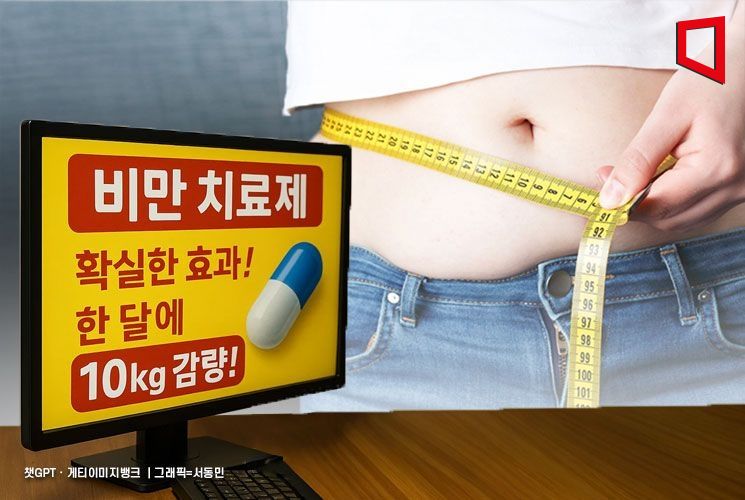
GLP-1 Is a Prescription Drug... Misuse Must Be Prevented
GLP-1 class injectable obesity treatments are prescription drugs. They are prescribed to adult obese patients with a body mass index (BMI) of 30 kg/m² or higher, or to overweight patients with a BMI of 27-30 kg/m² who also have at least one weight-related comorbidity such as hypertension.
Even when used within the approved indications, gastrointestinal side effects such as nausea, vomiting, diarrhea, and constipation, as well as injection site reactions like rash, pain, and swelling, can commonly occur. Cases of hypersensitivity, hypoglycemia, acute pancreatitis, cholelithiasis, and fluid depletion have also been reported. If used by underweight or normal-weight individuals, the blood concentration of the drug relative to body weight increases, raising the risk of adverse effects.
However, as the weight loss effect has been highlighted, interest in obesity treatments is growing, and illegal distribution and advertising cases are also on the rise. In 2024 alone (from January to December), there were 522 cases of illegal distribution and advertising violations related to obesity treatments. Before Wegovy was launched in Korea in 2023, there were only 103 such cases.
As it is expected that major obesity treatments may be prescribed to adolescents in the future, there are calls to strengthen crackdowns on illegal advertising and distribution to prevent misuse. Seo Mihwa stated, "Despite the Ministry of Food and Drug Safety's checks on illegal advertising from pharmaceuticals to new drugs, illegal distribution, brokering, and advertising of obesity treatments remain rampant," and urged, "Rather than simply blocking sites amid a flood of SNS advertisements, the ministry's inspections and enforcement must be further strengthened."
© The Asia Business Daily(www.asiae.co.kr). All rights reserved.


















