China Orders Companies to Refrain from Using Nvidia's Latest AI Chips
Antitrust Probe Launched Into 2020 Mellanox Acquisition
Nvidia's China Revenue Accounts for 13% of Total Sales
China's internet regulatory authorities have instructed companies to refrain from using Nvidia's latest artificial intelligence (AI) chips, raising concerns that Nvidia's sales in China will face significant setbacks. China accounted for about 13% of Nvidia's total revenue last year, making it a key market, and industry observers predict that a substantial shortfall in short-term earnings is inevitable.
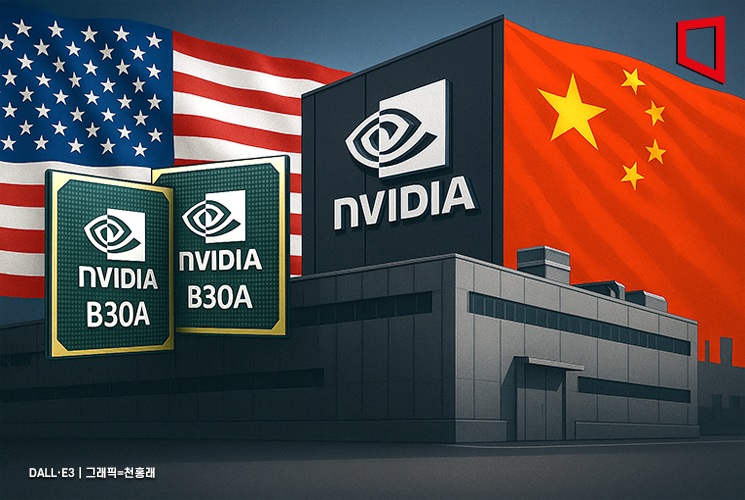
On September 17 (local time), the Financial Times cited three sources, reporting that the Cyberspace Administration of China (CAC) has notified companies such as ByteDance and Alibaba to halt testing and orders of the low-spec China-exclusive AI chip, the "RTX 6000D," starting this week. This chip was designed for industrial AI applications and was personally unveiled by Nvidia CEO Jensen Huang during his visit to Beijing in July.
The Wall Street Journal commented, "This measure is part of a series of pressures targeting Nvidia, which has emerged as the world's most valuable company," and added, "The US-China trade war has drawn the top US market cap company even deeper into the fray."
This action marks a stronger regulatory move than the restrictions China has imposed since last year on the high-performance AI chip "H20." While the H20 regulation was limited to a specific chip, the RTX Pro 6000D directive targets Nvidia chips more broadly, representing a tougher stance. Previously, the Trump administration controlled exports of the H20, but during US-China trade negotiations last July, some sales were allowed, although actual shipments have not taken place. Nvidia agreed to pay 15% of its China sales revenue to the US government as a condition for export approval, but the relevant regulations have not yet been finalized.
Additionally, this week, Chinese authorities released preliminary findings that Nvidia violated the country's antitrust laws in connection with its 2020 acquisition of Mellanox. These actions are seen as a message that China is unwilling to rely on Nvidia's older chips while following US export controls, and as a strategy to gain leverage in US-China negotiations.
When asked about the issue in London, CEO Huang stated, "We can only play a role in the market when that country wants us to," and added, "It is disappointing because we have contributed greatly to the Chinese market, but I understand there are bigger issues between the US and China." He went on to describe Nvidia's recent business experience in China as "like a roller coaster," and explained, "I have instructed analysts to exclude China from future financial outlooks." This statement is seen as an acknowledgment that stable revenue from the Chinese market can no longer be expected.
Some analysts predict that Nvidia will find it difficult to expect any revenue from new products in China this year, including the RTX Pro 6000D and H20. On this day, Nvidia's stock price fell by 2.6% on the New York Stock Exchange, reflecting investors' concerns over this short-term revenue decline. For Nvidia, China remains an indispensable core market. According to Reuters, China's share of Nvidia's revenue last year was about 13%.
© The Asia Business Daily(www.asiae.co.kr). All rights reserved.

















