'Living Witness of K-Shipbuilding' Shin Dongsik, Chairman of Korea Maritime Technology
"An Asset Tied to National Hegemony... Alliance Alone Is Not Enough"
"Technological Superiority Must Be Maintained... Long-Term Investment Is Essential"
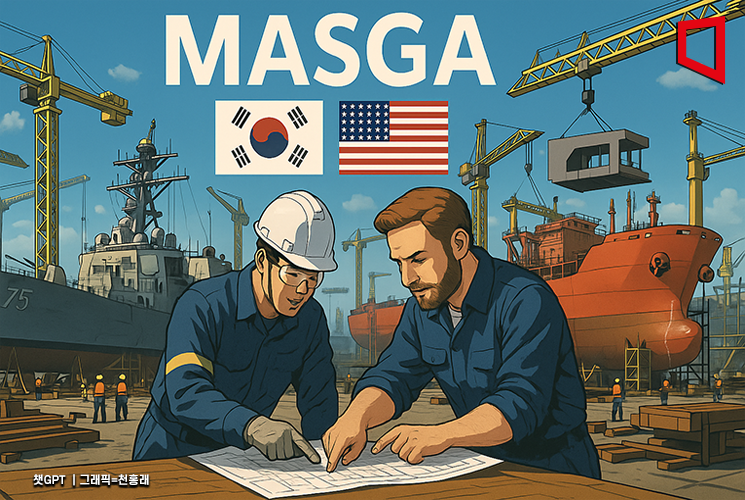
Shin Dongsik, Chairman of Korea Maritime Technology (pictured), a living witness to more than half a century of Korea's shipbuilding success story, emphasized the need for thorough preparation regarding the Korea-U.S. shipbuilding cooperation project MASGA (Make American Shipbuilding Great Again). He stated, "Korea cannot take the lead unless it matches the meticulousness of American-style manuals." Chairman Shin was a key figure who designed the blueprint for Korea's shipbuilding industry during the Park Chung-hee administration, turning the national vision of becoming a 'shipbuilding powerhouse' into reality and making significant contributions to the construction of the Okpo Shipyard in Geoje. This marked the beginning of Korea's rise to become the world's number one shipbuilding nation in just over 50 years. The MASGA project is expected to provide another quantum leap for Korea's shipbuilding industry.
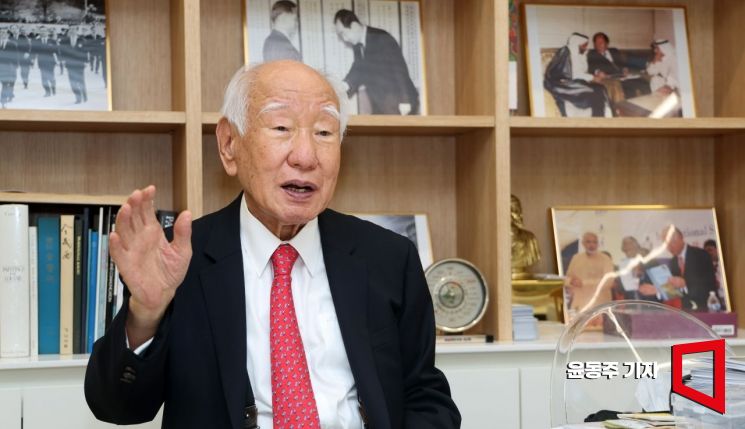 Shin Dongsik, Chairman of Korea Maritime Technology, is being interviewed by Asia Economy. Photo by Yoon Dongju
In an interview with Asia Economy on September 16, Chairman Shin stressed, "Shipbuilding is not simply an industry that builds ships; it is a strategic asset tied to national hegemony." He added, "It is not persuasive enough to just say 'let's work with the United States' or 'let's strengthen the alliance.' Korea and the U.S. must create a blueprint that brings practical benefits to both sides." During the interview, he also proposed concrete methods of cooperation. He emphasized the need to demonstrate a willingness to secure production bases in the United States by building new shipyards, expanding existing ones, or acquiring them, and to clarify the extent to which Korea can participate in military and commercial ship maintenance, repair, and overhaul (MRO) cooperation.
He noted that the strengthening of the U.S. shipbuilding industry represents an opportunity for Korea. In the past, the United States was shocked by the Soviet Union's launch of the Sputnik satellite and invested in space, IT, and shipbuilding and marine industries, but ultimately failed in shipbuilding. The U.S. lost its capabilities to build both military and commercial vessels, and its competitiveness rapidly declined due to the Jones Act, which mandates that only ships built in the U.S. and owned by Americans can be used for domestic shipping. He recalled, "President Donald Trump was very surprised when he saw the world's largest crane during his visit to a Korean shipyard," adding, "That experience must have left a strong impression of Korea's shipbuilding industry."
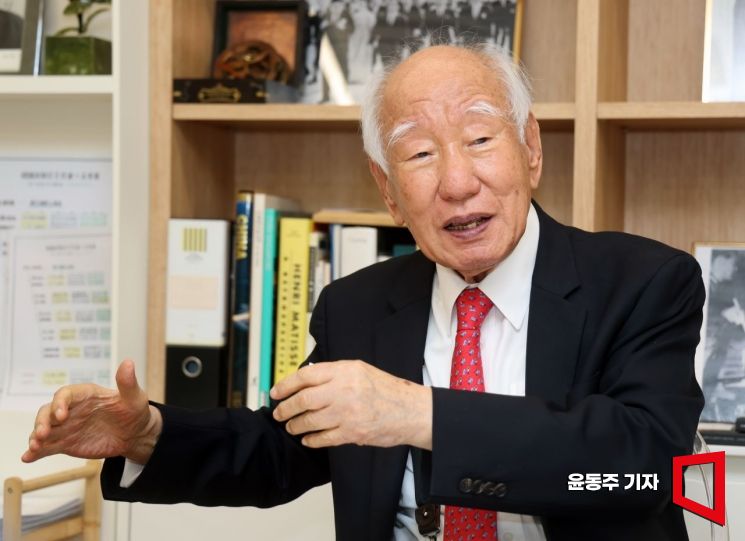 Shin Dongsik, Chairman of Korea Maritime Technology, is being interviewed by Asia Economy. Photo by Yoon Dongju
Chairman Shin suggested that for Korea's shipbuilding industry to continue growing, it needs a strong control tower to maintain a technological lead, bold investment in research and development (R&D), and the cultivation of talent.
He said, "To become a first mover, bold investment in scientific and technological research institutes is necessary. The government's current method of providing one-off R&D funding is insufficient. Long-term and consistent investment is required," he emphasized.
He also advised that shipbuilding should be redefined as a 'century-long plan' industry connected to the national ecosystem. "Building a single shipyard requires 50,000 people, and including their families, you need to design a city for 150,000 residents," he said. "Designing an ecosystem that includes hospitals, schools, and post offices is essentially the same as nation-building." Reflecting on the resilience of Korea's shipbuilding industry, which has endured for over 60 years, Chairman Shin said, "Having achieved world number one from barren ground, nothing is impossible even now."
© The Asia Business Daily(www.asiae.co.kr). All rights reserved.



















