Laying the Foundation for Next-Generation Artificial Intelligence Technology
The research team led by Professor Hongseop Lee of the Department of Materials Science and Engineering at Kyung Hee University announced on September 17 that they have developed a new semiconductor device that is expected to become a key component of next-generation artificial intelligence hardware.
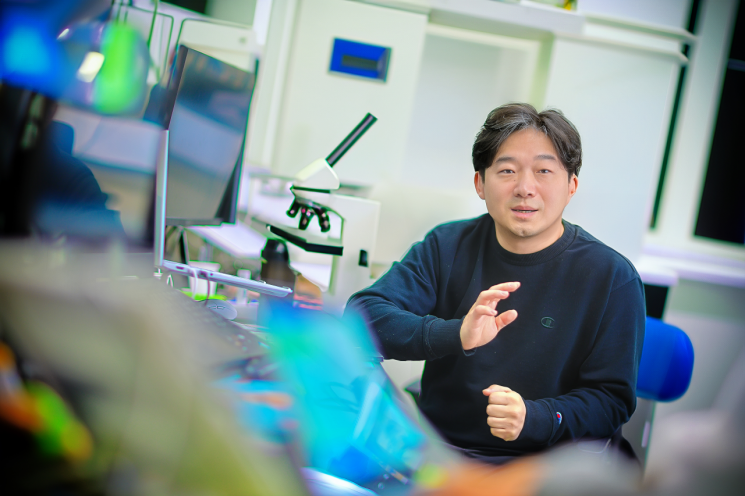 Professor Hongseop Lee, Department of Materials Science and Engineering, Kyung Hee University. Kyung Hee University
The results of this research have been published online in the international academic journal Advanced Materials.
The memtransistor is a portmanteau of “memristor” and “transistor,” and refers to a device that can control the flow of current like a switch while also storing information. By enabling simultaneous processing of computation and memory, it can shorten the processing time compared to conventional computers.
The research team developed an ion migration-based memtransistor using lithium (Li). While conventional memtransistors required a high voltage of 60 to 80 volts, the newly developed device operates at voltages below 3 volts.
The team inserted a lithium layer beneath the electrode and performed heat treatment to control the barrier between the electrode and the channel, successfully achieving stable memory functionality.
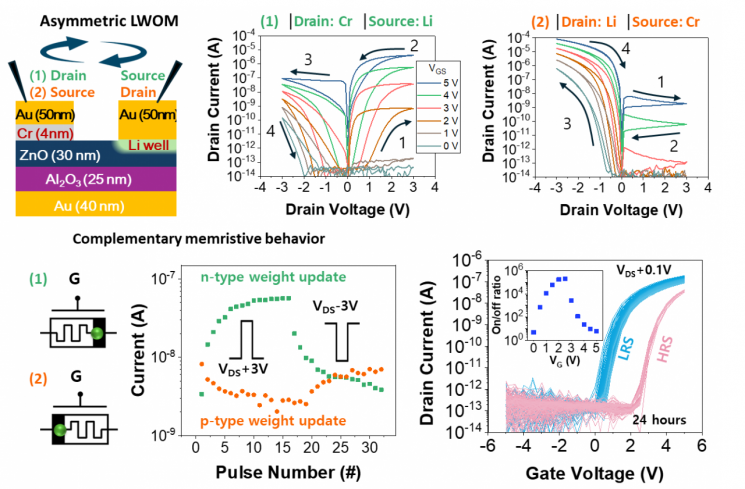 Schematic diagram of the structure of a lithium-based memtransistor (Li well memtransistor) device and the non-volatile weight update characteristics controllable by the gate terminal. Kyung Hee University
This device exhibits analog memory characteristics similar to the way the human brain processes information. As a result, it enables flexible and rapid processing with low power consumption during artificial intelligence training that requires large-scale data computation. In particular, the zinc oxide (ZnO) used in the semiconductor device is highly compatible with semiconductor fabrication processes.
Additionally, the team fabricated an array structure based on the developed device and conducted experiments. As a result, 438 out of 441 devices precisely reached the target value, achieving a high yield rate of 99.31%.
Professor Lee stated, “This demonstrates the potential of neuromorphic semiconductor devices that combine low power consumption with high reliability,” and predicted, “It will be utilized as a core component in next-generation artificial intelligence semiconductors.”
Meanwhile, this research was supported by the Young Researcher Program and the Nano and Materials Technology Development Program of the Ministry of Science and ICT, as well as the Gyeonggi Regional Cooperation Research Center.
© The Asia Business Daily(www.asiae.co.kr). All rights reserved.


















