Hyundai Motor and Kia Develop Wireless Communication Technology for Smart Factories
Patent Applications Filed for Wi-Fi 6 and P-5G Technologies
Hundreds of Robots Operate Without Communication Interruptions
On September 17, Hyundai Motor and Kia introduced state-of-the-art wireless communication technology, a core component of smart factories where hundreds of robots are deployed.
Hyundai Motor and Kia have become the first in the world to develop a wireless connectivity device capable of simultaneously processing both Wi-Fi 6 and P-5G (Private-5G), and have filed patents for this technology in both Korea and the United States. This communication technology has been applied to Hyundai Motor’s Ulsan plant and Hyundai Motor Group’s Meta Plant America (HMGMA) in the United States since the end of last year.
The factories operated by Hyundai Motor and Kia feature not only various production robots, but also logistics robots such as AGVs (Automated Guided Vehicles) and AMRs (Automated Mobile Robots) that transport parts within the plant, as well as Boston Dynamics’ Spot, which detects hazards. All of these advanced robots operate on wireless communication networks.
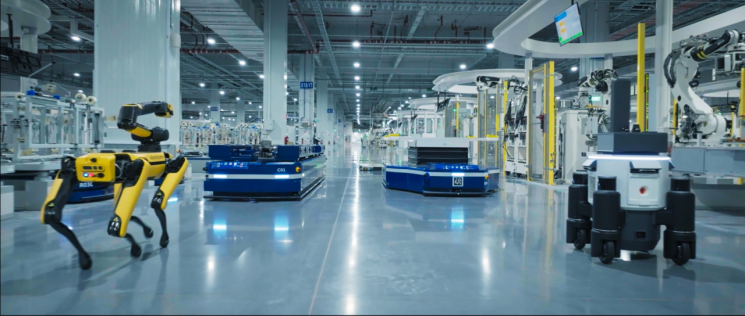 Robot deployed at Hyundai Motor Group's Meta Plant America (HMGMA). Provided by Hyundai Motor Group.
These devices do not simply move according to preset instructions; they must respond to changing situations in real time. Above all, wireless communication stabilization technology is essential for robots to operate along precise routes at the exact required moments.
Previously, separate devices existed to process Wi-Fi and mobile networks individually, so only one could be installed on a robot. In such cases, if a communication failure occurred, the robot would stop operating.
As Hyundai Motor and Kia’s production plants have rapidly automated, the volume of robot communications has increased exponentially. As a result, it has become crucial to diversify and stabilize communication channels to prevent network congestion from causing disruptions.
By developing and applying the integrated Wi-Fi 6 and P-5G device, Hyundai Motor and Kia have dramatically reduced the number, size, weight, and cost of the devices. If a failure occurs on the P-5G network, the system immediately switches to Wi-Fi 6 to maintain communication, thereby solving potential communication interruption issues.
Currently, Hyundai Motor and Kia are also developing an integrated device technology that supports Wi-Fi 7, which offers superior speed and stability compared to Wi-Fi 6. They plan to complete development early next year and install the technology in domestic and overseas plants to maximize production efficiency.
© The Asia Business Daily(www.asiae.co.kr). All rights reserved.
![Clutching a Stolen Dior Bag, Saying "I Hate Being Poor but Real"... The Grotesque Con of a "Human Knockoff" [Slate]](https://cwcontent.asiae.co.kr/asiaresize/183/2026021902243444107_1771435474.jpg)
















