August MPC Minutes Released: "Expectations for Rising Home Prices Remain"
"Rate Cuts Should Not Fuel Housing Price Expectations"
Sustained Interest in Preferred Districts Such as Gangnam, Riverside Areas, and Newly Built Properties
Economic Conditions and Housing Prices to Remain Key Variables in October Rate Decision
"While the scale of household debt growth has decreased, it is difficult to determine whether the housing market is showing a trend of stability." The Bank of Korea's Monetary Policy Committee decided to keep the base interest rate at 2.50% per annum last month, largely due to the prevailing view that it was necessary to continue monitoring the stability of the housing market in Seoul and the greater metropolitan area, as well as household debt conditions. Although the rate of increase in housing prices in Seoul has slowed since the announcement of the June 27 household debt management measures, upward trends remain pronounced in preferred districts, particularly those associated with keywords such as Gangnam, riverside areas, and newly built properties. As a result, it is expected that housing prices will continue to be a key factor in the interest rate decision for October.
 Lee Changyong, Governor of the Bank of Korea, is reviewing documents at the Monetary Policy Committee meeting held at the Bank of Korea in Jung-gu, Seoul on August 28, 2025. Photo by Joint Press Corps
"Expectations for Rising Home Prices Remain" ... Housing Prices to Remain a Key Variable in October
According to the minutes of the August Monetary Policy Committee meeting released by the Bank of Korea on the 16th, a significant number of committee members expressed the view that policy responses should be made only after confirming whether market sentiment in the housing sector had stabilized, prior to making last month's rate decision. In the ongoing conflict between economic sluggishness and financial imbalances, the committee placed greater emphasis on financial stability.
One member noted, "The June 27 measures and similar policies have significantly reduced the pace of household debt growth and slowed the rate of increase in housing prices." However, the member also pointed out, "Expectations for a loosening of financial conditions and concerns about insufficient housing supply are sustaining expectations for rising home prices in some parts of the metropolitan area. Moreover, the rate of increase in housing prices remains higher than after previous policy announcements. Therefore, it is difficult to judge whether financial imbalances are showing a trend of stabilization." The member added that it is still premature to assess the market as having entered a stable trend, given supply constraints in Seoul, continued demand for owner-occupied housing, and additional investment demand stemming from expectations of domestic and international interest rate cuts.
Another member also pointed out, "The rate of increase in apartment prices in Seoul's preferred areas remains high, and expectations for further price increases persist, so we need to remain cautious and continue monitoring the situation." Yet another member emphasized, "Although the upward trend is limited to certain areas, it is continuing, so we should be mindful of the risk of rising instability. At this point, monetary policy should focus on the sustainability of stability in the housing market and household debt."
Housing prices are expected to remain a key variable in the October rate decision as well. According to the nationwide housing price trend survey released by the Korea Real Estate Board, the comprehensive sales price index for Seoul rose by 0.45% last month. This is a slowdown compared to June (0.95%) and July (0.75%), but the upward trend continues. In particular, districts such as Songpa-gu (1.20%), Yongsan-gu (1.06%), Seongdong-gu (0.96%), Seocho-gu (0.61%), and Mapo-gu (0.59%) showed marked increases. Interest remains strong, with steady inquiries from buyers, especially for preferred complexes such as newly built or soon-to-be-redeveloped properties. According to the most recent data, as of the second week of September, the sale price of apartments in Seoul rose by 0.09%, widening from the previous week's 0.08% increase.
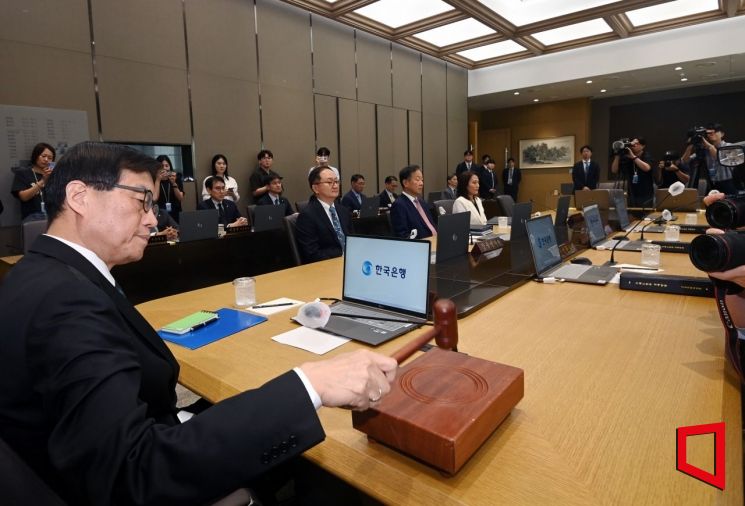 Lee Changyong, Governor of the Bank of Korea, is striking the gavel at the Monetary Policy Committee meeting held at the Bank of Korea in Jung-gu, Seoul on the morning of the 28th. 2025.08.28 Photo by Joint Press Corps
Strong Exports and Recovery in Consumption Ease Pressure to Cut Rates ... Tariff Risks Remain a Concern
Meanwhile, the rebound in domestic economic growth, driven by robust semiconductor-led exports and a recovery in private consumption, eased concerns about the decision to hold rates steady in August. Most committee members expect consumption to continue recovering in the near term, supported by improved economic sentiment and the effects of the supplementary budget. However, the construction sector remains sluggish. One member emphasized, "Rather than artificially stimulating the construction sector, it is time to accelerate restructuring efforts, such as resolving delayed real estate project financing (PF) issues, to improve fundamentals and achieve a rebound."
Domestic prices have risen for agricultural, livestock, and fisheries products due to heavy rainfall and heat waves, but low demand pressure and falling international oil prices have kept inflation stable around the target level (2.0%). Many members expect inflation to remain fundamentally stable going forward.
The global economy is expected to gradually slow. While progress in trade negotiations between the United States and major countries has reduced uncertainty in the trade environment, it is anticipated that the impact of tariff increases will become more pronounced. Uncertainties remain high regarding unresolved tariff issues for items such as semiconductors and pharmaceuticals, as well as ongoing US-China trade negotiations, which continue to be areas of concern.
On the other hand, committee member Shin Sunghwan focused on economic sluggishness and expressed a minority opinion that it would be appropriate to lower the base rate by 0.25 percentage points to 2.25% in August. Shin stated, "Given that the timing of a rate cut has been delayed due to rising housing prices in the metropolitan area, it is appropriate to cut rates now, as the upward momentum has weakened compared to July." He added, "To reduce financial market instability and downside economic risks arising from some industrial restructuring scheduled for this year and ongoing real estate PF restructuring, it is desirable to create more accommodative financial conditions."
© The Asia Business Daily(www.asiae.co.kr). All rights reserved.


















