Ministry Plans to Raise Renewable Energy Targets
Offshore Wind Site Development, Solar Setback Distances to Be Abolished
Even 78 GW by 2030 Is Challenging; Concerns Over Moving Too Fast
No Nuclear Power Content Included, Increasing Policy Uncertainty
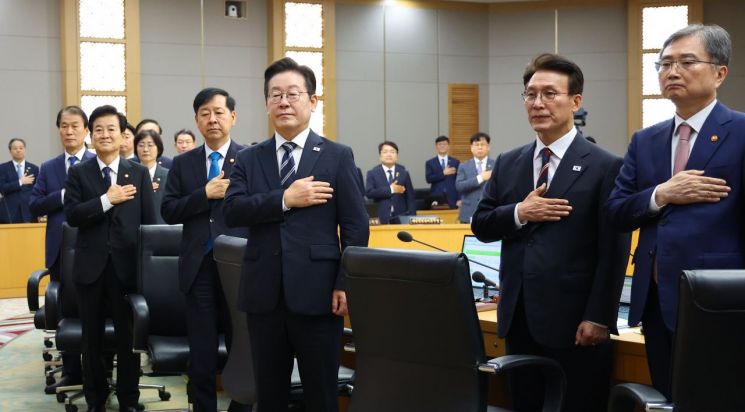 President Lee Jae-myung salutes the national flag at the 42nd Cabinet Meeting held at the Government Complex Sejong on September 16, 2025. Photo by Yonhap News Agency
The government has decided to raise its renewable energy deployment target, which was previously set at 78 gigawatts (GW) by 2030. To achieve this, it plans to significantly ease or abolish regulations on offshore wind and solar power. However, concerns have been raised that excessively increasing the target, even when the previously announced goal is already difficult to achieve, may lead to negative side effects caused by moving too fast. Content related to nuclear power, including small modular reactors (SMRs), has been removed from the list of national policy tasks.
On September 16, the government finalized 123 national policy tasks at a Cabinet meeting attended by President Lee Jaemyung. This is an adjustment and supplementation at the government level of the 123 major national policy tasks announced by the National Policy Planning Committee on August 13.
The Ministry of Trade, Industry and Energy announced that it would establish and implement a roadmap to increase the renewable energy target of 78 GW for 2030. While the National Policy Planning Committee had initially proposed supplying 78 GW of renewable energy by 2030 based on the 11th Basic Plan for Electricity Supply and Demand, the government has now raised the target even further.
As of June 2025, the domestic renewable energy facility capacity stands at 35.1 GW, making it challenging to reach 78 GW within five years.
The Ministry stated, "We will support this by diversifying the locations for offshore wind and solar power and improving the system by easing or abolishing setback distances."
Specifically, for offshore wind, the government plans to establish offshore wind complexes in the West Sea and Jeju by discovering planned sites, quickly creating cluster complexes, and streamlining the permitting process. For solar power, it will diversify locations to include industrial complexes, agrivoltaic sites, parking lots, and public land owned by local governments.
The government will gradually restructure the renewable energy supply system into a contract-based market and simplify the permitting process. It will introduce government-led planned sites, relax standards for radio wave impact assessments, and improve the permitting process for installing wind measurement devices.
The government will also promote the early commercialization of next-generation solar cells, technology development for offshore wind turbines and parts, the construction of installation vessels, and the establishment of dedicated ports. It plans to expand "sunlight and wind pensions" to increase local acceptance and pursue the enactment of a special law to provide exceptional incentives for RE100 industrial complexes.
The timeline for phasing out coal-fired power plants has been set for 2040, as pledged by President Lee Jaemyung.
This set of national policy tasks overseen by the Ministry of Trade, Industry and Energy does not include content related to nuclear power. In the nuclear industry, policy uncertainty is growing regarding major projects such as selecting sites for new nuclear power plants and extending the operation of existing plants.
The energy policy tasks announced on this day appear to have been influenced by President Lee Jaemyung's recent remarks.
At a press conference marking his 100th day in office on September 11, President Lee stated, "It takes 15 years to build a nuclear power plant, so we need to significantly expand renewable energy," and added, "Starting new nuclear power plants is not realistic." He also emphasized, "SMR technology has not been developed," and "We must massively construct wind and solar power, which can be completed in just one or two years." Previously, Minister of Environment Kim Seonghwan suggested that public discussion is necessary for new nuclear power plants.
The energy industry expects that the 12th Basic Plan for Electricity Supply and Demand, which is to be established by the end of next year, will see major strategic changes.
This set of national policy tasks also includes plans to build an "energy highway," featuring the early construction of high-voltage direct current (HVDC) transmission lines along the west coast and a U-shaped power grid across the Korean Peninsula. The government announced that it would gradually lift connection restrictions in the Honam region by expanding grid stabilization devices such as energy storage systems (ESS).
To accelerate the construction of power grids, the government will utilize private sector construction capacity and review improvements to the power grid operation and management system to enhance grid stability and efficiency. It plans to introduce a real-time market that can respond to power supply and demand instantly and to establish a regional electricity pricing system that differentiates rates by region. Currently, the Korea Power Exchange forecasts the next day's power demand one day in advance and instructs power generators to operate accordingly, but this will be changed to a real-time market.
The government also announced plans to strengthen the independence of the Electricity Regulatory Commission to establish a fair order in the electricity market. The commission currently reviews matters such as electricity rate adjustments, permits for electricity generation businesses, and the establishment or revision of the Basic Plan for Electricity Supply and Demand. There have been criticisms that, since it is under the Ministry of Trade, Industry and Energy, it cannot be free from government influence.
The government will also promote the activation of the ESS industry and actively utilize demand response (DR) resources for supply and demand management, thereby fostering climate technology. Demand response is a system in which electricity consumers are compensated for reducing consumption when demand is high and supply is limited, helping to supplement the volatility of renewable energy. The government will also build a clean hydrogen ecosystem and foster the heat pump industry.
The government also plans to provide support to achieve the national greenhouse gas reduction target (NDC) for the industrial sector by 2035. It will conduct preliminary feasibility studies for large-scale research and development (R&D) in areas such as hydrogen-based steelmaking (steel industry), bio, and feedstock conversion (petrochemicals).
© The Asia Business Daily(www.asiae.co.kr). All rights reserved.
![Clutching a Stolen Dior Bag, Saying "I Hate Being Poor but Real"... The Grotesque Con of a "Human Knockoff" [Slate]](https://cwcontent.asiae.co.kr/asiaresize/183/2026021902243444107_1771435474.jpg)
















