Enforcement Decree of the Special Act on Power Grid Expansion Approved
Up to 75% Additional Compensation for Landowners Who Reach Agreement Within Three Months
Compensation Now Possible Through Right-of-Way Land Purchase
Direct Compensation for Residents in Designated Transmission Line Areas
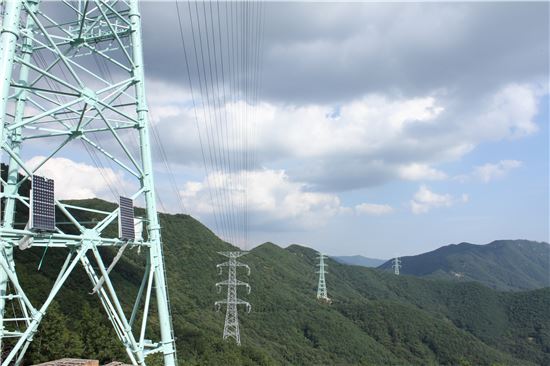 Appearance of the Miryang Transmission Tower.
Going forward, landowners in areas designated for transmission lines will be eligible to receive up to 75% additional compensation if they reach an early agreement. It will also be possible to purchase land located directly beneath transmission lines (known as the right-of-way). With direct support for residents living near transmission lines being strengthened, the pace of power grid construction is expected to accelerate.
According to the Ministry of Trade, Industry and Energy on September 16, the government approved an enforcement decree for the Special Act on Expanding National Power Grid Infrastructure at a Cabinet meeting held that day. The Special Act on Power Grid Expansion will take effect on September 26.
The main points of this enforcement decree include: significantly increased support for local residents, landowners, and local governments; support for resident-led renewable energy projects; proactive involvement of the central government in site selection and issue resolution; and expanded collection of opinions from residents and local governments.
First, if landowners reach an early agreement on transmission lines within three months, they will receive up to 75% additional compensation. Previously, only usage rights were secured and an average usage fee equivalent to 33% of the compensation was paid for land under transmission lines (right-of-way), but now compensation through land purchase is also possible.
For areas covered by the Special Act, the full amount of compensation calculated under the existing Transmission Facility Surrounding Area Act will be paid directly to residents, and an additional 50% will be allocated for village support projects.
Additional compensation has also been introduced for areas densely populated with transmission and substation facilities. Households located within 300 meters of a 345kV line or in areas with multiple lines will be eligible to receive up to 4.5 times more support than before.
For renewable energy generation projects under 10 megawatts (MW) in which residents and landowners participate, the government will cover grid connection costs (up to 1 billion won), and will also offer support such as right-of-way and long-term, low-interest leases.
For local governments where overhead transmission lines pass through, a lump sum payment of 2 billion won per kilometer will be provided to help promote projects such as the undergrounding of existing overhead lines. For industrial complexes located in local governments with a high concentration of facilities such as substations, the operator (Korea Electric Power Corporation) will be obligated to prioritize the installation of power supply facilities.
Through the Power Grid Committee, chaired by the Prime Minister, the central government, local governments, and experts will work together to resolve conflicts related to the power grid. The committee will include the Ministry of Economy and Finance, Ministry of the Interior and Safety, Ministry of Trade, Industry and Energy, Ministry of Environment (Ministry of Climate, Energy and Environment), Ministry of Land, Infrastructure and Transport, Ministry of Oceans and Fisheries, Ministry of National Defense, and the Korea Forest Service. The Ministry of Trade, Industry and Energy stated, "We expect that by managing initial conflicts such as site selection, we can prevent projects from being delayed for extended periods."
In addition, the working committee, chaired by the Vice Minister of Trade, Industry and Energy (or after the revision of the Government Organization Act, the Vice Minister of the Ministry of Climate, Energy and Environment), will guarantee the participation of basic local governments and extend the period for collecting opinions on implementation plans from the current 30 days to 60 days.
The government expects that the implementation of this Special Act on Power Grid Expansion will reduce the current 13-year construction period for transmission lines (based on 345kV) to 9 years.
A Ministry of Trade, Industry and Energy official stated, "Based on the institutional momentum provided by the Special Act on Power Grid Expansion, we will strengthen consultations with stakeholders such as local governments and residents. Through this, we plan to build the power grid, including the energy superhighway, in a timely manner to ensure the smooth expansion of renewable energy and the stable power supply for advanced industries such as AI."
© The Asia Business Daily(www.asiae.co.kr). All rights reserved.
















