Professor Jaeyoung Kim's Team Tracks Changes in Black Hole Magnetic Fields Over Multiple Years
Next-Generation Black Hole Video and Space-Ground-Moon Linked Exploration Research
An international research team, including Jaeyoung Kim, Professor of Physics at Ulsan National Institute of Science and Technology (UNIST), has released a new image of the black hole at the center of the M87 galaxy.
The Event Horizon Telescope (EHT) international collaboration announced on September 16 that it has confirmed a reversal in the magnetic field pattern in images of the black hole taken over four years since 2017.
The Event Horizon Telescope (EHT) is an international cooperative project that connects radio telescopes distributed around the world to create a virtual telescope the size of Earth, aiming to capture images of black holes. The name also refers to this virtual telescope. The event horizon is the boundary that separates the inside and outside of a black hole.
This latest image of M87 was obtained from observations in 2021, following the world’s first black hole image in 2017 and a subsequent image in 2018, making it the third in the series. While the central shadow and ring shape remained unchanged, the polarization pattern of the light changed significantly.
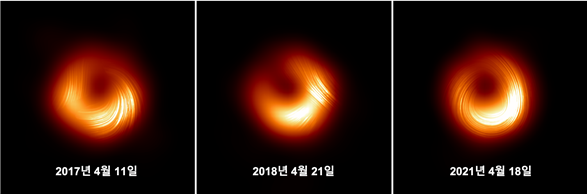 Video of the M87 black hole captured by the Event Horizon Telescope. From left to right, it shows the results from 2017, 2018, and 2021. The thin lines above the ring indicate the direction of the observed linear polarization (electric field vector). In all three videos, the central dark area known as the black hole shadow and the light bent by the black hole’s gravity were observed in a ring shape. While the size of the black hole shadow and the ring remains almost constant, the location of the brightest part and the polarization pattern change year by year. (Source: EHT Collaboration)
Compared to the 2017 image, the direction of polarization rotation was completely reversed. The research team suggested that this could be due to a structural change in the magnetic field near the M87 black hole or the influence of a ‘Faraday screen’ as the magnetic field mixed with plasma. This provides evidence that the magnetic field and matter near the event horizon are far more dynamic and complex than previously predicted.
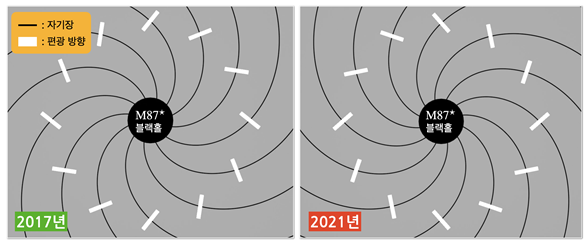 A schematic diagram showing the change in the magnetic field around the black hole, one of the theoretical models explaining the polarization direction between 2017 (left) and 2021 (right). The black circle in the center represents the M87 black hole, the white bars indicate the polarization direction of the observed light ring, and the black solid lines represent the direction of the magnetic field. In this model, as the pattern of the polarization direction is reversed, the direction of the magnetic field around the black hole also changes accordingly. (Source: Event Horizon Telescope Collaboration)
Professor Jaeyoung Kim worked with key scientists in the international research team to set major scientific research goals and led essential preparations, such as securing observation time on the Atacama Large Millimeter/submillimeter Array (ALMA), which is central to the EHT network. He also directly participated in data analysis and has been deeply involved in the project overall.
 Jaeyoung Kim, Professor of Physics at Ulsan National Institute of Science and Technology (UNIST).
Deokhyeong Lee, a master's student under Professor Kim's guidance, led the actual verification and statistical analysis of the 2021 data. This marked a notable case in which a Korean graduate student took direct responsibility for key data in a large-scale international project.
Paul Tiede, a researcher at the Harvard-Smithsonian Center for Astrophysics, stated, "With long-term imaging, we have been able to gain a deeper understanding of the extreme environment of the black hole." Michael Janssen, Professor at Radboud University in the Netherlands, explained, "While reconfirming Einstein's theory, we also uncovered unexpectedly complex magnetic field structures."
Professor Jaeyoung Kim analyzed, "Around the event horizon, high-temperature, high-pressure plasma either falls into the black hole or is ejected in an instant. This flow seems to stir the surroundings, causing the observed changes in polarization." He added, "To understand this phenomenon, more precise research that goes beyond existing models is needed."
Korean researchers played a prominent role in this study. Professor Jaeyoung Kim and researcher Deokhyeong Lee of UNIST contributed to increasing the reliability of the image reconstruction algorithms and interpreting the changes in the magnetic field structure. In particular, the case of a graduate student directly verifying and comparing key data within the international collaboration added significance to the development of the next generation of researchers.
The EHT team has continued observations in 2018, 2021, 2022, 2024, and 2025, following the initial 2017 results. In 2026, they plan to capture the first-ever black hole video by observing M87 twice a week for about three months. The Korean VLBI Network (KVN) will also participate to enhance the precision of the images.
Professor Kim, as a member of the EHT Science Council, is involved in establishing the long-term scientific objectives and development plans for the international research team. He stated, "The EHT team continues to expand its network, upgrade equipment, and develop new algorithms each year. In the future, we aim to connect space and ground-based, as well as ground and lunar, radio telescopes to image even more distant black holes."
The results of this study were published in the September 2025 issue of the international journal Astronomy & Astrophysics.
The research was a joint effort, with Jongho Park, Professor at Kyung Hee University's Department of Astronomy and Space Science, and Ilje Cho, a postdoctoral researcher at the Korea Astronomy and Space Science Institute and Yonsei University, also participating.
© The Asia Business Daily(www.asiae.co.kr). All rights reserved.


















