Sequential Construction Begins at Ministry of the Environment Building
Second Case Following Prime Minister's Office Front Yard
Decontamination soil (soil contaminated with radioactive materials) resulting from the Fukushima nuclear power plant accident has been transported to a government building flowerbed in the heart of Tokyo. This move is being interpreted as an attempt to overcome public resistance and reignite discussions on the reuse of decontamination soil.
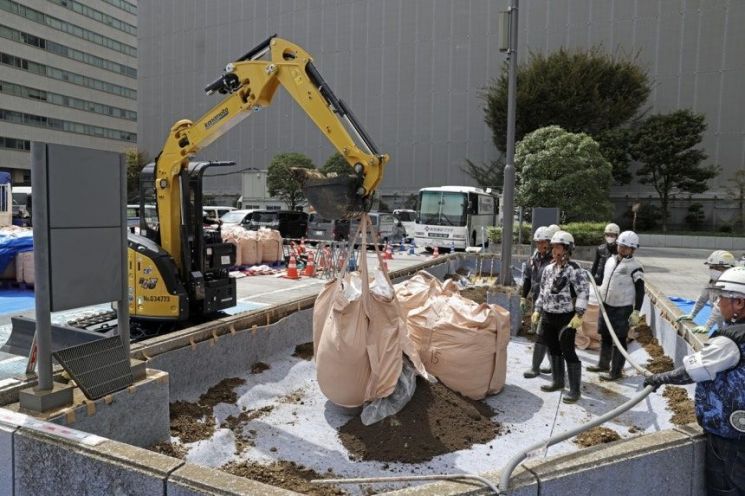 On the 14th, decontamination soil is being placed in the flowerbed of the Ministry of Economy, Trade and Industry building in central Tokyo. Photo by Kyodo News
According to Kyodo News, NHK, and other sources on September 14, a project was carried out to place 45 cubic meters of soil from the Fukushima Daiichi nuclear power plant decontamination work into the flowerbed of the Kasumigaseki government complex in Tokyo, where the Ministry of the Environment, Ministry of Economy, Trade and Industry, and Reconstruction Agency are located. This government complex is situated in central Tokyo, an area with a high volume of daily foot traffic. The process involved burying the decontamination soil at a depth of 55 centimeters and then covering it with a 20-centimeter layer of regular soil.
This marks the second instance of decontamination soil being used outside Fukushima Prefecture, following a similar case in July when it was placed in the front yard of the Prime Minister's Office in Chiyoda Ward, Tokyo. At that time, 2 cubic meters of decontamination soil were laid in a 2-meter by 2-meter area and then covered with regular soil and grass.
The decontamination soil was collected during cleanup operations after the 2011 Fukushima nuclear disaster, targeting surrounding homes, farmland, and other areas. The Japanese government has enacted a law stating that this decontamination soil will be permanently disposed of outside Fukushima by March 2045.
The current amount of decontamination soil stored in facilities is approximately 14.1 million cubic meters, enough to fill 11 Tokyo Domes. In an effort to reduce the final disposal volume, the Japanese government has announced plans to use soil with low levels of radioactivity for nationwide road and railway construction, as well as for public facilities.
The Japanese government has set the standard for radioactive cesium concentration in decontamination soil that can be used in public facilities at 8,000 becquerels or less per kilogram. The radioactive cesium concentration in the soil used in this project was about 4,000 becquerels, which is half the standard.
As public resistance has so far prevented significant progress in the reuse of decontamination soil, the Japanese government appears to be pursuing a strategy of using the soil first in government offices and official residences to broaden public understanding. An official from the Ministry of the Environment stated, "The measured radiation levels before and after the project are almost the same," and announced that the measurement results will be released on the ministry's website.
However, doubts about safety and public anxiety persist. Until now, every attempt by the Japanese government to use decontamination soil outside Fukushima Prefecture, including in Tokyo, has been repeatedly thwarted by strong opposition from local residents. Experts have voiced concerns that this project is intended to serve as a foothold for the nationwide use of decontamination soil.
© The Asia Business Daily(www.asiae.co.kr). All rights reserved.

















