The aftermath of the incident continues to unfold as it has belatedly emerged that Korean workers detained by US immigration authorities were subjected to inhumane treatment, including being denied proper food and having to use toilets without partitions during their detention. However, the Ministry of Foreign Affairs stated that such information was not conveyed during consular interviews at the time of detention, and announced plans to conduct a comprehensive investigation, focusing on the companies involved, to determine if there were any issues.
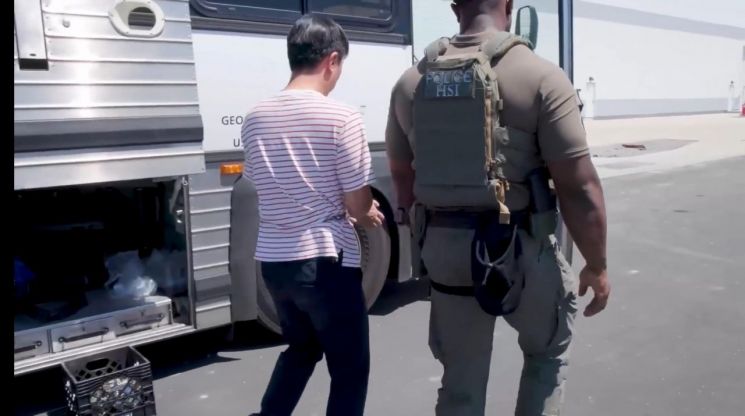 US immigration enforcement authorities released videos and photos on their website showing the illegal residency and employment crackdown conducted on the 4th (local time) at the construction site of the joint battery factory of Hyundai Motor Group and LG Energy Solution in Georgia. 2025.9.6 Yonhap News Agency
On the 15th, an official from the Ministry of Foreign Affairs met with reporters and, when asked whether there had been any statements regarding inhumane treatment of the Korean workers, said, "During the consular visit at the Foxton detention facility, we did not hear any such specific accounts," adding, "We will further investigate the facts regarding any alleged human rights violations in consultation with the companies involved."
Details have also emerged regarding the urgent negotiations with the US Immigration and Customs Enforcement (ICE) in Atlanta. On September 6 (local time), two days after the workers were detained, Consul General Cho Kijung held the first round of working-level negotiations with the ICE field supervisor, resulting in an agreement to repatriate the workers early using a Korean chartered flight. Based on this, Chief of Staff Kang Hoonshik announced on the 7th (Korean time) that "negotiations for release have been concluded."
However, at that time, issues regarding potential future disadvantages such as re-entry bans had not yet been resolved. While ICE agreed to the voluntary departure of the Korean workers, it maintained that the operation was a "legitimate law enforcement action" and insisted that the workers must acknowledge "violations of stay requirements." As a result, the Ministry of Foreign Affairs' rapid response team, which was urgently dispatched to the site, held further negotiations with ICE Deputy Director and other officials overseeing the operation on the morning of the 9th, eventually reaching an agreement that the workers would not be required to admit to "violations of stay requirements" in official documents. During this process, a member of the rapid response team strongly protested the illegality of the operation, pointing out that a large number of those detained held short-term business (B1) visas. Nevertheless, ICE reportedly did not acknowledge any wrongdoing. Throughout the negotiations, neither the government nor the companies involved were able to accurately determine the number of detained Koreans, and the confirmed figure of "317" was only ascertained just before their release.
The Ministry of Foreign Affairs official stated, "It is still necessary to determine what activities our workers were engaged in at the time of the crackdown, whether anyone was unjustly detained, and whether there were any human rights violations in the detention facility," adding, "We will work with LG Energy Solution and other related companies to establish the facts, and if there are further issues to raise with the US side, we will do so." Regarding specific channels for raising concerns or possible legal action, the official said only, "We will consult with the companies involved."
Regarding some reports that a local consulate official effectively pressured the detainees to "sign the departure documents unconditionally," the official explained, "Since it was important to expedite the 'voluntary departure' that was difficultly agreed upon with the US side in order to get out of detention quickly, we requested their signatures," adding, "It is generally assessed that in such cases, detention typically lasts three to four months." The official further stated, "If our citizens wish to seek judicial remedies in the US for issues such as unjust detention or human rights violations, that would be a much more complex matter."
Of the 317 Korean workers detained this time, it is understood that about 130 had traveled on short-term business (B1) visas. Notably, one individual who remained locally to pursue legal action held an Employment Authorization Document (EAD) and was an applicant for US permanent residency. According to the Ministry of Foreign Affairs, negotiations regarding those with B1 visas resulted in an agreement that their already issued visas would not be invalidated. Following consultations between the foreign ministers of South Korea and the US, the two countries plan to establish a working group to discuss visa issues, including expanding the scope of B1 visa use, and will continue follow-up discussions.
© The Asia Business Daily(www.asiae.co.kr). All rights reserved.

















