Findings Shared with Customs Authorities
"Possible Data Duplication Due to Steel Tariffs"
The Wall Street Journal (WSJ) reported on September 14 (local time) that Whirlpool, a U.S. home appliance manufacturer, has raised suspicions that imported products such as Korean-made washing machines are evading massive tariffs in the United States by using an "undervaluation" scheme-declaring a lower value than the actual price on import documents.
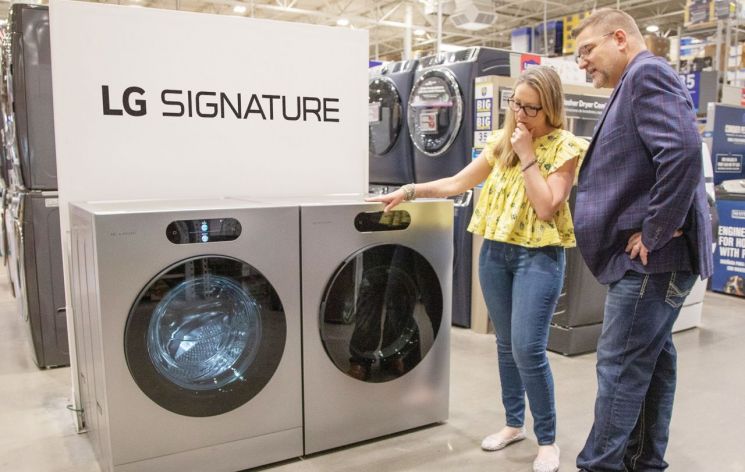 LG Signature washing machines and dryers are displayed in a store in the United States. LG Electronics
Whirlpool has raised these suspicions against Samsung Electronics and LG Electronics of South Korea, as well as Haier of China, the current parent company of what was formerly the American company GE Appliances.
According to Whirlpool's analysis of federal government data generated from import documents, the declared customs value of various home appliances imported into the United States dropped sharply starting in June this year. Since lower declared prices result in lower tariff payments, the company pointed out that the prices may have been deliberately set low to avoid tariffs.
WSJ, after reviewing the data provided by Whirlpool, stated that the average declared import price of Chinese-made food waste disposers was $21 from January to May this year, but fell to $9 in June and dropped below $8 in July.
The average price of gas ranges from Thailand fell to $175, less than half of the previous price, while the average price of Korean-made washing machines plummeted from $838 to $73, which is about one-eleventh of the original amount.
Whirlpool pointed out that the retail prices of these imported appliances did not fall accordingly. These products are subject to import tariffs ranging from 13% to 60%.
Whirlpool stated that it shared these findings with agencies within the U.S. administration, such as the Customs and Border Protection (CBP), but has not filed a formal complaint.
Daniel Calhoun, a former legal executive at the Department of Commerce during the first Trump administration and currently a trade legal advisor to Whirlpool at Rock Creek Trade Partners, told WSJ, "We expect this administration to respond swiftly and decisively to tariff evasion and send a message to potential future fraudsters."
CBP declined to comment on Whirlpool's allegations but stated that it would take appropriate action if necessary.
Samsung Electronics declined to comment, while LG Electronics emphasized that it has a firm policy of complying with all U.S. laws and regulations, according to WSJ.
GE Appliances stated that it places great importance on compliance with tariff regulations and claimed that Whirlpool's allegations are inaccurate. For example, Whirlpool alleged that GE Appliances imported a certain type of clothes dryer, but the company stated that it did not actually import such products. GE Appliances said, "We value competition and believe it benefits American consumers, but Whirlpool's latest attack appears to be an outburst over its own lagging performance."
However, Whirlpool maintained its position, stating, "These are very large and sophisticated companies that are well-versed in import declaration procedures," and stood by the results of its investigation.
Whirlpool's stock price has fallen by about 20% this year due to weak product demand. The company manufactures 80% of the home appliances it sells in the United States domestically.
Whirlpool has previously raised issues with unfair trade practices by foreign competitors. In 2018, during the first Trump administration, it succeeded in having tariffs imposed on imported washing machines. At that time, Samsung Electronics and LG Electronics built washing machine manufacturing plants in the United States.
According to WSJ, federal government statistics showed that the number of imported home appliances surged and declared prices dropped for some products this summer. Nunzio De Filippis, co-CEO of CargoTrans, a customs brokerage firm, explained that this was likely due to data entry errors.
In June this year, the Trump administration introduced new product-specific tariffs on steel, complicating the declaration process, and some brokers double-counted product quantities. As a result, the import volume appeared to spike while the per-unit price seemed to plummet. CEO De Filippis added that when statistically abnormal figures are detected, CBP requests confirmation from the brokers.
© The Asia Business Daily(www.asiae.co.kr). All rights reserved.



















