Hanmi Pharmaceutical, Numeco, and Daewoong Pharmaceutical
Accelerate Entry into Latin America
Korean pharmaceutical and biotech companies are accelerating their entry into the Latin American market. As the region has a low pharmaceutical self-sufficiency rate and competition among multinational pharmaceutical companies is not yet fierce, there is a growing movement to proactively target Latin America as a new growth engine.
According to industry sources on September 16, Hanmi Pharmaceutical signed a license and supply agreement for a diabetes combination drug with Mexican pharmaceutical company Silanes the previous day. Numeco, a subsidiary of Medytox, also recently obtained product approval for its botulinum toxin product 'Newlux' from Bolivia's drug and medical device regulatory agency (AGEMED).
Last month, Daewoong Pharmaceutical signed a Nabota export contract worth 34.1 billion won with Colombian pharmaceutical company Valentec Pharma. In addition, SK Bioscience and HK Inno.N are also known to have entered the Latin American market.
The Latin American market is one of the representative "pharmerging" markets. The term "pharmerging" is a combination of "pharma" and "emerging," and refers to markets with high growth potential such as Latin America, Southeast Asia, and Africa, in contrast to established large-scale markets like the United States and Europe.
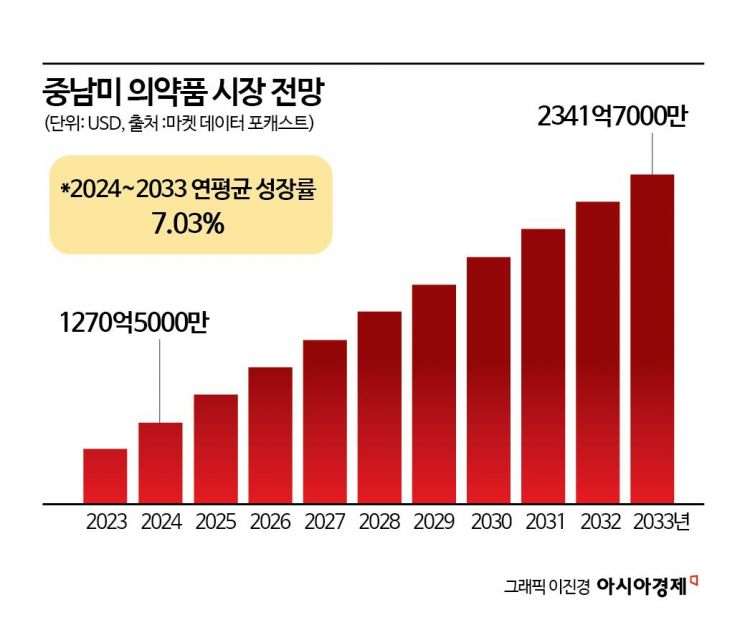
According to global market research firm Market Data Forecast, the Latin American pharmaceutical market is expected to grow from $127.05 billion (about 176.33 trillion won) last year to $234.17 billion (about 325.04 trillion won) by 2033. The compound annual growth rate is projected to reach 7.03%.
In addition, demand for pharmaceuticals in Latin America is rising due to the increasing prevalence of chronic diseases and an aging population. According to the World Health Organization (WHO), more than 70% of all deaths in the region are caused by chronic diseases, and the population aged 60 and older is expected to surpass 100 million by 2030.
In response to these trends, Latin American countries are implementing active government-level policies to improve access to medicines. Brazil, for example, has reportedly procured more than 400 million medicines through its Unified Health System (SUS), which provides free pharmaceuticals. Mexico is also expanding insurance coverage for those who lack access to medical services.
Interest in biosimilars and generic medicines is also steadily increasing. Colombia and Argentina have introduced policies to include biosimilars in national formularies to alleviate the burden of treatment costs. Brazil, Mexico, and Colombia have implemented regulatory reforms and procurement policies for generic drugs. This suggests that Korean pharmaceutical and biotech companies, which are highly competitive in terms of quality and price, could rapidly expand their presence in the region.
Lee Hyunwoo, Head of the Global Division at the Korea Pharmaceutical and Bio-Pharma Manufacturers Association, stated, "The entry of Korean companies into Latin America is significant, as it allows them to secure a foothold in untapped regions with high growth potential and a continually increasing population." He added, "Many Latin American countries have national bidding systems, and at the association level, we will strengthen business support by facilitating communication with Latin American government agencies."
© The Asia Business Daily(www.asiae.co.kr). All rights reserved.

















