Slang Terms Like "Bomb" and "Kill" Targeted in Searches
AI Utilized for Preemptive Prevention of Terrorist Crimes
The Japanese police are set to utilize artificial intelligence (AI) to prevent crimes committed by individuals acting alone, who are not affiliated with any specific organization, from planning terrorist acts in advance. On September 15, Yonhap News, citing the Asahi Shimbun, reported that the National Police Agency will use AI to monitor social networking services (SNS) and identify posts suspected of indicating signs of terrorism as a means of crime prevention.
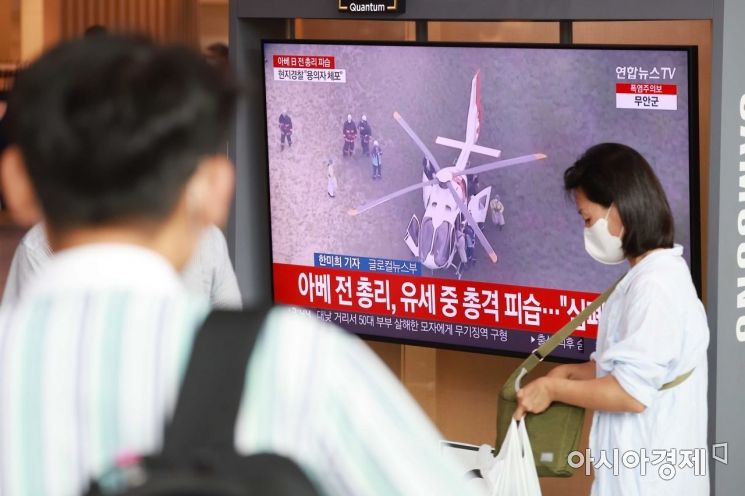 The perpetrators of the 2022 shooting incident targeting former Prime Minister Shinzo Abe and the 2023 terrorist attack aimed at former Prime Minister Fumio Kishida were both ordinary men acting alone without any backing. Photo by Asia Economy Database
The perpetrators of the 2022 shooting incident targeting former Prime Minister Shinzo Abe and the 2023 terrorist attack targeting former Prime Minister Fumio Kishida were both ordinary men acting alone without any backing. During the House of Councillors (Upper House) election in July of this year, a post threatening to "kill you if you come" was found on former Prime Minister Kishida's SNS account ahead of his speech, prompting police to identify and warn the author. The individual reportedly explained that he wrote the post while intoxicated.
The Asahi Shimbun noted that since people may use extreme language on SNS as a joke, it is necessary to prioritize the level of risk. The newspaper reported that "AI will analyze whether there have been posts praising terrorism in the past and select posts that should be flagged for caution." For example, slang terms meaning "bomb," "kill," or "die" will be targeted in searches. Based on AI analysis, the Japanese police plan to identify high-risk individuals and issue warnings or take other preventive measures.
Debate Over Crime Prevention Using AI
Not only in Japan, but recently, U.S. President Donald Trump has also advocated for strengthening public safety using AI technology. In particular, President Trump has supported tough law enforcement policies such as "Stop and Frisk" and has argued for reducing police accountability. Amid the lack of federal regulations, there are concerns that if individual police departments autonomously introduce AI, citizens' freedoms could be severely infringed. There are particular worries about identifying protest participants through facial recognition technology and monitoring phone calls via AI-based voice recognition. Furthermore, the fact that technology industry leaders such as Elon Musk are seeking cooperation with the Trump administration has heightened these concerns.
 Not only in Japan, but recently, U.S. President Donald Trump has also advocated for strengthening public safety using AI technology. In particular, President Trump has supported tough law enforcement policies such as "Stop and Frisk" and has argued for reducing police accountability. Photo by Pixabay
These developments also offer implications for South Korea's public safety policies and AI industry. With world-class IT infrastructure, a 5G network, and an extensive closed-circuit (CC) TV network, South Korea is well-positioned to build police AI systems. However, establishing institutional mechanisms for ethical AI implementation-such as data governance, verifying algorithmic bias, and ensuring transparency-is also required.
Experts emphasize that legal foundations, including the Personal Information Protection Act and the Police Officers' Duty Execution Act, must first be established, and the creation of an independent body to oversee AI systems should be considered. In conclusion, while AI technology is a powerful tool for enhancing law enforcement efficiency, its use requires a cautious approach. It is time for the government, businesses, and civil society to work together to find a balance between technological innovation and the protection of human rights.
© The Asia Business Daily(www.asiae.co.kr). All rights reserved.


















