$350 Billion U.S. Investment Plan
Disagreements Persist Over Structure and Profit Distribution
Visa Issues and Other Pending Matters Also on the Table
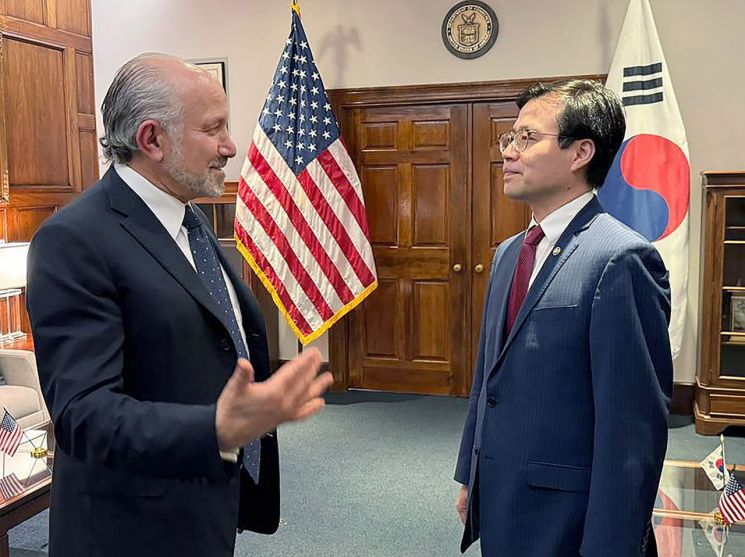
As the South Korea-U.S. tariff negotiations have reached an impasse, the South Korean government has urgently dispatched its top trade official to the United States once again. On September 14, immediately after Minister of Trade, Industry and Energy Kim Jungkwan returned to Korea in the early morning, Deputy Minister for Trade Yeo Han-koo boarded a flight to the United States, effectively conducting a "baton-passing negotiation."
According to the Ministry of Trade, Industry and Energy on September 15, Deputy Minister Yeo departed for the United States from Incheon International Airport that morning for follow-up discussions on the South Korea-U.S. tariff negotiations.
Previously, Minister Kim had met with U.S. Secretary of Commerce Howard Lutnick in New York on September 11 and 12 for negotiations, but returned without resolving the key issues. Industry insiders have described this as a "return empty-handed." It is reported that disagreements remain unresolved regarding the structure of the investment and profit distribution, particularly concerning the United States' demand for a $350 billion (approximately 480 trillion won) investment plan from South Korea.
In particular, the United States wants South Korea to provide direct cash injections or establish a special purpose company (SPC) to raise investment funds. In contrast, South Korea prefers to minimize its burden through indirect methods such as guarantees or loans. On profit distribution, the United States is demanding a Japanese-style model, which involves differential profit allocation before and after the initial investment recovery, while the South Korean government considers this "irrational" and is rejecting the proposal.
Industry observers interpret this latest move as a sign that the negotiations have entered a "long-term battle" that will be difficult to conclude quickly. Deputy Minister Yeo is a seasoned expert who has overseen trade issues such as the Free Trade Agreement (FTA) and World Trade Organization (WTO) dispute responses. Unlike the minister, whose role was to deliver political messages and symbolism, the government expects this round to focus on the detailed terms of the negotiations-a "second round of working-level talks."
In addition to the tariff negotiations, there are numerous other pending issues. Notably, the recent incident in which more than 300 Korean workers were detained and then released by U.S. Immigration and Customs Enforcement (ICE) at an electric vehicle battery plant in Georgia is also expected to be discussed. The South Korean government has consistently argued that the prolonged restrictions on skilled worker visas are the root cause of the incident and has called for institutional reforms.
The government plans to mobilize both its trade and political teams to seek a breakthrough in negotiations with the United States. However, with Washington strengthening its protectionist stance ahead of next year's presidential election, it remains uncertain how flexible a solution South Korea can find. Industry insiders have also expressed concern, noting that "the tariff negotiations are not just about tariff rates, but are intertwined with various issues such as investment in the United States, supply chains, and visa matters," and warned that "if the negotiations drag on, business uncertainty could increase."
An official from the Ministry of Trade, Industry and Energy said, "As discussions with the United States are ongoing, it is difficult to disclose specific details," declining to comment further.
© The Asia Business Daily(www.asiae.co.kr). All rights reserved.
![Clutching a Stolen Dior Bag, Saying "I Hate Being Poor but Real"... The Grotesque Con of a "Human Knockoff" [Slate]](https://cwcontent.asiae.co.kr/asiaresize/183/2026021902243444107_1771435474.jpg)
















