Bank of Korea, BOK Economic Research: "The Impact of Demographic Changes on Regional Labor Markets"
Analysis conducted with Lee Chulhee, Professor of Economics at Seoul National University
Influx of young people into large cities widens the gap
It is projected that if the current trend of young people moving to major cities continues, within the next 20 years, there will be as many as 15 local governments with fewer than 10,000 people available to work.
According to the BOK Economic Research report, "The Impact of Demographic Changes on Regional Labor Markets," released by the Bank of Korea on September 14, there are currently no cities, counties, or districts (si/gun/gu) with an economically active population below 10,000. However, by 2032, one such region is expected to emerge, and by 2042, the number is projected to rise to 15, accounting for 6.6% of the total 229 regions. The economically active population refers to people aged 15 or older who are both willing and able to work.
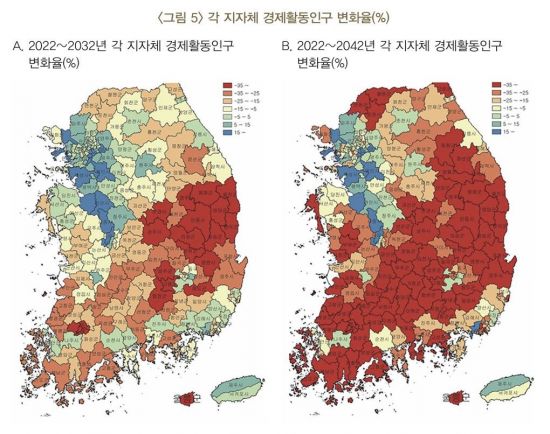
Overall, the economically active population is expected to decline in 198 out of 229 regions, or nearly 90%, by 2042. In 105 regions, the economically active population is projected to decrease by more than 30%, and in 31 regions, it is expected to plummet by over 50%. Only nine regions are expected to see an increase in the economically active population, including the working-age population, over the next 20 years.
If the current trend continues, the polarization of the economically active population by region is expected to intensify. The analysis projects that the number of regions with more than 300,000 economically active people will increase from 18 currently to 21 by 2042. As a result, the gap between the top 10% and bottom 10% of regions in terms of economically active population will widen from 13.4 times to 26.4 times, and the Gini coefficient will rise from 0.49 to 0.56.
This phenomenon has been shown to be heavily influenced by age-specific population migration. The tendency of young people to move from small and medium-sized cities to major cities, and from population-declining areas to growing ones, has further entrenched regional polarization.
Scenario analysis suggests that if the migration of young people to major cities decreases, the trend of economic population imbalance will be alleviated. At the same time, encouraging the growing movement of middle-aged people to small and medium-sized cities also proved effective in curbing the widening imbalance.
Lee Cheolhee, Professor of Economics at Seoul National University, and Jung Jongwoo, Associate Research Fellow at the Bank of Korea Economic Research Institute, who authored the report, stated, "This shows that easing the concentration of young people in major cities and supplementarily encouraging the influx of middle-aged people into small and medium-sized cities can be effective in preventing the widening imbalance of the labor force between regions. If we foster regional hub cities with high-quality educational and cultural infrastructure and good jobs, creating an environment where young people can find economic opportunities even in non-metropolitan areas, it will help mitigate the current regional disparities in youth migration."
They added, "We should also consider encouraging the current middle-aged population to move from major cities to small and medium-sized cities by providing economic incentives and strengthening welfare and medical services."
© The Asia Business Daily(www.asiae.co.kr). All rights reserved.

















