Kim Junggwan, Minister of Trade, Industry and Energy, who visited the United States for follow-up discussions on the Korea-U.S. tariff negotiations, returned to Korea on the 14th.
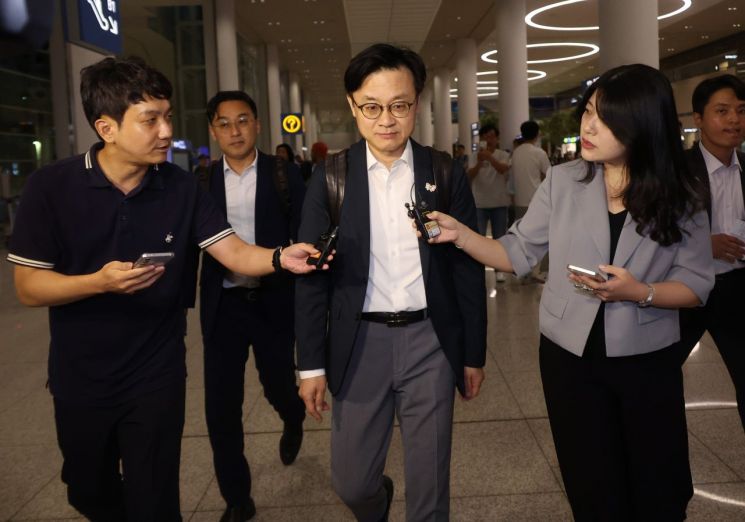
Arriving at Incheon Airport early in the morning, Minister Kim did not provide specific answers to reporters asking about the outcome of the negotiations as he exited the arrival hall, stating, "Bilateral consultations are still ongoing."
On September 12 (local time), Minister Kim reportedly met with Secretary Rutnik in New York to attempt to reach an agreement on details such as the structure, method, and profit distribution of Korea's promised investments in the United States. However, as both the Korean and U.S. trade authorities have not released any explanation regarding the outcome of the ministerial meeting, it appears that the two sides have not been able to narrow their differences on key issues.
In the tariff negotiations last July, Korea and the United States agreed to lower the 25% reciprocal tariff that the U.S. planned to impose on Korea to 15%, in exchange for Korea making a total of 350 billion dollars (approximately 486 trillion won) in investments in the United States.
Even during the Korea-U.S. summit held at the White House last month, the two countries were unable to finalize discussions on the specific details of the negotiations. On September 8, a joint working-level delegation from the Ministry of Trade, Industry and Energy and the Ministry of Economy and Finance held working-level talks with the Office of the United States Trade Representative (USTR) in Washington, D.C., but it is reported that they were unable to resolve differences on issues related to investments in the United States.
As a result, Minister Kim personally traveled to the United States on September 11 to hold ministerial-level talks with Secretary Rutnik.
Korea wants to minimize the proportion of direct investment in the United States and offset it with guarantees to reduce its burden, but the United States is reportedly strongly demanding a higher proportion of direct investment.
Regarding the selection of investment targets, the United States insists on taking the lead, while Korea is suggesting that Korean companies should decide after reviewing business feasibility. On the issue of profit distribution, the United States is pressuring Korea by citing the case of Japan, with which it recently concluded negotiations. In the U.S.-Japan agreement, profits are split 50-50 until the investment is recovered, but after recovery, the United States takes 90% of the profits.
When asked whether Secretary Rutnik demanded the adoption of the "Japan model," Minister Kim avoided a direct answer, saying, "Rather than the Japan model, there is already a tariff package in place." When asked if Korea could accept all of the U.S. demands, he replied, "It would not be appropriate to say that we will accept all of them."
The United States is also demanding the removal of non-tariff barriers in sectors such as agriculture and digital, while Korea is reportedly pushing for favorable terms by proposing industrial cooperation plans in sectors such as shipbuilding.
Meanwhile, Minister Kim reportedly reiterated concerns regarding the incident in which 330 people, including Korean workers, were detained during an immigration raid at the Hyundai Motor Group-LG Energy Solution joint battery plant construction site in Georgia. He also conveyed Korea's position that improvements to visa policies are necessary for Korean companies to invest stably in the United States.
© The Asia Business Daily(www.asiae.co.kr). All rights reserved.

















