"World Heritage Must Present the Full History"
A Japanese expert has criticized the Sado Mine Memorial Ceremony for once again failing to mention the forced nature of Korean labor, following last year’s omission.
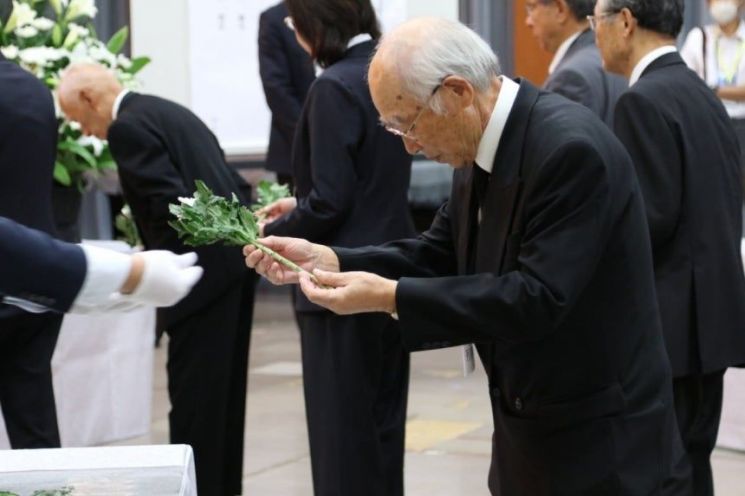 At the Aikawa Development Comprehensive Center on Sado Island, Niigata Prefecture, Japan, participants received flowers for offering at the 'Sado Mine Memorial Ceremony' held on the 13th. South Korea did not attend the memorial ceremony this year as well, following last year, making it a 'half' event for two consecutive years. Photo by Yonhap News Agency
On the 13th, Kyodo News reported that Yoshizawa Fumitoshi, a professor at Niigata University of International and Information Studies who researches Korea-Japan relations, stated, "Repeating the same statement as last year by the Japanese government is an insult to the victims," and added, "What is needed is not words of gratitude, but an apology."
Professor Yoshizawa pointed out, "The memorial ceremony is meant to reflect on and carry forward the issue of forced Korean labor," and emphasized, "A memorial ceremony that does not put this into practice is meaningless." He further stressed, "In order to preserve the significance of World Heritage, it is important for Korea and Japan to find common ground through dialogue."
Asaba Yuki, a professor at Doshisha University and a researcher of Korean politics, also criticized, "World Heritage should convey the entirety of history, including both positive and negative aspects. Selectively presenting only what is convenient is unacceptable," and warned, "If the full story is not shown, it could be seen as historical revisionism."
Arai Mari, a member of the Sado City Assembly, also pointed out, "Reflection and apology are necessary," and added, "We need to create a memorial ceremony that empathizes with the pain of workers who endured harsh conditions."
Kyodo News explained, "South Korea insists on clarifying the forced nature of labor for workers from the Korean Peninsula, but the Japanese government maintains the position that wartime conscription was not forced labor in violation of international treaties." Regarding this, an official from the Japanese Ministry of Foreign Affairs stated, "The positions of Japan and South Korea remain parallel," and added, "There is no other choice but for each side to hold its own memorial ceremony."
Meanwhile, Okano Yukiko, Director-General for International Cultural Exchange at the Ministry of Foreign Affairs, who attended the memorial ceremony as the Japanese government representative, mentioned that Koreans under Japanese colonial rule worked in harsh conditions and stated only, "I sincerely express my condolences to all those who have passed away." This statement was not significantly different from the remarks made by Ikuina Akiko, Parliamentary Vice-Minister for Foreign Affairs, at the first Sado Mine Memorial Ceremony held in November last year.
South Korea decided not to attend the memorial ceremony for the second consecutive year, judging that the address would once again fail to sufficiently mention the forced nature of Korean labor. As a result, the ceremony has again become a one-sided event attended only by Japan. South Korea plans to hold a separate memorial ceremony in the future.
© The Asia Business Daily(www.asiae.co.kr). All rights reserved.

















