Professor Kim Seyong of Korea University Delivers Special Lecture at Incheon Asia Architects Conference
Points Out Limits to Seoul's Outward Expansion... Proposes 'Compact City' Utilizing Underused Spaces
Equity Accumulation Housing Offers Young People a Pathway to Homeownership
Development Expert Who Led SH and GH, Also Served as National Policy Advisor
Professor Kim Seyong of the Department of Architecture at Korea University, who formerly served as president of Seoul Housing & Communities Corporation (SH) and Gyeonggi Housing & Urban Development Corporation (GH), has diagnosed the limitations of the "four-person family new town" model that has supported Korean society for the past half-century, and has presented a new blueprint for the future of cities. His proposals are the "compact city" and "equity accumulation housing." He explained these as solutions to address the physical limitations of Seoul and the changing population structure.
Transition in Hardware: "No More Land" - Awaken the Sleeping City Center
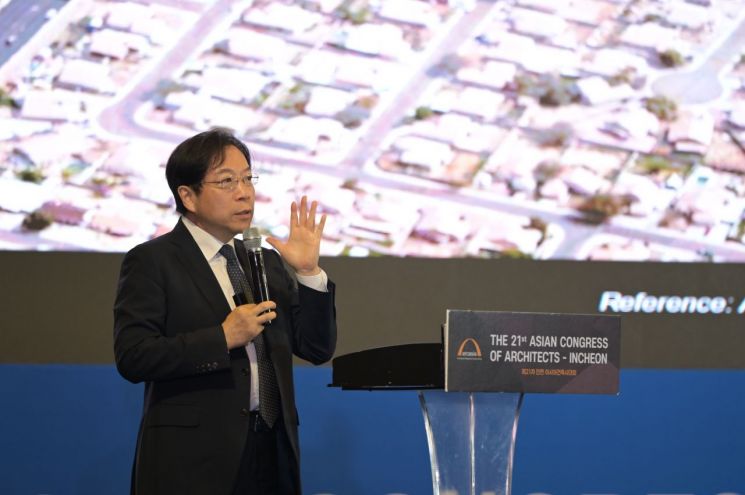 Professor Se-Yong Kim of Korea University, who gave a special lecture at the 21st Incheon Asia Architects Conference. Korean Institute of Architects.
On September 12 at the 21st Incheon Asia Architects Conference held at Songdo Convensia in Incheon, Professor Kim stated in his special lecture, "The 20th-century new town model was based on the mass adoption of automobiles and the four-person nuclear family, but now those premises have collapsed." He continued, "With nearly 70% of all households consisting of one or two people, there is no longer any reason for them to endure long commutes to live in new towns; they want to live closer to their workplaces in the city center."
The problem is that Seoul's physical space has reached its limits. Professor Kim pointed out, "Seoul is surrounded by mountains to the north and blocked by the greenbelt to the south, so there is no more land available for expansion." He added, "The easiest solution would be to lift the greenbelt and bulldoze the area, but that would simply repeat the old approach of incurring massive infrastructure costs."
As an alternative, he proposed the "compact city." Instead of expanding outward, this concept involves supplying housing and infrastructure by making three-dimensional use of underutilized and idle spaces within the city center.
A representative example is the "Sinnae 4 Public Housing District Development Project," which plans to build housing above the Bukbu Expressway. An artificial platform will be constructed above the Bukbu Expressway between Sinnae IC and Jungnang IC, where 788 units of public housing will be built. This approach allows for affordable housing supply without land acquisition costs. Other examples he presented include high-density, mixed-use redevelopment of low-rise public facilities in city center transit zones, such as bus garages, rainwater pumping stations, and community centers.
Innovation in Software: 'Equity Accumulation Housing' to Prevent 'Yeongkkeul'
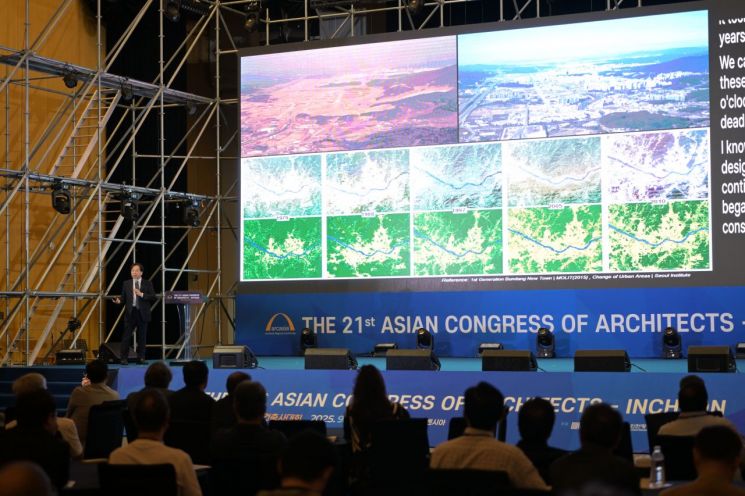 Professor Se-Yong Kim of Korea University, who gave a special lecture at the 21st Incheon Asia Architects Conference. Korean Institute of Architects.
If the compact city is a hardware solution related to space, "equity accumulation housing" is a software solution in the realm of finance. This model originated from concerns over the phenomenon in which people in their 30s became the main actors of "Yeongkkeul" (maxing out loans to buy homes) around 2019. One of the initiatives Professor Kim actively promoted during his tenure as GH president was equity accumulation housing.
Equity accumulation housing allows homebuyers to pay only 20% of the total sale price to receive the title and move in, while the remaining 80% equity is held by a public institution. Residents then purchase additional shares every four years over a period of 20 to 25 years, eventually acquiring 100% ownership. As the government recently announced a major expansion of public housing in its September 7 policy measures, there is a high likelihood that equity accumulation housing will become one of the main supply models in the future.
Professor Kim explained, "The key is to overcome the instability of rental housing and provide young generations with stable opportunities for homeownership," adding, "This can become a realistic housing ladder that allows people to achieve ownership without excessive borrowing."
Professor Kim Seyong: A 'Development Expert' Who Led GH and SH
Professor Kim is recognized as a leading expert in urban planning and housing policy, spanning academia, public institutions, and government policy advisory bodies. He graduated from the Department of Architectural Engineering at Korea University, earned master's degrees from the Graduate School of Environmental Studies at Seoul National University and the Graduate School of Architecture at Columbia University in the United States, and received his doctorate in architectural engineering from the graduate school of Korea University. As a professor at Korea University's Department of Architecture, he established a theoretical foundation, and as president of SH and GH, he applied theory to policy practice. Recently, he has also participated in national policy formulation as a member of the Presidential National Policy Planning Advisory Committee.
© The Asia Business Daily(www.asiae.co.kr). All rights reserved.
![Clutching a Stolen Dior Bag, Saying "I Hate Being Poor but Real"... The Grotesque Con of a "Human Knockoff" [Slate]](https://cwcontent.asiae.co.kr/asiaresize/183/2026021902243444107_1771435474.jpg)













