An Agenda That Cannot Be Traded:
Uncovering the Truth Behind the Insurrection vs. the Government Organization Act
"Not a Matter for Compromise, the Government Organization Act Can Proceed Gradually"
On the Constitutionality Debate Over the
On September 11, President Lee Jaemyung stated at a press conference marking his 100th day in office that he would make pragmatic choices if they benefit the national interest and improve people's livelihoods, but he would not tolerate any compromise that undermines fundamental principles. He reiterated his position regarding the investigation and trial of the '12·3 Martial Law' insurrection, saying that while he is willing to implement policies flexibly if they serve a practical purpose, he will not make choices that would break the reform drive and principles that are the foundation of the new administration.
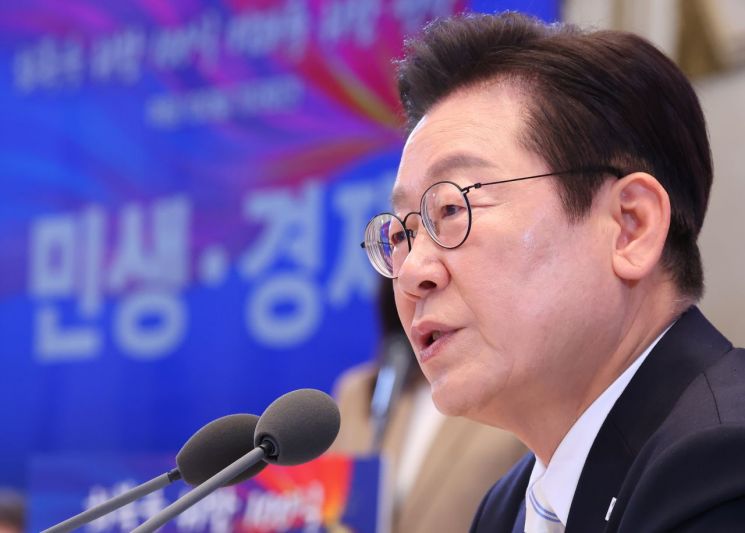
During the press conference, which lasted over two hours at the Blue House State Guest House, President Lee said, "How can we trade off government restructuring with the imperative to uncover the truth about the insurrection and hold those responsible to account? That is not a compromise." This was in reference to the previous day's agreement between the floor leaders of the Democratic Party and the People Power Party, who exchanged revisions to the 'three major special prosecutor bills' (insurrection, Kim Keonhee, and the fallen marine) and the proposal to establish the Financial Supervisory Commission. Democratic Party leader Jung Cheongrae rejected the agreement on the same day, and within a day, the deal collapsed entirely.
Regarding concerns that the amendment to the Government Organization Act could be delayed, President Lee responded that patience is necessary. He said, "There was a lot of noise about passing the Government Organization Act on the condition that the special prosecutor's investigation into the insurrection would not be extended. There is public opinion suggesting that I ordered this, and I am being criticized, but I was actually unaware of the details. Moreover, I do not want it to happen that way." He added, "Not being able to restructure the government does not mean we cannot govern. The Government Organization Act can be handled slowly. We can designate it as a six-month fast-track bill." This makes it clear that even if there are immediate difficulties in running the government, he firmly believes that the principle of 'ending the insurrection' must not be compromised.
Regarding the constitutional controversy surrounding the special tribunal for the insurrection, another major issue, he responded, "How is that unconstitutional?" He strongly criticized the judiciary, making it clear that he cannot accept resistance from the judiciary that deviates from the principle of thoroughly uncovering the truth about the insurrection. President Lee said, "Judicial independence does not mean the judiciary can do whatever it wants. In the Republic of Korea, there is a clear hierarchy of power." He added that the order of power in Korea is 'the sovereign people, elected officials, and appointed officials,' in that order.
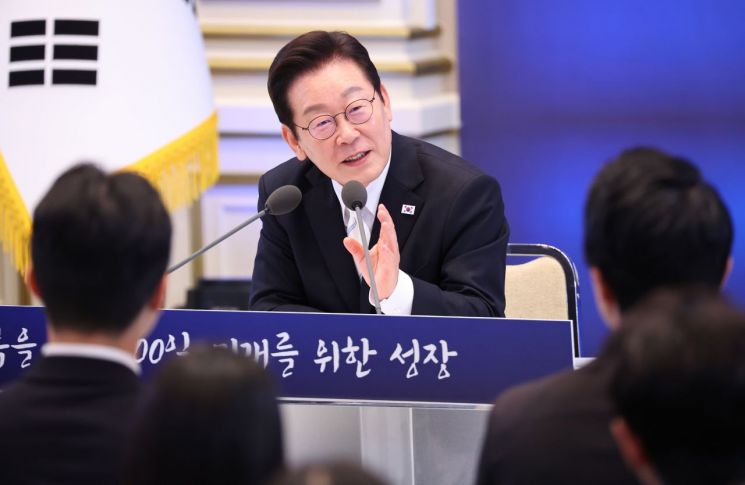
President Lee indicated that the pace of prosecutorial and media reform should be adjusted flexibly. Regarding prosecutorial reform, he explained that since the principle of separating investigation and indictment will be included in the Government Organization Act, subsequent issues such as supplementary investigative powers should be approached carefully by gathering opinions from various sectors. He said he would not be swayed by calls to abolish the prosecution's supplementary investigative powers, and would also listen to concerns about the capacity and efficiency of criminal investigations. President Lee stated, "You can't throw away the entire jar just because you dislike maggots, and it's also a problem if wrongdoers go unpunished," adding that he would seek input from experts, both ruling and opposition parties, as well as the prosecution. He also said that the government should lead the follow-up discussions.
On the ongoing discussions about revising the Media Arbitration Act, which are part of broader media reform, President Lee took a cautious stance. He said, "If we target only the media, it could be grounds for claims of media oppression," and explained that he wants the debate to focus on holding those who deliberately and maliciously spread fake news strictly accountable and increasing compensation for damages.
Despite the challenging external environment, President Lee said he would continue to uphold essential principles while seeking solutions. Regarding tariff negotiations with the United States, he said, "There will be countless hurdles to overcome in the future," but added, "I will not make any behind-the-scenes deals. I will never make decisions that go against the national interest of the Republic of Korea." On inter-Korean relations, he stated that although North Korea remains unresponsive, efforts for peace on the Korean Peninsula must continue.
© The Asia Business Daily(www.asiae.co.kr). All rights reserved.
![Clutching a Stolen Dior Bag, Saying "I Hate Being Poor but Real"... The Grotesque Con of a "Human Knockoff" [Slate]](https://cwcontent.asiae.co.kr/asiaresize/183/2026021902243444107_1771435474.jpg)

















