New Book "Forecasting the Era: The Birth of Lightweight Civilization"
Economies of Scale No Longer Needed
Rapid Adaptation with AI Is Essential
Large Organizational Size No Longer Necessary... AI Takes Over
A Challenge for Both Compani
Daemapilsa (The Bigger They Are, The Harder They Fall) - Being Huge Means Death
Futurist Song Kilyoung, former Vice President of Daumsoft, argued that the traditional economy of scale has reached its limits in the era of artificial intelligence (AI), declaring the advent of the "lightweight civilization." The lightweight civilization is a concept that shifts away from the existing "heavyweight civilization," characterized by increased efficiency in achieving goals through agility and rapid transformation.
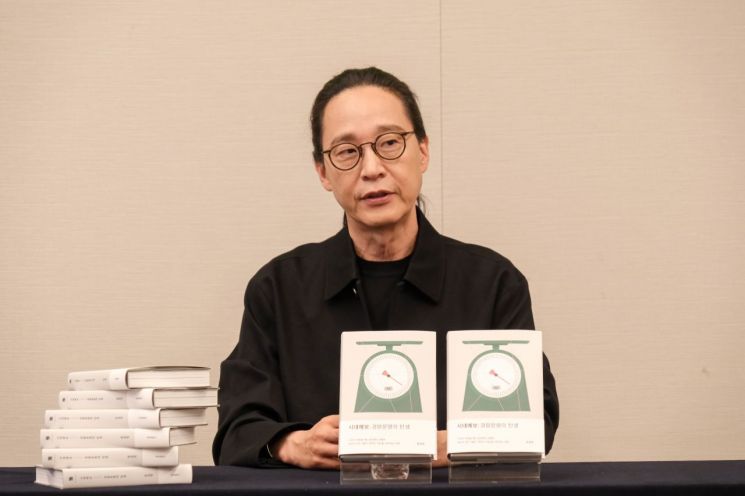 On the morning of the 11th, at the Kyobo Building in Gwanghwamun, Seoul, author Song Kilyoung is speaking at the press conference for the release of his new book "Forecast of the Era: The Birth of Lightweight Civilization." Provided by Kyobo Bookstore
At a press conference for his new book held on the morning of the 11th at the Kyobo Building in Gwanghwamun, Seoul, Song stated, "Something enormous is coming. The civilization of the past 200 years has run its course, and a new civilization has arrived." He asserted, "The old rule of growth, where organizational expansion must be accompanied by an increase in manpower, has come to an end."
In the traditional economy of scale, "Daemabulsal" (The Big Horse Never Dies) was the main survival strategy. As companies grew, they increased investment in human and material resources, expanding their organizational size. However, now, large scale can actually become an obstacle to rapid transformation. According to the "Lean AI Leaderboard" website, which ranks AI companies by revenue per employee, as of July, the top 43 companies posted an average revenue per employee of 2.39 million dollars (about 340 million won). The average market capitalization per employee (the value created by one employee) was 163.3 billion won, which is 96 times higher than Samsung Electronics' 1.7 billion won per employee. Many top-ranked companies had only one to a dozen employees.
The collapse of the economy of scale is shifting competition from being between companies to being between companies and individuals. This is because AI can handle tasks that previously required multiple employees, resulting in much higher efficiency. For example, in the past, the broadcasting industry required expensive equipment and many staff, but now new models such as one-person media are threatening the dominance of traditional broadcasters. Song predicted, "There is no longer a need to build up credentials just to join a large organization. The focus will shift to choosing one's own work and making individual efforts."
Song emphasizes that individuals can enjoy a more prosperous life by utilizing AI. Recently, he quickly identified problematic clauses in a contract from a foreign company using AI, and with AI's help, he was able to draft and send a reply email with suggested changes in less than five minutes. This saved him both the cost and effort of requesting a legal review from a law firm.

Such changes are occurring throughout the business world. Recently, TV personality Noh Hongchul negotiated directly with global big tech company Meta for an advertisement, bypassing intermediaries such as agencies and partners. The need for middlemen has disappeared. Song analyzes that the rise of AI has especially threatened the existence of numerous agencies. "Travel agencies, real estate brokers, advertising agencies, talent and celebrity agencies, and insurance agencies can all be replaced by systems and AI."
Song warns that just as the advent of online shopping enabled direct transactions between producers and consumers, eliminating countless intermediaries, another major seismic shift is on the horizon. "People may refuse to consume if they dislike or fear someone, but once they are connected to the production stage, there is no way to avoid it."
Song advises abandoning the mindset of a "fast follower" and instead becoming a "fast changer" who adapts quickly to change. "Prove that you can do what AI cannot," he said, adding that companies that have closed their doors to recruitment no longer have the capacity for 'social consideration.' He advises, "You must make the transition as soon as possible. Once humans build something, they want to protect it. Give up what you have built so far and transform yourself from a follower into a changer."
In the face of an era of infinite competition and survival of the fittest, Song concludes, "For those who lead change, this will be a warm era, but for those accustomed to organizations, it will be a cold one. This is an era where giant organizations will shrink and individuals can grow. I hope you believe in your ability to realize your own dreams."
© The Asia Business Daily(www.asiae.co.kr). All rights reserved.

![Clutching a Stolen Dior Bag, Saying "I Hate Being Poor but Real"... The Grotesque Con of a "Human Knockoff" [Slate]](https://cwcontent.asiae.co.kr/asiaresize/183/2026021902243444107_1771435474.jpg)
















