Analysis of Organic Compounds in Ancient Riverbed
Possible Traces of Microbial Metabolism
Final Verification Requires Return to Earth
NASA's Mars robotic rover Perseverance has collected rocks from an ancient riverbed, believed to have flowed billions of years ago, that may preserve evidence of ancient microbial life, according to new research findings.
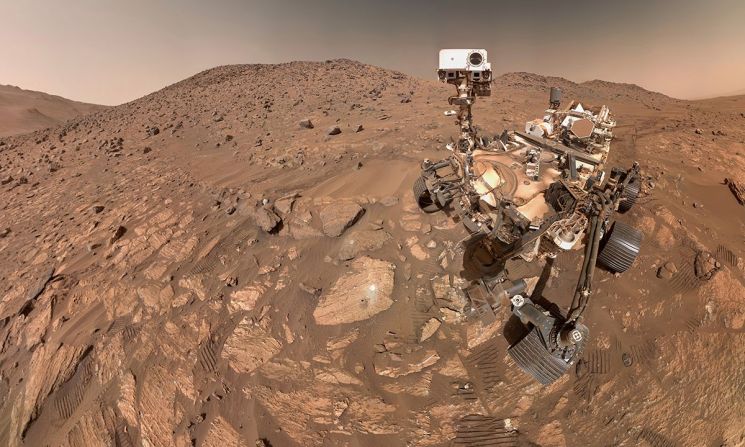
On September 10 (local time), international media outlets including the Associated Press reported that NASA held a press conference at its headquarters in Washington, D.C., where it announced that the unmanned Mars rover Perseverance had discovered "potential biosignatures" in the rocks it collected. The research findings were also published in the international journal Nature. Potential biosignatures refer to substances or structures of biological origin that require further data or additional research before drawing any conclusions about the existence of life.
Perseverance has been exploring Mars since 2021, and in July last year, it used a drill to extract the sample known as Sapphire Canyon. The research team explained that they found spots of various colors in the sample, resembling poppy seeds and leopard spots. The sample contained organic carbon, sulfur, phosphorus, and iron oxide. This suggests that microorganisms may have used these substances as energy sources. However, final verification can only be performed if the sample is brought back to Earth for further study.
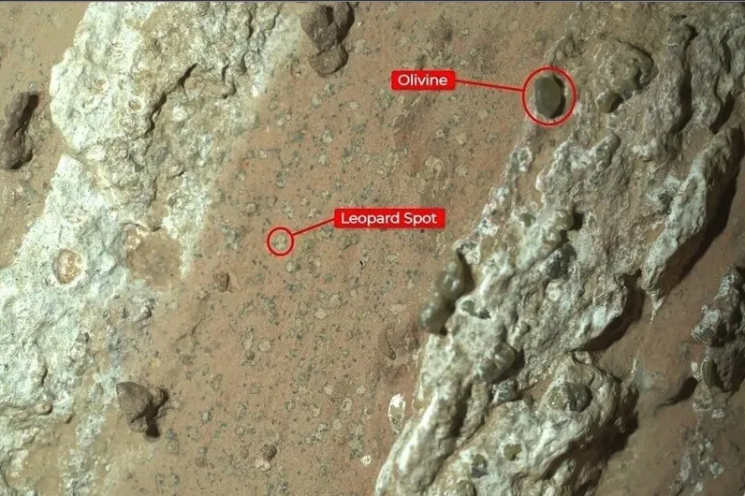 Rock of Cheyava Falls on Mars photographed by NASA's rover Perseverance in July last year. Researchers discovered leopard spots (red circle on the left) on this rock, which can be seen as traces left by ancient microorganisms. The red circle on the right indicates olivine formed by volcanic activity. NASA
However, the timeline for Mars sample return, which NASA has set for the early 2030s, is currently uncertain. Not only has the schedule been postponed to as late as 2040 due to budget issues, but President Donald Trump's budget proposal also includes the cancellation of the sample return mission, raising the possibility that the plan itself could be scrapped. As estimated costs for the Mars sample return soared to 11 billion dollars last year, NASA is now seeking alternative, more cost-effective methods instead of the original plan. Perseverance has collected a total of 30 samples so far, including 27 rocks, with a target of 38 samples. Sean Duffy, Acting Administrator of the U.S. Department of Transportation and NASA, stated, "We will review the budget and timeline, look for better ways to spend, and explore technologies that can enable us to retrieve the samples more quickly."
© The Asia Business Daily(www.asiae.co.kr). All rights reserved.


















