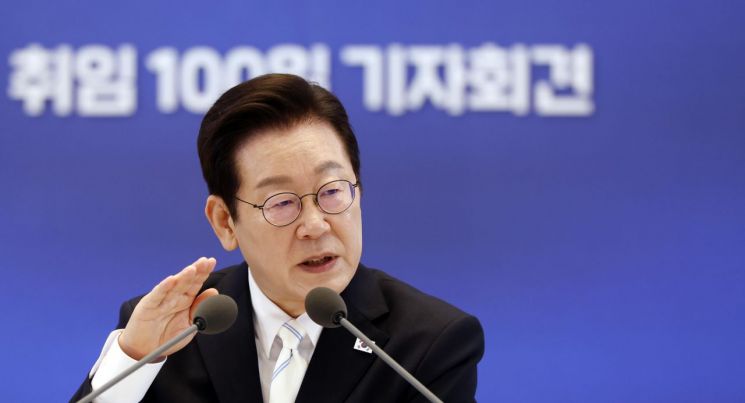
President Lee's 100-Day Press Conference
Shifting Real Estate Funds to Advanced Industries
Reaffirming the Major Transformation in Finance
"Real Estate Speculation Hinders Economic Development"
"Control While Ensuring Effective Supply"
"The remaining four years and nine months ahead will be a time for 'leap forward and growth.'"
On September 11, President Lee Jaemyung emphasized economic growth during a press conference marking his 100th day in office. He pledged to pursue "real growth" by leading the world with an innovative economy and to achieve "growth for all" by sharing the fruits of growth with everyone.
President Lee described the past 100 days as "a period for recovery and normalization." He said, "Due to the prolonged domestic demand slump, our economy has become severely weakened and required urgent resuscitation," highlighting the need for an expansionary fiscal policy. Immediately after its launch, the Lee administration implemented a second supplementary budget of 3.18 trillion won, distributing livelihood recovery consumption coupons to all citizens as part of its domestic demand stimulus policies. President Lee assessed, "Fortunately, thanks to the swift supplementary budget and the distribution of consumption coupons, consumer sentiment has recovered to its highest level in seven years and seven months, and economic indicators are also reversing upward."
He reaffirmed the policy of a "major shift in finance," which aims to redirect funds concentrated in real estate into high-tech industries and everyday economic sectors. President Lee pointed out, "The structure of the Korean economy is fundamentally centered on real estate speculation," and added, "Because of its large share, it has become an obstacle to economic development." As a prerequisite for this financial transformation, he cited the stabilization of the real estate market. He explained that real estate prices must be managed stably to guide a soft landing and a shift in direction.
Specifically, on the demand side, he stated that policies should focus on actual demand while minimizing speculative real estate acquisitions. Gap investment-buying homes with jeonse (long-term deposit rent) loans-is a representative example. President Lee said, "Borrowing money to buy a house with jeonse raises housing prices, reduces consumption capacity, and deprives young people of opportunities to buy homes," adding, "To address this issue, we must continuously control speculative demand and ensure effective supply."
He also foreshadowed additional real estate measures. President Lee remarked, "We announced a supply policy this time, and since there has been neither praise nor criticism, I think we did well. I will discuss detailed policies at another opportunity." Through the September 7 real estate measures, the government announced plans to expand housing supply in the Seoul metropolitan area. The core of the plan is to completely restructure the Korea Land and Housing Corporation (LH) and reorganize housing supply to focus on the public sector. The goal is to increase the number of housing units started in the metropolitan area to about 1.35 million by 2030. Measures to curb demand by tightening loan regulations were also introduced. The loan-to-value (LTV) ratio for regulated areas such as the three districts of Gangnam (Gangnam, Seocho, Songpa) and Yongsan District was tightened from 50% to 40%. The guarantee limit for jeonse loans provided by guarantee institutions for single-home owners was reduced from a maximum of 300 million won to 200 million won.
Normalizing the stock market to channel real estate investment funds into the financial market was also identified as a key task. He explained that the stock market must be normalized to transform it into productive finance. The direct cause preventing the normalization of the stock market, he pointed out, is a lack of trust in corporate management. President Lee said, "People don't buy stocks because they think company executives might embezzle company funds at any time."
He also stressed the need to amend the Commercial Act to restore trust. President Lee stated, "There are claims that amending the Commercial Act would stifle companies, but that's not the case. In fact, some unscrupulous executives are pressuring minority shareholders," adding, "I believe we need to protect genuine shareholders more strongly and ensure that companies contribute more to the national economy."
He also announced the intention to maintain an expansionary fiscal stance to sustain economic growth. Last month, the government drafted next year's budget at 728 trillion won, clearly committing to an expansionary fiscal policy to restore the potential growth rate to 3%. President Lee said, "It takes tremendous energy to reverse a downward economic trend. The scale of budget increases and fiscal investment is unprecedented, but by doing so, we will contribute to economic growth and development, and as corporate profits rise, the stock market will also grow further."
© The Asia Business Daily(www.asiae.co.kr). All rights reserved.

















