Near the end of the play, I felt uneasy as the lead actor pressed against and lay down by the left end wall of the container. This was because, earlier in the play, I had witnessed the right end wall of the container collapse inward.
On September 10, at Daehakro Theater Quad in Jongno-gu, Seoul, the play "End Wall - What Is Beyond That Wall?" premiered. The play was inspired by a tragic incident in April 2021 at Pyeongtaek Port, Gyeonggi Province, where a university student was removing debris from the floor of an open container (FRC) and was fatally crushed when the end wall of the container collapsed. The "End Wall" refers to the part of the container, also called the wing, that fell on the student, who was the victim of the accident.
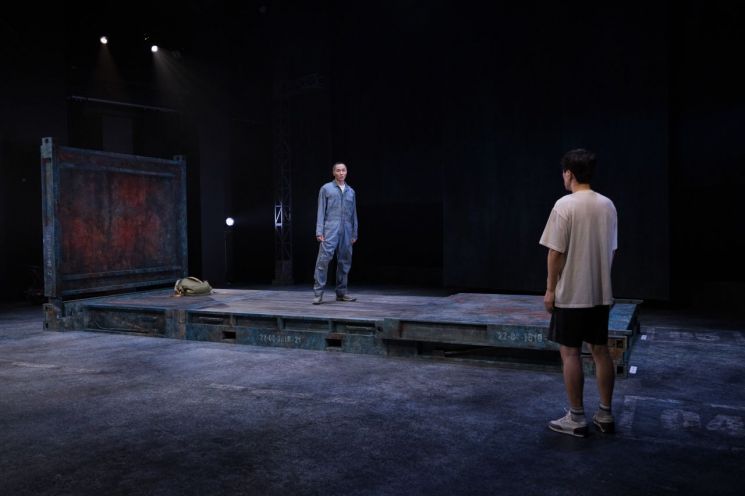 Theater performance scene of 'End Wall - What Is Beyond That Wall?'
 [Photo provided by Seoul Foundation for Arts and Culture, (c) Daehangno Theater Quad·Lee Gangmul]
The play begins with the soul of the university student, "Aseong," who cannot leave the scene of the accident and continues to wander there. The soul of "Mumyeong," a peer of Aseong who also died while working at a waste processing plant, appears as well, and together they drive the narrative forward. As the stories of Aseong and Mumyeong's accidents unfold, various issues related to labor in Korean society are exposed, including migrant workers, primary contractors, subcontractors, and further subcontracts. The "End Wall" thus becomes a story about people driven into a corner, embodying the meaning of being up against a wall.
The thing Aseong and Mumyeong are most curious about is why they had to lose their lives. However, their conversations are neither blunt nor direct; instead, they are poetic and sentimental.
Director Ha Sumin explained at a preview on September 9 that the motivation for creating the play was to talk about the sea that Aseong could not see because of the container wall, and the dreams he might have had beyond that wall.
"The reason why he died was important, but what mattered more was what the university student dreamed of while he was alive. Although Aseong and Mumyeong are fictional characters in the play, I felt it was necessary to talk about their dreams."
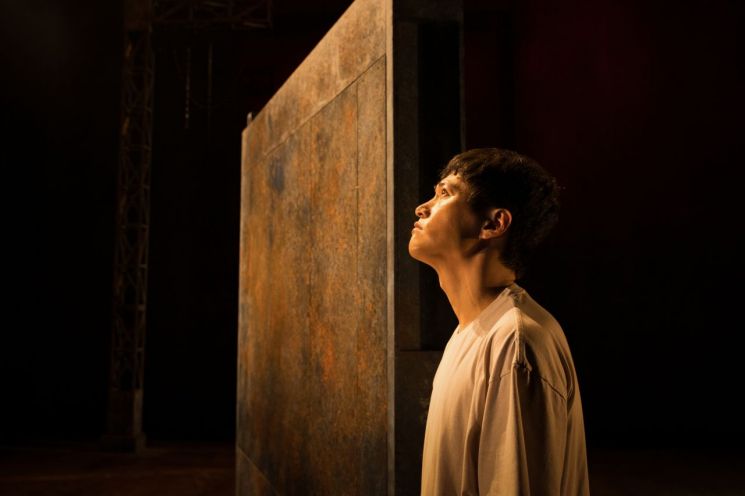 Theater performance scene of 'End Wall - What Is Beyond That Wall?' [Photo provided by Seoul Foundation for Arts and Culture, (c) Daehakro Theater Quad·Lee Kangmul]
The play features a significant scene where Aseong, after finishing the college entrance exam, promises to travel with friends and revels in a sense of liberation. Aseong is portrayed as an ordinary university student with humble dreams, someone you might see anywhere around you.
Director Ha Sumin also wrote the script herself. She said she visited the site at Pyeongtaek Port several times. "I couldn't actually enter Pyeongtaek Port, so I observed the site from the fifth floor of a building across the street while conceptualizing the play. I also reflected on my own experiences working as a day laborer in my twenties."
The actors physically portray various mechanical devices found at construction sites, such as forklifts. For example, when an actor does a spinning kick, the accompanying "thud" sound effect depicts the movement of a massive object. The actors sweat considerably as they repeat these strenuous movements. This can be interpreted as a metaphorical indictment of the harsh reality where humans are treated like machines at construction sites.
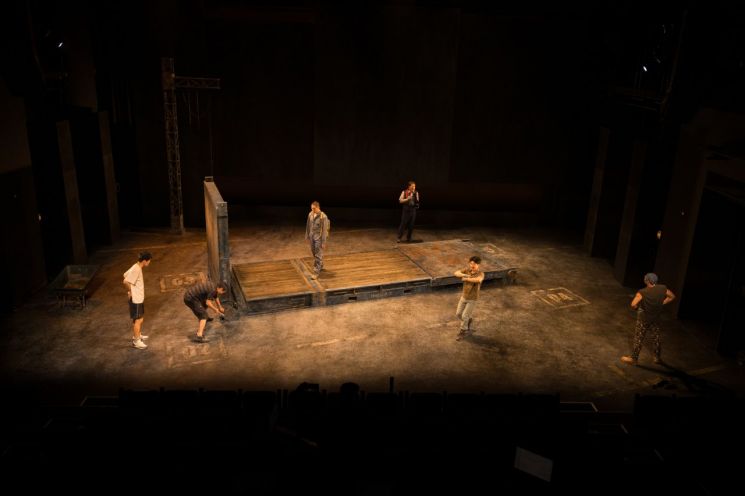 Theater performance scene of 'End Wall - What Is Beyond That Wall?' [Photo provided by Seoul Foundation for Arts and Culture, (c) Daehakro Theater Quad·Lee Kangmul]
Director Ha Sumin said, "I wanted to create a play that makes you sweat. It's a play about labor, after all. Labor is not something special; it is something we all do. I especially wanted to depict port workers as people who sweat while working. That's what it means to be alive, and I believe that in itself is beautiful. Our actors are also working, so I wanted to show their beautiful, sweat-soaked appearances."
"End Wall" won the 2nd Seoul Playwriting Award by unanimous decision of the judges. The Seoul Playwriting Award was established in 2023 by the Seoul Foundation for Arts and Culture to discover original plays and ensure the sustainability of the theater ecosystem. "End Wall" will be performed until September 28.
© The Asia Business Daily(www.asiae.co.kr). All rights reserved.



















