Next-Generation Nuclear SMRs to Be Commercialized After 2030
Fuel Cells Can Be Installed Within Six Months, No Grid Connection Needed
Spotlight on Bloom Energy in the US and Doosan Fuel Cell in Korea
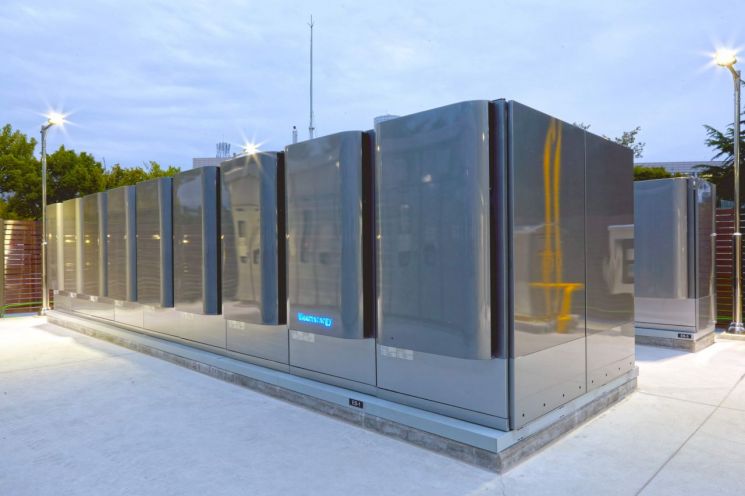
As power demand for artificial intelligence (AI) data centers rapidly increases, concerns are mounting over power supply shortages and grid bottlenecks. Small modular reactors (SMRs), which are being highlighted as next-generation power sources, are expected to be commercialized after 2030. On September 11, Korea Investment & Securities stated in its report "Power Grid Free Pass: Revisiting Fuel Cells" that fuel cells, which can be installed in as little as six months and generate electricity on-site, are garnering attention.
Fuel cells are facilities that convert the chemical energy of fuel into electrical energy. Unlike batteries, they can continuously generate electricity as long as fuel is supplied. In the early stages of the market, fuel cells attracted attention because they use hydrogen as fuel and emit almost no carbon. However, growth stagnated as technological development for applications such as hydrogen vehicles and other hydrogen fuel cell uses progressed slowly. As an alternative, fuel cell technology using natural gas as a feedstock has been improved.
Rising Use of Natural Gas Fuel Cells Expected
Amid forecasts of accelerating global power shortages, interest in fuel cells as a power source has been increasing significantly. The proportion of experts who responded that they would use on-site power sources at data centers by 2030 jumped from 13% last year to 38% this year.
Currently, solid oxide fuel cells (SOFCs) are used for power generation. Since there is no combustion process, almost no air pollutants are produced compared to fossil fuel-based power sources. However, when hydrogen is produced by reforming natural gas, carbon dioxide is generated in the process, and because natural gas is the main feedstock, it has not been recognized as a clean energy source.
However, the situation has changed. Due to supply chain bottlenecks, delivery times for gas turbines used in power generation have been delayed, and SMRs will only be available for commercial operation after 2030. Dasom Jung, an analyst at Korea Investment & Securities, analyzed, "As an alternative, the potential of distributed on-site power sources such as fuel cells is being reevaluated. For AI companies that urgently need to secure power sources for data centers, if a natural gas supply infrastructure is already in place, fuel cells-which can be installed and operated within five to six months-have emerged as an attractive alternative." Another advantage of fuel cells is that they do not require connection to a wide-area power grid, which typically takes five to seven years.
Although the United States has partially removed benefits under the Inflation Reduction Act (IRA), it has deleted the greenhouse gas emission-free requirement from the investment tax credit (ITC), allowing fuel cells that use reformed natural gas to also receive tax credits. The combination of rapid delivery and tax benefits is creating a favorable environment for fuel cells.
However, fuel cells have the disadvantage of higher production costs compared to renewable energy or gas power generation. Analyst Jung explained, "If the feedstock can be replaced with biogas or hydrogen in the future, and if hydrogen production costs decrease in the long term, fuel cells could become a final clean power source rather than just a bridge technology."
Companies Responding to Market Expansion
Fuel cells come in various types depending on the electrolyte used. Among them, the SOFC method operates at high temperatures above 600 degrees Celsius, so it has not been developed for transportation use and has only been developed for power generation. By utilizing combined heat and power (CHP), conversion efficiency has been increased to over 80%, earning recognition for its potential as a main power source rather than just an auxiliary power supply.
Bloom Energy, a leading American fuel cell company, has recently signed a series of contracts with data center operators. A notable example is its contract last November with American Electric Power (AEP) to supply 1GW of fuel cells. Bloom Energy plans to expand its manufacturing capacity to 2GW by 2026 to meet growing demand.
In Korea, Doosan Fuel Cell, which mainly produces phosphoric acid fuel cells (PAFCs), partnered with Ceres Power in the United Kingdom and invested about 155 billion won in the first half of the year to establish a 50MW SOFC production facility. The new SOFCs operate at lower, medium-to-low temperatures compared to existing products, increasing their expected lifespan, and mass production is set to begin in the second half of the year.
Doosan Fuel Cell was a major winner in the clean hydrogen power generation market (CHPS) introduced in Korea last year, securing 61% of the general hydrogen bidding volume this year. The company also plans to export PAFC-based power generation fuel cells to the United States in the future. Analyst Jung commented, "While PAFCs are less efficient than SOFCs, since Bloom Energy is the only company capable of producing SOFC fuel cells at the megawatt scale, supply is limited, so Doosan Fuel Cell could absorb some of the demand for power generation fuel cells at data centers in the United States."
© The Asia Business Daily(www.asiae.co.kr). All rights reserved.
![Clutching a Stolen Dior Bag, Saying "I Hate Being Poor but Real"... The Grotesque Con of a "Human Knockoff" [Slate]](https://cwcontent.asiae.co.kr/asiaresize/183/2026021902243444107_1771435474.jpg)
















