Korea Automotive Mobility Safety Society Hosts National Assembly Seminar
Amid intensifying competition over certification systems and standardization in global autonomous driving technology, a proposal has been made to unify autonomous driving pilot zones nationwide. This suggestion stems from the observation that current pilot zones serve mainly as demonstrations, and that the data collected separately by each company is difficult to integrate, thereby slowing down commercialization.
Shin Donghoon, Vice President of the Korea Automotive Mobility Safety Society (Professor at Korea Maritime and Ocean University), stated at a National Assembly seminar held on the 10th, "It is necessary to transform all autonomous driving pilot zones across the country into a 'National AI Vehicle Certification Test Platform' to build a digital twin, while also serving as a hub for data standardization and certification." The seminar was held under the theme of autonomous driving certification systems and related policy measures.
Currently, autonomous driving pilot operation zones have been designated in various locations nationwide, including Sangam in Seoul. These zones benefit from regulatory exemptions, such as partial waivers of safety standards, and are operated through consultative bodies between the government and local authorities. However, there have been ongoing criticisms that some areas do not offer actual services and that data management is not systematic.
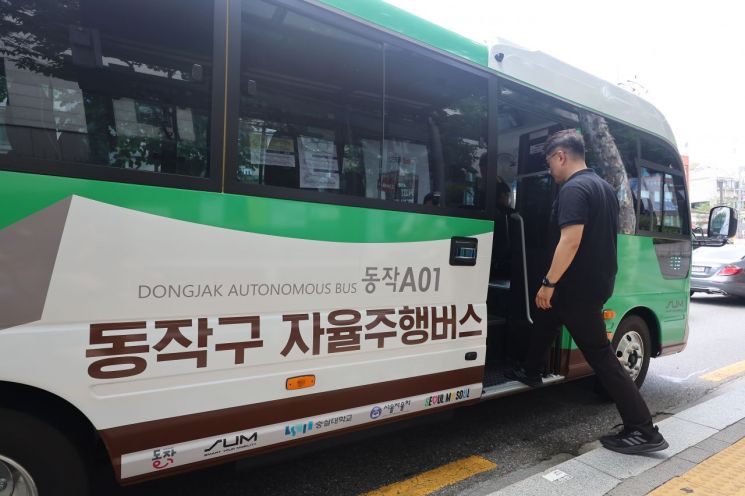 A staff member is riding the Dongjak A01, a 'Community Companion Autonomous Bus,' at a bus stop near Soongsil University in Dongjak-gu, Seoul. Photo by Yonhap News Agency
Shin argued that it would be more efficient to manage these pilot zones as a single platform. He suggested that by replicating all pilot zones in a virtual space, it would be possible to simulate tens of thousands of risk scenarios that are difficult to reproduce on real roads. He also emphasized the need for a "data dam" to collect and manage the operational data of autonomous vehicles running in the unified pilot zones according to national standards. He proposed designing a system in which only vehicles that pass through this platform would be permitted to operate at Level 4, where no driver is required.
He believes that realizing this concept would help prevent redundant investments by institutions and companies. Currently, each research and development stage autonomous vehicle uses different sensors to collect data, and the lack of standards has made it virtually impossible to share data collected by different parties. Shin claims that this would not only lower testing barriers for small and startup companies but also enable the establishment of a world-class national certification infrastructure.
The vehicle certification system is directly linked to safety. As autonomous driving technology is only now emerging, discussions on certification systems and evaluation methods have become more active. The United Nations Economic Commission for Europe (UNECE) WP.29, which discusses international automotive regulatory standards, is forming new subgroups such as the GRVA and separate expert groups to review specific methods. In Korea, the Korea Automotive Mobility Safety Society mainly participates in these discussions.
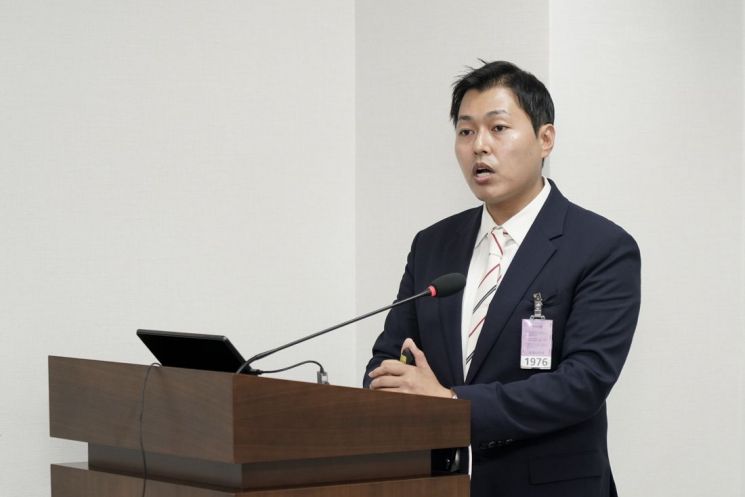 Shin Donghoon, Vice President of the Korea Automotive Mobility Safety Society (Professor at Korea Maritime and Ocean University), is presenting on the autonomous driving certification system at a National Assembly seminar on the 10th. Provided by the Korea Automotive Journalists Association
Shin stated, "We should form a 'Team Korea' with organizations such as the Korea Automobile Testing and Research Institute to strategically participate in WP.29 discussions and propose certification technologies that leverage our strengths in 5G communications and semiconductors as international standards."
The government has also expressed its intention to provide multifaceted support to accelerate the commercialization of autonomous driving. Kim Jeongwan, Director of the Transportation Division at the Korea Agency for Infrastructure Technology Advancement, said during the discussion, "With the completion of a living lab for integrated autonomous driving demonstrations, we will be able to focus more on data collection and analysis starting next year. We are also pursuing research and development projects next year on regionally specialized demonstration cities, integrated data sharing platforms, and autonomous driving services linked to public transportation."
Choi Yunseok, Head of the Future Mobility Team at the Ministry of Trade, Industry and Energy, said, "We believe that for autonomous driving service companies to survive, there must be hub companies capable of large-scale investment," adding, "We are reviewing major overseas cases, including those in China such as Huawei." Lim Wolsi, Director of the Autonomous Driving Policy Division at the Ministry of Land, Infrastructure and Transport, stated, "We are aiming to expand representative cities where autonomous vehicles can be easily experienced in daily life, thereby increasing experiential autonomous driving services."
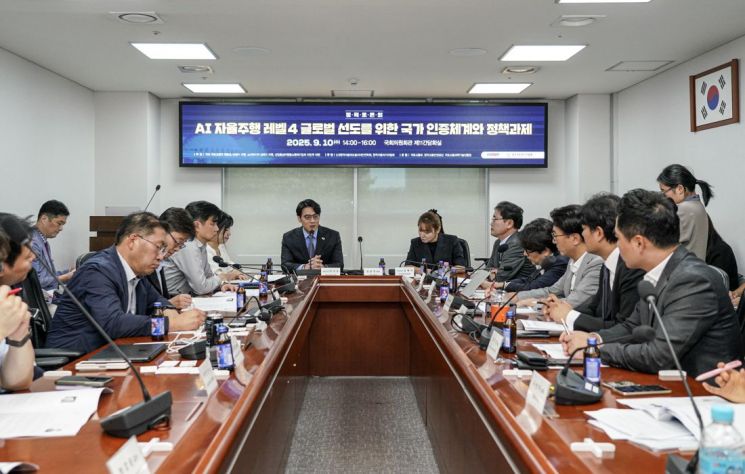 On the 10th, a National Assembly seminar on the theme of 'AI Autonomous Driving Level 4' was held at the National Assembly Members' Office Building. Junho Han, a member of the Land, Infrastructure and Transport Committee from the Democratic Party, and Yeji Kim, a member of the Health and Welfare Committee from the People Power Party, attended and promised future legislative and budgetary support. Provided by the Korea Automotive Journalists Association
© The Asia Business Daily(www.asiae.co.kr). All rights reserved.



















