Matdongsan, Sable, Ghana, and Bibibig Celebrate 50th Anniversary
The Secret to Half a Century of Success: Fundamentals and Innovation
The year 1975 holds a special place in the history of Korea's snack industry. Haitai Confectionery's Matdongsan and Sable, Lotte Wellfood's Ghana Chocolate, and Binggrae's Bibibig were all launched that year. Even after 50 years since their debut, these four products remain at the center of store shelves and are regarded as quintessential national snacks. They have grown into brand assets that span generations, and are recognized as long-standing brands that have proven their staying power through continuous product innovation.
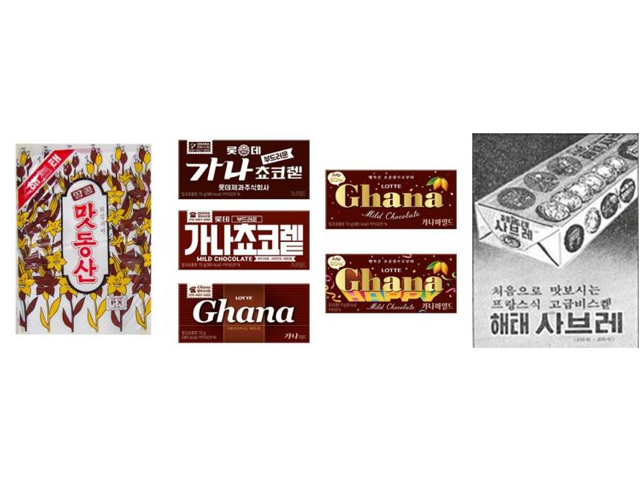 Snack favorites born in 1975: Haitai Confectionery's Matdongsan (from left), Lotte Wellfood's Ghana Chocolate, Haitai Confectionery's Sable [Photo by Each Company]
Matdongsan, the National Snack Born from 'Hangwa DNA'
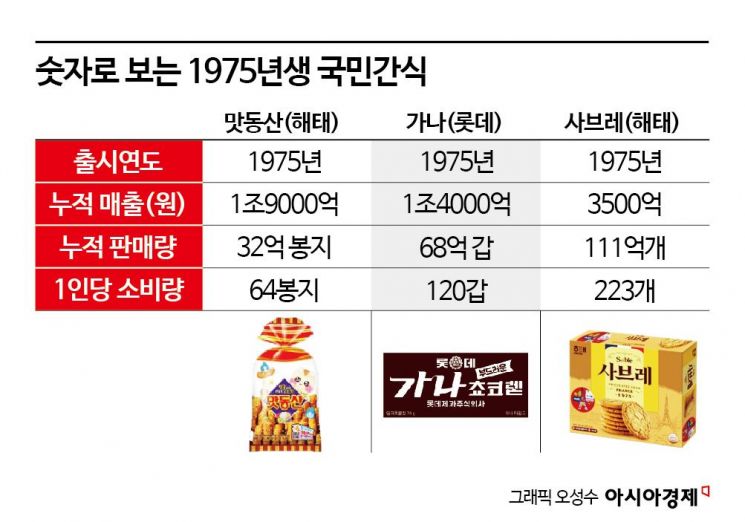
According to the food industry on September 12, Haitai Confectionery's Matdongsan has achieved cumulative sales of 1.9 trillion won and 3.2 billion bags sold. This means that, on average, each Korean has consumed 64 bags.
After releasing a trial product called 'Matboda' in 1974, Haitai Confectionery improved its facilities and products the following year to launch Matdongsan. Reflecting consumer demands identified through surveys, the company doubled the quantity (200g) and changed the packaging to resemble a lucky pouch. The use of peanut coating and a fermentation process set it apart from competitors.
In its first year, Matdongsan sold 5 million bags, generating sales of 500 million won (equivalent to 75 billion won today). In 1976, it became the first snack to air a television commercial. The commercial song, "Enjoy a party with Matdongsan~," combined with the image of top comedian Bae Samryong, significantly boosted brand recognition.
By the 1980s, Matdongsan earned the tagline "One sold every second," with annual sales surpassing 5 billion won. A dedicated snack factory was established in Cheongju, enabling a daily production system of 10,000 boxes. During the 1997 financial crisis, its "generous value for money" attracted consumers, making it a best-selling product. In 1988, Matdongsan also drove Haitai Confectionery's highest-ever monthly sales of 75 billion won.
Matdongsan is also famous as Korea's first fermented snack. It pioneered the category, undergoing two fermentation processes over 22 hours. In 2006, lactic acid fermentation was introduced, followed by a traditional Korean music fermentation method in 2010. During the dough maturation process, a total of 13 songs-including traditional Korean music, classical music, and advertising jingles-are played to the dough. This stimulates yeast activity, resulting in a softer texture. Even today, music fills the dough room daily at the Cheongju factory in Chungbuk Province. Recently, the brand has continued to expand in line with trends, launching variants such as brown sugar, chocolate, salted almond caramel, and pretzel versions.
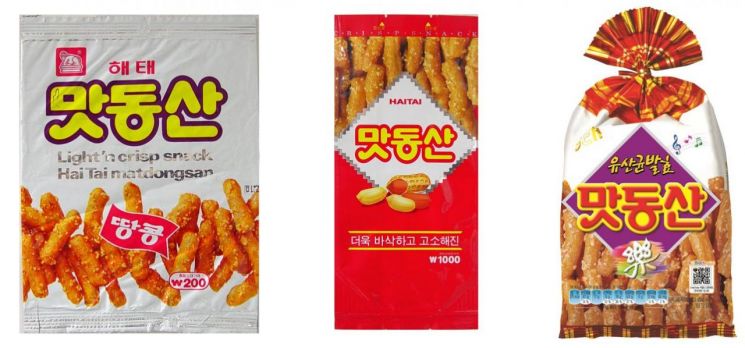 Changes in Matdongsan Packaging. Matdongsan in 1985 (from left), Matdongsan in 1997, Matdongsan in 2006 [Photo by Crown Haitai Confectionery]
The Pioneer of Premium Korean Cookies, Sable
Launched alongside Matdongsan in 1975, Haitai Confectionery's Sable took its name from the traditional French Normandy cookie, "sabl?." With its crumbly texture from sugar granules, Sable became known as "the pioneer of premium Korean cookies."
The introduction of British automated ovens in the early 1970s enabled mass production. The company targeted children and women with its buttery flavor and crisp texture. Sable is also recorded in Korean cultural history. In Professor Yu Hongjun's "My Cultural Heritage Exploration," there is a passage stating, "Haitai's Sable, with its rich butter, captivated children's tastes." This reflects how the product met consumers' desire for premium goods during Korea's period of industrialization.
To date, Sable has sold a cumulative 11.1 billion pieces, generating 350 billion won in sales. This equates to 223 pieces per person in Korea. The brand has continued to evolve with releases such as Choco Sable in 2009, Cacao Nibs Sable in 2018, Maple Cinnamon in 2021, Apple Caramel in 2022, and last year's Black Bean and Flat White flavors, extending the brand's lifespan.
'A Lover in Your Mouth,' Ghana Chocolate
Lotte Wellfood's Ghana Chocolate marks the starting point of Korea's chocolate market. Since its launch in 1975, which incorporated Swiss technology, it has achieved cumulative sales of 1.4 trillion won and 6.8 billion packs sold. This means that, on average, each Korean has consumed more than 120 packs. In its early days, the company invited Swiss technicians to improve quality and prominently featured Ghanaian cocoa beans. In 1976, its market share soared to 47%.
The manufacturing process has continually evolved. Micro-grinding technology created a fine particle texture, and since 1996, the BTC process has stabilized both taste and color. The brand has built an image of "chocolate that conveys love" by featuring top stars such as Chae Sira, Lee Miyeon, IU, and Jun Jihyun in its advertisements.
Recently, Ghana has expanded beyond simple chocolate to become a dessert brand. The "Ghana, Becomes Dessert" campaign, which began in 2021, led to a pop-up store called "Ghana Chocolate House" in Seongsu-dong, attracting a cumulative 30,000 visitors. This year, a special exhibition titled "Atelier Ghana" was held at Lotte Museum in Jamsil, collaborating with five contemporary artists. As chocolate was reinterpreted as art, it offered a new experience to younger consumers.
This summer, the brand partnered with the Lotte Giants to launch a limited-edition package featuring baseball uniform-inspired designs and random keyrings, targeting fandom-driven consumption.
The Iconic Red Bean Ice Cream, Bibibig
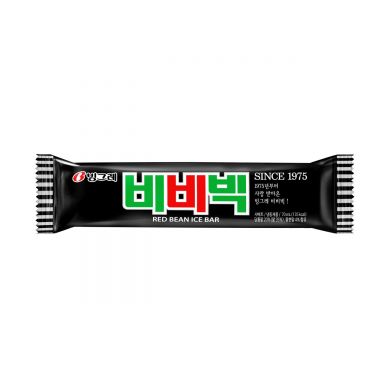
Binggrae's Bibibig is also a product of 1975. For Koreans, the mention of red bean-flavored ice cream naturally brings Bibibig to mind. When Bibibig was launched, the ice cream market was dominated by Western flavors such as vanilla, chocolate, and strawberry, but Binggrae boldly highlighted red beans, a flavor familiar to Korean palates.
Bibibig uses whole red beans instead of mashed ones, delivering both nuttiness and sweetness. The combination with milk has earned it the reputation of being "a perfect blend of sweet red bean porridge and ice cream." During the 1980s and 1990s, it became a staple summer snack, earning the title "national ice cream." Although various forms such as cones, bars, and tubes have been introduced since, Bibibig has maintained its position.
During the wellness trend of the 2000s, Binggrae launched "W Bibibig" with added peas and black beans, and more recently, the "The Prime" series, which reinterprets traditional ingredients such as injeolmi (rice cake), black sesame, pumpkin, and mugwort in modern ways. The injeolmi version sold over 2.5 million units within a year of its release. In 2021, Binggrae collaborated with Paris Baguette to launch cakes and shakes.
The reason Matdongsan, Sable, Bibibig, and Ghana have endured for 50 years lies in their unwavering commitment to quality. Matdongsan has consistently delivered the savory taste of peanuts, Sable the richness of butter, Ghana the depth of cocoa, and Bibibig the chewy texture of red beans. Their willingness to reinterpret their brands in line with trends has also played a role. Mini versions, sour flavors, limited editions, and collaborations have attracted consumers across generations. The "newtro" craze has enabled children to share nostalgic experiences with their parents. These four brands have become more than just food-they are now regarded as "cultural assets that connect generations."
© The Asia Business Daily(www.asiae.co.kr). All rights reserved.
![Clutching a Stolen Dior Bag, Saying "I Hate Being Poor but Real"... The Grotesque Con of a "Human Knockoff" [Slate]](https://cwcontent.asiae.co.kr/asiaresize/183/2026021902243444107_1771435474.jpg)


















